Les Deux Fridas : le chef d'œuvre de Frida Kahlo, expliqué. (Analyse)
Why is "The Two Fridas" a masterpiece?
4 chapitres
- Birth of an ArtistHistorical Context• "The Two Fridas" was painted in 1939, the year Frida Kahlo and Diego Rivera divorced • The contrast with a painting created 10 years earlier, shortly after their marriage, shows the artist's evolution • In 1928, Frida joined a circle of artists around Julio Antonio Mella, founder of Cuban communismArtistic Influences• Diego Rivera was already an established artist, recognized for his murals expressing his political convictions • Frida's work bears the mark of the Mexican Revolution and cultural renewal • She incorporates elements of Mexican culture: clothing, jewelry, colors, vegetation and domestic animalsPersonal StyleUnlike the monumental works of muralist painters, Frida painted small personal canvases, sincere, honest and sometimes brutal. She was inspired by "Ex-votos", small symbolic paintings offered to Saints.The Defining Accident• At 18, Frida suffered a violent bus accident hitting a streetcar • She remained bedridden for 3 months and suffered throughout her life, forced to wear an orthopedic corset • This event marked the beginning of her artistic career; during her recovery, painting occupied her time
- Frida, Diego and OthersMarriage and Dependence• Frida and Diego married on August 21, 1929; she was 22 and he was 42 • In the double portrait, Frida depicted herself disproportionately small beside her husband • She was only "the painter's wife" while Diego was the artist who worked and providedTumultuous Relationship• Between Frida and Diego, the relationship was passionate but turbulent with infidelities on both sides • In 1935, Diego began an affair with Cristina, Frida's younger sister • Frida had a brief romance with Leon Trotsky, but distanced herself when the relationship became publicIndependence in Europe• After her relationship with Trotsky, Frida's career expanded with her first group exhibition in Mexico • She was invited to New York and Paris for solo shows, having several relationships with admirers • Her European experience was disappointing: exhibitions were not a great economic success and she harshly criticized Parisian surrealist paintersReturn and SeparationAfter her time in Paris, Frida canceled her final London exhibition and decided to return to America. Upon her return, Frida and Diego divorced.
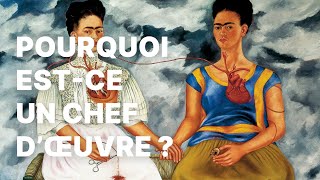
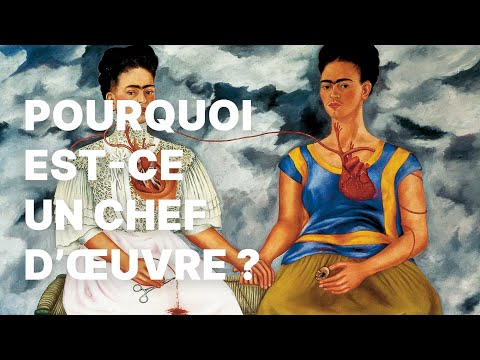
- Analysis of the MasterpieceFormat and Proportions• "The Two Fridas" is a large-scale painting: 173 centimeters by 173 centimeters • This choice is strategic as large paintings sell better • The painting represents Frida's dual personalityFrida of the Past• On the right is the Frida that Diego loved, holding an amulet with her husband's portrait • She wears a traje tehuana, a traditional garment from a matriarchal society, which became a symbol of the Mexican Revolution • This clothing affirms her cultural belonging, her nationalism and her feminismIndependent Frida• The second Frida is dressed in European style, marking a break with Diego • The European Frida suffers openly-hearted, aware she must stop the hemorrhage • But the blood overflows and continues to spill onto the rest of her dressOverall MeaningIn this painting, Frida encapsulates her entire life: her love story, the symbols running through her work, and her duality. She represents both the woman defending her origins and the artist struggling for independence and survival in the face of illness.
- Legacy and ImpactReconciliation and Conditions• In 1940, Frida and Diego remarried but the marriage was "conditional" • Frida desired to remain independent and the couple lived in Frida's house, her parents' blue houseLate Career• In the 1950s, Frida exhibited alone in Mexico for the first time and enjoyed growing recognition • Illness struck again: she underwent several operations and amputation of her right leg • Her production became less intense but she experimented with other styles, sometimes more mystical or optimisticBreaking Conventions• In a world dominated by men, Frida broke all codes and conventions • She expressed with strength and honesty fundamentally feminine themes • She painted not reality as it is, but as she felt itTimeless Icon• Frida is both an icon and an artist whose work is rooted in her life • She inspired during her lifetime, after her death, and continues to inspire women and men • Her influence endures in encouraging people to surpass themselves, build themselves and define themselves