
Game Theory: BEWARE Link's Hookshot in Legend of Zelda!
7 chapters
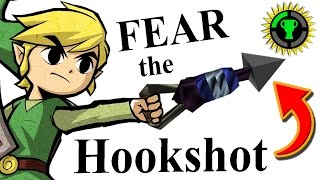
- Introduction to the HookshotThe IconThe Hookshot is one of the most iconic items from the Legend of Zelda franchise and was first introduced in A Link to the Past.Variations• Hookshot (original) • Longshot • Switch Hook • ClawshotBasic MechanicsThe hook shoots forward, lodges in place, and the chain recoils pulling Link to his new destination. Some versions have a laser pointer built-in.In-Game RoleUsually appears starting in the underwater temple and serves as both a primary weapon for stunning or killing enemies at close range and a traversal tool.
- The Central QuestionWeapon ClassificationShould the Hookshot actually be considered a weapon in Link's arsenal given its mechanics and effects?Key Issues• What is the real cost of using such a powerful hooking and shooting device? • Is the Hookshot more dangerous to Link than the enemies he faces?Analysis ApproachThe investigation will use mathematical calculations and physics to determine the forces involved in firing and using the Longshot from Ocarina of Time.Focus ItemThe Longshot is chosen because it is the most powerful variant of Link's hookshot weapons, launching twice the distance of the original Hookshot and requiring greater launch force.
- Material Analysis and Mass CalculationMaterial Identification• Iron is ruled out because it weighs Link down heavily when worn as Iron Boots • Aluminum and lighter metals lack the hardness needed for repeated use • Steel is selected as it has the required hardness, doesn't rust when wet, and fits the bill perfectlyHook MassUsing pixel measurements from gameplay, the hook volume is estimated at 0.0012 cubic meters. Combined with steel's density of 8050 kilograms per cubic meter, the hook weighs approximately 9.5 kilograms or 21 pounds.Chain MeasurementUsing Link's known height of 5 feet as a scale reference, the Longshot's maximum extension in the Water Temple is calculated to be approximately 65 feet or 20 meters.Chain MassWith a chain-link diameter of half an inch, the 65-foot steel chain weighs approximately 169 pounds. Combined with the hook, the total Longshot weight is 189 pounds or 86 kilograms.
- Launch Force CalculationsPhysics Principles• Newton's Third Law: For every action there is an equal and opposite reaction • Newton's Second Law: Force equals mass times acceleration (F=MA) • Density formula: Mass equals density times volumeVelocity and AccelerationThe Longshot travels 20 meters in one second. The acceleration phase occurs in approximately one-tenth of a second from standstill to launch, resulting in an acceleration of 200 meters per second squared.Launch Force ResultUsing F=MA with the Longshot's mass of 86 kilograms and acceleration of 200 m/s², the backward force on Link is 17,200 Newtons.Injury AssessmentSince bone fracture typically requires around 12,000 Newtons, Link would break his fingers, wrist, and potentially other arm bones just from launching the Longshot. He could not possibly hold onto it afterward.
- Recoil and Chain Pull AnalysisRecoil MechanicsAfter the hook lands, the Longshot immediately begins recoiling its chain, violently jerking Link toward the other side of the room.Link's MassWith a height of 5 feet and medium build, Link's average weight is estimated at approximately 135 pounds or 61 kilograms. Notably, the Longshot itself is heavier than Link.Recoil ForceThe recoil and acceleration distance are similar to the launch phase, resulting in a force of approximately 12,200 Newtons applied to Link's arm and shoulder as he is dragged.Additional Injuries• Enough force to break bones beyond those already fractured during launch • Sufficient to dislocate Link's shoulder from its socket • Force is less than the 30,000 Newtons needed to completely sever an arm
- G-Force Impact and Organ DamageBody Acceleration ProblemThe human body is not a solid mass. While bones and cartilage accelerate with the pull, soft internal organs lag behind and continue sloshing around, unable to keep up with the rapid acceleration.G-Force ExposureLink experiences acceleration equivalent to 45 miles per hour in a fraction of a second, subjecting his organs to approximately 20 Gs—20 times the force of gravity on Earth.Tolerance Limits• Body position makes a huge difference: G-forces are harder to tolerate when parallel to the spine, which is exactly Link's position during recoil • Trained humans can endure 20 Gs for about 10 seconds before death • NASA and international space agencies have conducted experiments showing permanent spinal damage from one second of 20G exposureEye and Blood Vessel DamageThe direction of acceleration (facing forward) is particularly dangerous because tiny blood vessels in the head and retinas are more easily damaged. Experimental subjects experienced permanent or semi-permanent blindness from this level of exposure.
- Final VerdictCumulative Injuries• Broken bones in hand and fingers from launch • Dislocated shoulder from recoil • Vertebral separation from G-force acceleration • Permanent or semi-permanent blindness from retinal damageConclusionUsing the Longshot even once would cause extensive and permanent injury to Link, making it far more dangerous to him than the enemies he fights with it.Game RealityRed potions and game mechanics allow Link to recover instantly, but in real physics, the Hookshot would be a destructive weapon primarily to its user.Final ThoughtThe Water Temple becomes even worse when you realize Link is sustaining catastrophic injuries with every use of the Longshot.