EQ or Compression First? Music Production Tutorial
5 capitulos
- Introduction and OverviewThe QuestionExploring the fundamental question of whether to apply EQ or compression first in music production, a common source of confusion for producers.What's Covered• Why certain processing orders are chosen • Examples of signal routing with EQ and compression • Different approaches depending on desired soundKey InsightThe answer depends on what you're trying to achieve and the sound you're going for, not a universal rule.Practical SetupDemonstration using FL Studio 20 with a guitar sample to show real-world processing techniques.
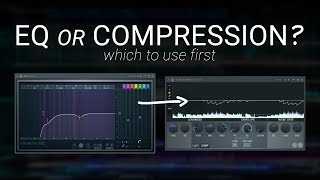
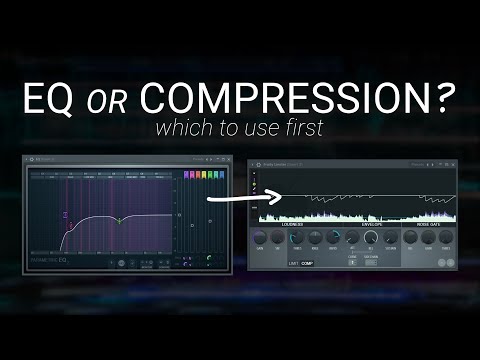
- Understanding EQ and Compression BasicsEQ Purpose• Increases or decreases energy at specific frequencies or frequency groups • Changes the distribution of frequency content in the signal • Can shift a sound from balanced to heavily mid-focusedCompression Purpose• Controls dynamic range by reducing peak levels • Controls transients to make sounds spiky or smooth • Adds warmth and color with analogue-style compressorsThe ConnectionEQ and compression are closely linked because the compressor acts on signal peaks, and EQ controls which frequencies contribute most to those peaks.Signal Chain ExampleEQ into gain plug-in, then TDR Nova compressor for visual frequency analysis of compression behavior.
- Analyzing Compression Behavior with Visual ToolsStandard CompressorUses threshold, ratio, attack, and release controls to reduce gain on peaks without showing which frequencies trigger compression.TDR Nova Advantage• Provides graphical representation of which frequencies cause compression • Shows threshold in blue and effective gain reduction in yellow • Helps visualize which frequencies have the most energyFrequency TriggeringCompression reduces the gain of all frequencies equally when active, even if only certain frequencies trigger it, potentially suppressing desired elements.Practical ObservationThe low-end rumble and a spike around 130-150 Hz were triggering excessive compression, reducing high-end and mid-range clarity.
- Pre-Compression EQ StrategyThe ProblemImbalanced frequency content before compression causes unwanted frequencies to trigger gain reduction on the entire signal.The Solution• Use subtractive EQ before compression to balance the sound • High-pass filter to remove excessive low-end rumble • Make targeted cuts to problem frequenciesBalanced CompressionWith pre-compression EQ, the compressor is triggered by high-end transients, mid-range tone, and balanced low-end together, resulting in more natural compression.Alternative FeatureSome compressors like FG Stress include a high-pass detection module that ignores low-end when deciding compression, achieving similar results without EQ.
- Post-Compression EQ and Final ApproachAdding Color BackAfter subtractive EQ and compression, use additive EQ with analogue modeling to restore warmth and thickness lost during processing.The Complete Chain• Subtractive EQ to clean and balance • Compression to control dynamics • Additive EQ to warm and colorArtistic ChoicesDifferent approaches work for different contexts, such as letting low-end trigger compression for indie rock guitar effects or keeping everything balanced for dense mixes.Decision FrameworkFollow a clear vision: clean up the sound, control peaks, and warm it back up while listening carefully to achieve the desired result.