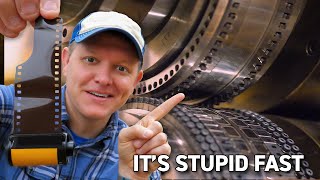
How Does Kodak Make Film? (Kodak Factory Tour Part 2 of 3) - Smarter Every Day 275
Film is back. Photos taken on film have a certain magic to them.
10 capitulos
- Introduction to Film Coating ProcessJourney OverviewDestin returns to Kodak's Rochester facility to explore the film sensitizing process. The first video covered how backing material is made; this video focuses on applying light-sensitive coating to that backing.Film TypesToday's production will be Ektar 100, a film known for extremely fine grain and really good color saturation.Challenge Overview• The coating must be applied in complete darkness to avoid exposing the film • The wet gelatin emulsion is fragile and cannot be touched on the wrong side • The machinery must operate with minimal human input in total darknessProcess SummaryThe basic process involves: unwind the backing, coat multiple layers, chill to solidify, dry to remove water, then wind back up. This cycle repeats for different coating layers.
- Film Structure and Chemistry FundamentalsExpert IntroductionDr. Jeffrey Hanson, a leading expert in designing and manufacturing photography films, guides the tour with over 30 years of experience.Film Dimensions• Support (backing) is approximately 130 microns thick - close to the thickness of a human hair • Light-sensitive chemical layers are 15-20 microns thick - half or smaller than a human hair • The emulsion is significantly thinner than the support materialEmulsion CompositionFilm emulsion consists of silver halide crystals suspended in gelatin. For color photography, different layers capture specific wavelengths and intensities of light, with layers stacked in a specific order to record full color images.Chemistry ComplexityEach layer has its own chemical makeup. Kodak precisely controls the size and shape of silver halide crystals. Even the diet of animals sourced for gelatin affects the final chemistry.
- The Coating Machine and Laminar FlowFactory DesignThe coating facility is approximately a mile long. It requires complete darkness to prevent film exposure and specialized machinery that operates with minimal human input.Laminar Flow Principle• Laminar flow is essential - it keeps different chemical layers from intermixing • Multiple layers flow simultaneously from different slots, creating parallel waterfall streams • Turbulent flow would destroy color separation and image qualityHopper TechnologyThe hopper is constructed from solid titanium for thermal and dimensional stability. It has precisely polished surfaces and maintains micro reservoirs to prevent pulsation. Bars are stacked to within 50 millionths of an inch tolerance.Operational ConditionsThe facility uses green lighting to reduce eye strain transitions. The hopper sits on a pedestal anchored to bedrock for seismic stability, ensuring coating uniformity across hundreds and thousands of feet of film.
- Live Coating Process DemonstrationControl RoomBobby Sanchez and team are coating specialists who manage the operation. Infrared cameras monitor coater 1 and coater 2 to detect physical defects on the left edge, right edge, and center of the film.Hopper Mechanics• A center-fed hopper slopes back and engages with the web underneath • Water flows down the door for air balance • Liquid flows from slots creating a uniform waterfall that must stay laminar • Guide wires on the edges prevent the liquid from necking down due to gravity and surface tensionMeniscus PreparationBefore coating starts, operators use wooden skewers to prepare the meniscus (waterfall edge). They perform slot sweeps to remove any foreign objects and ensure a smooth, even surface across the entire width.Start-up ProcessAs the process begins, operators monitor for color separation and layer stability. Initial turbulence gradually settles into stable laminar flow. The pan pre-coat truck drops and moves to the halfway point before the actual coating begins in darkness.
- Hopper Design and Fluid DynamicsComponent AssemblyMelted chemicals are pumped through pipes and hoses, combining various kettles to form layer entrances. The solid titanium hopper bars have polished surfaces that fill slots and create consistent pressure across the width.Slot Design• Slots are staggered and dragged at different heights • Spacing acts as micro reservoirs preventing pulsation • Flow rate must be very low to ensure sheet flow and laminar conditions • Stepping down with each layer creates a tooth-like pattern as layers flow on top of each otherViscosity ControlBy controlling viscosity and the amount of gelatin and water, different layers maintain separate properties so they don't intermix. The top and bottom layers require the most precise control due to liquid-air and liquid-solid boundary conditions.Edge StabilizationVacuum conditions behind the curtain help maintain shape. Guide wires with water use surface tension to pin the liquid edges, preventing necking and maintaining the curtain as it falls. Guide wires stay submerged in the falling liquid.
- Film Transport and Quality ControlSplicing SystemWhen a roll diameter becomes small enough, the machine stops. A knife clamps and cuts through both materials, tape is applied, and the new roll is spliced together before the machine restarts.Autonomous Loading• Automatic Guided Vehicles (AGVs) have been used since 1990 to transport support rolls • AGVs are wire-guided with radio communication for navigation • Spindles index on roll sides and engage with positioning sensors to ensure correct placementTesting ProtocolAfter coating starts, samples are taken from the first assessment stop at the unwinder. The testing group examines the film in about 45-50 minutes to verify proper exposure levels and check for defects.Production FlowLeaders between coated material and the next run are non-sensitized, allowing the machine to stay threaded without re-threading. Diameter is measured in real time to calculate remaining footage and prevent pulling the end off the roll.
- Chilling and Drying OperationsChilling ProcessAfter coating, the wet, jiggly gelatin must be chilled and solidified. Cool air blows from above while air is sucked in from the edges. The film flips upside down after the curtain coating hits the web.Drying Challenges• The film cannot be dried at high temperatures as this affects gelatin structure and sensitometry • Bulk of the facility is dedicated to drying because it requires significant time and air flow • Air bars have corrugated surfaces to allow air to escape upward without adding excessive pressureAir Flow ManagementDew point is lowered to pull moisture out effectively. Corrugated air bars allow the film to float while hot air underneath dries the support. Large exhaust ducts pull moisture-laden air out of the facility.Film HandlingNothing touches the emulsion side throughout the process. Only the support back receives direct air contact. The film is elevated on air like an air hockey puck during the entire drying section.
- Advanced Turning and Centering SystemsTurning Bar DesignThe film makes turns without contact by floating over turning bars. The machine turns the film up and over, then down and back, making approximately 45-degree turns while maintaining tension and floating position.Pressure Monitoring• Holes in the turning bar measure feedback pressure to monitor how much air is needed to float the support • This serves as a secondary tension calculation to verify tension control is working correctly • Static pressure sensors monitor air pressure right under the support in the middleAutomatic CenteringUltrasonic sensors detect the edge of the web to keep it centered. A motorized electromechanical actuator moves the turning bar back and forth based on sensor feedback, creating a closed-loop feedback system that operates continuously during production.Precision ControlAn eighth-inch wide inlet holes provide air jets. The system automatically steers the web to stay centered between sensors. Variable frequency drives adjust fan speeds to change air pressure for different film types and drying conditions.
- Storage and Finishing PreparationAutomated Storage SystemThe ASRS (Automated Storage Roll System) has two alleys with automated vehicles that lift two-ton rolls. The system stores rolls for incoming support material or outgoing coated film ready for shipping.Quality Testing• Raster scanner searches the entire film for dirt and defects, creating a digital map of locations • Sensitometry testing develops sample film to verify proper exposure response • Testing happens in a specialized quality lab before final packagingProduction FlowMaster rolls are packed in light-tight caskets after coating and drying. Completed rolls are scanned, stored in the ASRS, and retrieved when trucks arrive for delivery to the finishing department.Historical SignificanceThese caskets have carried film that captured major historical moments. Film processed in this facility has been used for significant photographs throughout history, making the production facility a point of human memory preservation.
- Team Perspective and Next StepsOperator SatisfactionWhile the coating process happens continuously in darkness, operators find satisfaction in the sensitometry results and quality verification. The finishing department experiences satisfaction watching thousands of rolls come out per minute.Quality as ProductDr. Hanson's primary product is quality. His team ensures the film works correctly before handing it over to the finishing department, which transforms master rolls into final consumer products.Production EfficiencyFrom one master roll measuring 7,000 feet long by 45 inches wide, Kodak can produce 60,000 individual film cartridges. A 24-exposure roll results in 60,000 units from a single master roll.Series ContinuationThis is the second of three videos on Kodak film manufacturing. The next video covers the slitting process that cuts master rolls into individual film strips and applies perforations. Additional detailed videos cover film chemistry and quality control procedures.
![How Does Film ACTUALLY Work? (It's MAGIC) [Photos and Development] - Smarter Every Day 258](https://img.youtube.com/vi/TCxoZlFqzwA/mqdefault.jpg)