
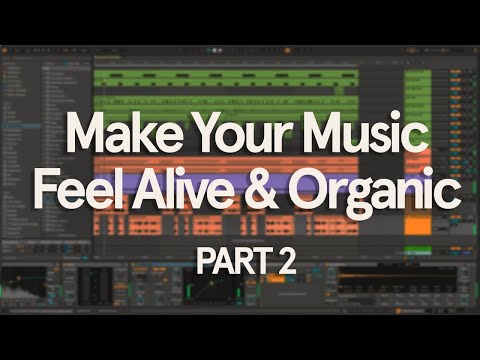
Techniques for Making Your Music Feel Alive & Organic - Part 2/2
4 chapters
- Building the Bass FoundationSetup and ConceptA MIDI clip mirrors the bass notes of piano chords, paired with a Moog synthesizer recording of an evolving bass drone on a single C note with tweaked filter cutoff and drive parameters.Creating Rhythm• Convert long legato notes into rhythmic patterns with 16th note subdivisions • Apply short filter envelope to add expression and movement to the baselineDynamic Modulation• Use LFO 2 with sine wave to modulate sample offset over two bars • Route velocity handles to filter envelope amount for expressive dynamic patterns • Add syncopation by splitting notes into shorter ones and moving them up semitonesMixing IntegrationCopy side chain compressor from piano to duck bass when kick hits, and reshape EQ by removing nasal frequencies and adding high-end crunch.
- Adding Melodic Depth with Synth PadsSynth SelectionLoad Arturia's Juno synthesizer with the Celestial Homeland preset, a smooth pad with brightness that contrasts darker tones while adding depth and movement.Sound Design• Turn off built-in delay and disable sub oscillator • Open filter for extra brightness • Map filter frequency, resonance, and arpeggiator parameters to macro dials • Use device randomizer for dynamic modulationRhythmic TreatmentAdd gate effect sidechain to wonky hats from Foley recording to create syncopated choppy sound, then freeze and flatten layer to begin chopping audio into a rhythmic loop.Final Processing• Scoop out low end to make room for bass and add brightness • Copy spring reverb from drums and widen to stereo • Apply limiter to boost loudness and copy side chain compressor from baseline
- Textural Elements and CharacterString AdditionIntroduce a high string element using Profit Ref 2 synthesizer as a common thread throughout the loop.Character Processing• Apply Sketch Cassette plugin to add warmth and imperfection to the string • Use tape page to affect filtering and saturation for distorted harmonics • Enable dropouts for subtle inconsistencies and flutter for random pitch modulationAutomation WorkHighpass the string to avoid low-end rumble, copy side chain compressor to connect string to beat, and automate flutter to gradually increase over the last four beats for organic evolution.Mixing WorkflowFocus on adding subtle effects and automation rather than drastic processing to maintain the natural, evolving character of the sound.
- Creating Variation and Atmospheric EffectsArrangement StrategyDuplicate the four-bar loop multiple times and remove certain elements in subsequent sections, such as chopped pad, string, and glitchy hats, to create more open, less busy sections for new elements.Tape Echo Technique• Use UAD EP34 plugin as faithful emulation of Echoplex delay • Set delay time in milliseconds instead of syncing to BPM • Offset delay time slightly to create natural drift and imperfect feel • Use dotted eighth note timing (511.36 milliseconds) with feedback automationNatural ImperfectionTape echoes add character and cannot sync perfectly to DAW tempo, drifting out of sync after a few bars to create natural and human feel in the song.Final Touches• Add saxophone loop from sample pack pitched down two semitones to match C minor key • Layer new melodic elements in the second half to keep listener engaged • Combine all layers and techniques to create cohesive organic production