
Why The First Computers Were Made Out Of Light Bulbs
6 chapters
- The Edison Effect and Thermionic EmissionLight Bulb DesignEarly light bulbs had a carbon filament sealed in a glass bulb with a vacuum inside. When electrical potential was applied, current heated the filament to over 2000 Kelvin, causing it to glow. The vacuum prevented the filament from burning immediately.Key DiscoveryThomas Edison observed that the glass in light bulbs became discolored over time, turning yellow then brown, but only on one side. This was caused by electrons being emitted from the heated filament, a phenomenon called thermionic emission.Electron Behavior• Electrons were boiled off the carbon filament surface • In the vacuum, electrons were unobstructed and attracted to the positive wire • They accelerated toward the positive electrode and crashed into the glass, discoloring itHistorical ImpactThe Edison effect was rediscovered multiple times by other scientists up to 27 years before Edison. This observation set the stage for an electronics revolution that eventually led to the first digital computers.
- The Thermionic Diode and AC-to-DC ConversionFleming's InnovationIn 1904, John Ambrose Fleming patented a device similar to Edison's light bulb but with a second electrode (plate) added inside. By charging this plate positively relative to the filament, electrons could be accelerated across the gap to complete the circuit.One-Way Mechanism• When the plate was slightly negative relative to the filament, it repelled electrons and no current flowed • Electrons could only flow from the hot filament to the plate, not the other way around • Fleming called it a 'one-way street for electricity'Technical RefinementScientists discovered that a more efficient design placed the filament in the center with the anode as a cylinder surrounding it. This cylindrical geometry captured more electrons and allowed larger currents to flow.Practical ApplicationsThe thermionic diode was initially used for detecting radio signals. A single diode converted AC into bumpy DC, and combining multiple diodes with a capacitor produced steady direct current, making it the first practical vacuum tube device.
- Amplification and the Triode RevolutionThe ProblemIn the early 1900s, electronics faced a major challenge: amplification. Radio signals had limited range, and telephone calls were restricted to 1300 kilometers because the signal became too faint to hear. Relays worked for telegraph signals but couldn't amplify complex analog signals from phones and radios.Triode StructureIn 1906, Lee de Forest added a third electrode (grid) to the diode. The grid was a sparse wire mesh positioned between the cathode and anode. This three-electrode device was called a triode.Amplification Principle• A large potential difference was applied across the anode and cathode • The grid voltage controlled how many electrons flowed between them • Small changes in grid voltage controlled huge changes in anode voltage • This enabled rapid, high-frequency amplificationRevolutionary ImpactThe triode enabled the first transcontinental phone call from New York to San Francisco on January 25, 1915. Vacuum tubes powered radios, TVs, and all electronics for decades, dominating the industry for the next half century.
- Boolean Logic Meets ElectronicsShannon's InsightIn his 1937 thesis, Claude Shannon discovered a connection between electric circuits and Boolean algebra. He realized that Boolean operations could be represented as electronic circuits, creating an equivalence between mathematical statements and electric circuits.Boolean Operations• George Boole developed a mathematical system where true statements were represented as 1 and false statements as 0 • Boole created operations like AND, where both statements being true produced a true output • These operations could be physically realized with just switchesFirst Digital CalculatorThat same year, George Stibitz built the first digital calculator using relays. It could add two 1-bit binary numbers. The calculator used switch inputs (0 if open, 1 if closed) and light bulbs to display outputs.Computing FoundationStibitz's circuit implemented XOR and AND logic gates, which are electronic versions of Boolean operators. By connecting multiple half adders, more complicated circuits could be built to perform complex mathematics, establishing the foundation for digital computing.
- From Relays to Electronic ComputersRelay Limitations• Relays were too slow for future computing due to their mechanical nature • Physical closing and opening of switches caused friction and wear on contacts • Relays made computers incredibly loud with constant mechanical clacking • They were unreliable and prone to breaking down frequentlyThe Electronic SolutionThe vacuum tube triode could act as an electronic switch without moving parts. By applying very negative voltage to the grid, no current flowed (representing 0). Very positive voltage produced maximum current flow (representing 1). Switching was rapid and silent.ENIAC MilestoneThe world's first electronic programmable computer, ENIAC, came online on December 10, 1945. It occupied a whole room, weighed 30 tons, used 175 kilowatts of power, and could complete 500 operations per second.Practical ImpactENIAC's flexibility made it immediately useful for hydrogen bomb development. The director of Los Alamos stated it would've been impossible to arrive at solutions without ENIAC's aid. Unlike previous computers, it could be programmed to solve different types of mathematical problems.
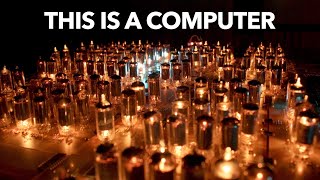
- The Drawbacks of Vacuum Tube ComputingPower ConsumptionVacuum tube filaments required constant heating, consuming significant power even when idle. ENIAC's enormous power draw led to a rumor that it dimmed the lights in Philadelphia whenever it turned on. The machine had its own dedicated electrical generator.Physical Constraints• Vacuum tubes were large and difficult to miniaturize • Complex glass bulbs with internal electrodes couldn't be made arbitrarily small • This size limitation restricted how much computing power could be packed into a single machineReliability IssuesVacuum tubes were inherently unreliable. On average, a tube in ENIAC broke down every few days and needed to be found and replaced. The longest ENIAC operated without failure was just 116 hours.Path ForwardThe first digital computers were essentially glorified light bulbs, which explains why they were big, power-hungry, and unreliable. The miracle of modern computing came when scientists figured out how to perform the same trick with electrons inside solid silicon material.