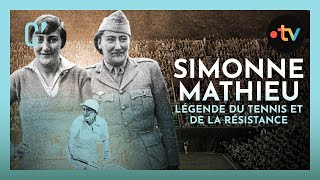
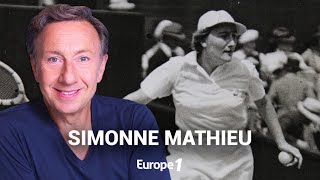
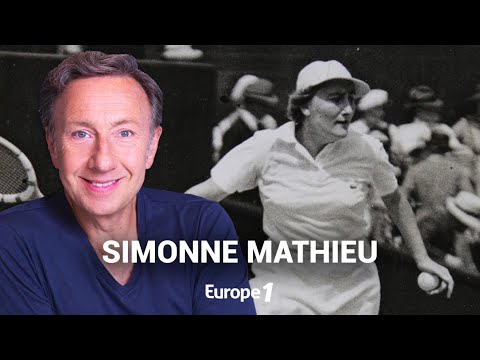
La véritable histoire de Simonne Mathieu, joueuse de tennis résistante racontée par Stéphane Bern
11 chapters
- The Stadium and Simone Mathieu's Forgotten LegacyCourt InaugurationRoland Garros stadium, located at Porte d'Auteuil in Paris, inaugurated in 2019 a new 5,300 m² court with 5,000 seats and tropical décor. The president of the French Tennis Federation called it the most beautiful tennis stadium in the world.Forgotten NameThis new court was named in honor of Simone Mathieu, a French tennis champion from the 1930s who remained largely unknown to the general public for a long time.Impressive RecordSimone Mathieu might have eclipsed Suzanne Langlene in the hearts of tennis enthusiasts, but after two victories at Roland Garros, she suddenly abandoned her career.Patriotic SacrificeHer patriotism took precedence over personal ambition when General de Gaulle made his appeal on June 18, 1940. Simone Mathieu was already in England, ready to join the Resistance.
- Origins and Early Tennis YearsBirth and NameSimone Pasmar was born on January 31, 1908, in Neuilly-sur-Seine northwest of Paris. Her first name is spelled with two n's (Simonne), probably due to a civil servant's oversight.Bourgeois Background• Daughter of Alice Melchior and Gaston Pasmar, a wealthy investment banker. • Her brother Pierre was a licensed tennis player at Stade Français. • Sports were common in this Parisian upper-class environment.First Tennis StepsTo strengthen Simone's fragile health, the family doctor advised her to follow her brother's example. Her parents agreed without objection because tennis was one of the most popular sports among the wealthy and suited a young girl.Combative SpiritFrom her first balls at age 12, Simone rushed onto the courts of Stade Français with agility and determination. Tennis quickly became her passion and she continued to improve.
- Marriage and Rise to the TopStrategic MarriageIn October 1925, at age 17, Simone married René Mathieu, son of one of the founders of Stade Français and creator of Smash magazine. He shared her passion for tennis and did not prevent her from pursuing her career.Personal Style• Did not try to resemble Suzanne Langlene. • Revealed her legs and shoulders on court but without glamour. • Her spider-like style with a visor intrigued but she cared little. • Wanted to display her strength, power, and technical skill.Winning TechniqueSimone built her victories from the baseline with a dynamic and aerial forehand perfectly balanced. She exhausted opponents with effective baseline play and forced them into errors.Indomitable CharacterHer tenacity, nerve, and reliability strongly marked her style. She did not hesitate to get angry at umpires, throw her racket, and criticize journalists for their unkindness toward women.
- International Dominance and Roland GarrosWorld Tours• Made her mark in Egypt, staying with a cousin of King Farouk. • Traveled to the Netherlands, Greece, Belgium, Switzerland, and Central Asia. • Reached the semifinals at Wimbledon six times on grass. • Represented France in international amateur competitions.Formidable RivalBetween 1929 and 1937, Simone Mathieu reached the Roland Garros women's singles final six times without ever lifting the trophy. Her regular opponent was American Helen Wills Moody, who outclassed her.Triple CrownOn June 11, 1938, Simone Mathieu finally won the Roland Garros women's singles final. She achieved an exceptional hat trick by also winning the women's doubles and mixed doubles.Peak and RecognitionFrance's number one player even managed to rank 3rd in the world. Her male peers held her in high esteem and her mixed doubles partner affectionately nicknamed her the Good Mother.
- The Interruption and Decision to EnlistWar Context• In late summer 1938, Hitler's Germany invaded the Sudetenland. • The prospect of war emerged but Simone remained focused on her game. • She won 32 trophies in 3 months in 1938. • In 1939, she was preparing for the US Open in August in New York.Symbolic WithdrawalOn September 1, 1939, Hitler invaded Poland. France and England declared war on Germany two days later. The US Open tournament was scheduled four days after. Simone Mathieu withdrew because it was no longer time for games.Family MotivationIn her family, there was no hesitation about enlisting. Her own father had fought in World War I. Simone remembered the horror of that conflict, the soldiers bogged down in trenches, and millions of dead.Enlistment in EnglandOn the journey home, Simone stopped in England and decided to stay despite her husband and two children in France. In February 1940, although her visa did not permit it, she enlisted in the Auxiliary Territorial Service (ATS), the non-combatant female branch of the British Army.
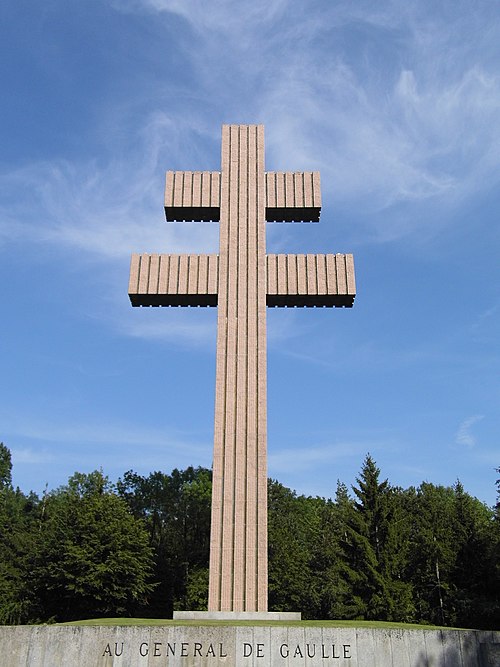
- The General's Appeal and the Free French ForcesCall from LondonOn June 18, 1940, General de Gaulle made an appeal over the BBC from London. His goal was to unite the people against the enemy and call for resistance. Simone Mathieu, on assignment in Wales, was deeply moved by this speech.CVF CreationSimone Mathieu obtained a meeting in September with Admiral Muselier, who replaced General de Gaulle. He proposed that she recruit and train 100 French volunteers. The Corps of French Volunteers (CVF) was officially created on November 7, 1940, with Simone Mathieu as its lieutenant.Fundamental PrinciplesSimone Mathieu expressed her threefold ideal: God, my country, my family. She clarified that her country came even before her family. She enlisted because she felt her place was in service to free France against the Germans.Recruitment and Uniforms• At Westminster House, she recruited through newspaper advertisements. • Volunteers aged 18 to 45 took on secretarial, postal, nursing, and driving work. • Some became liaison aircraft pilots or were sent on espionage missions. • Simone obtained that the CVF have its own uniform so women felt they served their nation.
- Combat and Military AuthorityBombing and CourageOn April 18, 1941, a bomb struck the women's barracks. One volunteer was killed and about ten others seriously wounded. Simone ran forward as a scout, kept her composure, and threw herself into the rubble to save her comrades.Problematic OutspokennessSome high-ranking officers in the General Staff struggled with her frankness. She caused trouble even in the General's inner circle. She refused to ignore an affair between a volunteer and General Petit and called him to tell him his relationship was over.Strategic RemovalOffended, General Petit took revenge by telling Simone that General de Gaulle would be inspecting his daughters the next day. Given last-minute notice, she learned her daughters would be at work or on maneuvers. On the appointed day, General de Gaulle inspected an empty barracks. Simone Mathieu was dismissed without further ado.Intelligence ServiceAssigned to the intelligence service of the Free French, she continued to carry out her missions with loyalty. In 1943, she was in Algiers with General de Gaulle to review the Free French Forces preparing for the landing in Provence.
- Liberation and Return to TennisTriumphant ReturnOn August 16, 1944, Simone Mathieu walked down the Champs-Élysées alongside General de Gaulle in a newly liberated Paris. She ended the war with the rank of captain and felt a pride unlike any she had ever known, decorated with medals.Family ReunionSimone finally reunited with her two sons, whom she had not seen in four years, and with the tennis courts. But at over 36 years old and after four years away, she knew her career was over.Symbolic UmpiringOn September 17, 1944, on the clay courts of Roland Garros where she had fought some of her finest matches, Simone Mathieu umpired only one match between her former partner Yvon Péra and Henry Cochet. This match celebrated liberation.Sports TransitionDecorated with the Legion of Honor, Simone Mathieu joined the coaching staff of the French Tennis Federation. For ten years, she held the position of captain of the French women's team with the firmness she was known for.
- Forgotten Legacy and Belated RecognitionQuiet DeathOn June 11, 1978, to celebrate the fiftieth anniversary of her first victory at Roland Garros, she made her last appearance on a court. On January 8, 1980, she died of illness at age 71 and faded into relative obscurity.Exceptional RecordWith 13 Grand Slam titles, Simone Mathieu is the second-most decorated French player of all time. If her patriotism had not outweighed her sporting ambitions, she might have surpassed Suzanne Langlene.Well-Deserved Rediscovery• It took until 2006 for Simone Mathieu to emerge from obscurity. • She was inducted into the Hall of Fame. • Her name was given to the women's doubles winners' trophy at Roland Garros. • In 2019, the stadium's 3rd main court was named after her.Dual LegacyWhen asked whether Simone Mathieu was a resistance fighter or a great tennis player, she might have answered both, General. She embodies both female patriotism and sporting excellence in French history.
- Historical Analysis: Women and the ResistanceUnrecognized Role• Women played a major role in resistance work. • They aided border crossings and supported resistant husbands. • Their missions were often limited to administrative tasks and feeding fugitives. • The history of women in the Resistance is very recent, barely 20–30 years old.Official UnderrepresentationOf more than 1,000 Companions of the Liberation, only six are women. When nominated as an officer of the Legion of Honor in 1953, it was extremely rare for a woman of her generation. Many more than six women could have received this prestigious title.Pioneer of Military ServiceIt is thanks to Simone Mathieu that women wear uniforms in the French Army today. Before her enlistment, women did not wear uniforms. She persuaded the officers and obtained that the CVF have its own uniform.AFAT FoundingFrom the Corps of French Volunteers led by Simone Mathieu arose the Corps of French Auxiliaries of the Land Army (AFAT) created on April 26, 1944. Though limited to auxiliary status, these women received better pay than men.
- Relations with Power and Postwar LifeThe General's ViewGeneral de Gaulle excused her bad temper on several occasions when she was in London. In 1943 in Algiers, she is found in de Gaulle's private office handling intelligence and cipher work. De Gaulle did not allow just anyone at his side.Vichy's PerceptionSimone Mathieu was seen as a traitor by the Vichy government and Marshal Pétain. She was lumped with the Free France movement and would have been condemned to death if she had remained in France.After the War• She served as captain of the French women's team for ten years. • She applied the same military discipline methods as in London. • She managed the magazine created by her husband René. • She became an accomplished bridge player and spent her fortune on the game.Modesty and SilenceSimone Mathieu did not write and did not seek media attention. She felt her actions were normal and did not see them as exceptional. Her lack of testimony and writings contributed to the forgetting of her extraordinary story.