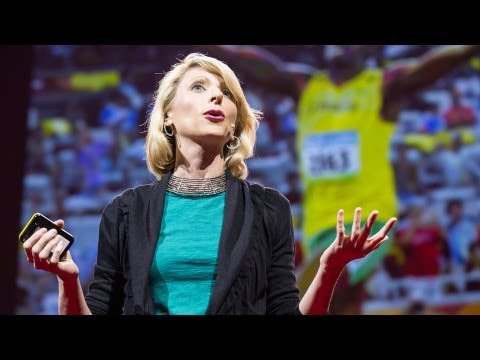
Your Body Language May Shape Who You Are | Amy Cuddy | TED
11 capitulos
- Introduction to Body Language's ImpactOpening ChallengeAmy Cuddy offers a free life hack that requires only changing your posture for two minutes, promising it could significantly change how your life unfolds.Current Awareness• Making yourself smaller through hunching, crossing legs, wrapping ankles, or holding arms • Spreading out to take up more space • The importance of noticing your own body positioningWhy It MattersBody language fascinates us, particularly in analyzing other people's nonverbal communication through awkward interactions, smiles, glances, winks, and handshakes.Real-World ExamplesA brief handshake or lack of handshake between political figures can generate weeks of discussion in major media outlets like the BBC and The New York Times.
- How Body Language Influences Judgments and OutcomesSocial Science EvidenceSocial scientists have extensively studied how body language affects the judgments we make about others, which can predict meaningful life outcomes like hiring, promotion, and dating decisions.Key Research Findings• Nalini Ambady at Tufts University found that 30-second soundless clips of physician-patient interactions predict whether a physician will be sued based on perceived niceness • Alex Todorov at Princeton showed that judgments of political candidates' faces in one second predict 70 percent of U.S. Senate and gubernatorial race outcomes • Emoticons used well in online negotiations can lead to claiming more value from that negotiationBidirectional CommunicationNonverbals influence how others judge us and what outcomes result, but we often forget that nonverbals also influence ourselves—our own thoughts, feelings, and physiology.The Overlooked AudienceWe are influenced by our own nonverbals, not just by how others react to them.
- Power Dynamics and Nonverbal ExpressionsProfessional InterestAs a social psychologist teaching at a competitive business school, Amy Cuddy became interested in studying power dynamics and nonverbal expressions of power and dominance.Universal Power Signals• In the animal kingdom, power is expressed by expanding, making yourself big, stretching out, taking up space, and opening up • This pattern is true across the entire animal kingdom, not just primates • Humans display the same power expressions both chronically when they have power and momentarily when feeling powerfulPride ExpressionJessica Tracy's research shows that people born with sight and those who are congenitally blind both display the pride expression (arms up in a V with slightly lifted chin) when winning a physical competition, regardless of prior exposure to the gesture.Powerlessness ResponseWhen feeling powerless, people do the opposite: close up, wrap themselves up, make themselves small, and avoid taking up space.
- Power Dynamics in the ClassroomComplementary BehaviorWhen someone displays high power, people tend to make themselves smaller and do the opposite of mirroring rather than matching their nonverbals.MBA Student Observations• Some students act like alpha caricatures, occupying the middle of the room, spreading out when sitting, and raising hands prominently • Other students virtually collapse upon entering, show it on their faces and bodies, make themselves tiny in their chairs, and raise hands minimallyGender and ParticipationWomen are much more likely to exhibit low-power nonverbals than men, and women feel chronically less powerful than men, which aligns with participation patterns in MBA classrooms.Academic ConsequencesThe correlation between power nonverbals and classroom participation is particularly important in MBA programs because participation counts for half the grade, contributing to observed gender gaps in grades between equally qualified men and women.
- The Mind-Body Connection: Bodies Shaping ThoughtsBidirectional Evidence• We know our minds change our bodies—for example, we smile when happy • But also, being forced to smile (by holding a pen in teeth) makes us feel happy, showing the relationship goes both waysKey Research QuestionThe main question became: Can you 'fake it till you make it'? Can people adopt powerful poses for a brief period and experience behavioral outcomes that make them seem more powerful?Characteristics of Powerful Minds• Powerful people tend to be more assertive, confident, and optimistic • They feel they will win even at games of chance • They can think more abstractly and take more risksHormonal Differences• High-power alpha males in primate hierarchies have high testosterone (dominance hormone) and low cortisol (stress hormone) • Powerful and effective leaders also show high testosterone and low cortisol • Power is about both dominance and how you react to stress
- The Two-Minute Power Pose ExperimentExperimental DesignResearchers brought people into a lab where they adopted either high-power poses or low-power poses for two minutes, with examples including the 'Wonder Woman' pose (standing with hands on hips) and various sitting positions.Procedure• Participants spit into a vial before the pose, held the pose for two minutes without viewing pictures of the poses • They answered questions about how powerful they felt • They were given an opportunity to gamble • Another saliva sample was collectedRisk-Taking ResultsWhen in the high-power pose condition, 86 percent of participants gambled, compared to only 60 percent in the low-power pose condition—a statistically significant difference.Hormonal Changes• High-power people experienced about a 20-percent increase in testosterone and about a 25-percent decrease in cortisol • Low-power people experienced about a 10-percent decrease in testosterone and about a 15-percent increase in cortisol • These two-minute hormonal changes configure the brain to be either assertive, confident and comfortable, or stress-reactive and shut down
- Real-World Application: The Job Interview StudyPractical ContextResearchers applied the power pose finding to evaluative situations like social threat scenarios: being evaluated by friends, speaking at school board meetings, giving pitches or talks, and doing job interviews.Media MisinterpretationAfter publishing findings, media suggested using power poses while speaking to interviewers, which researchers strongly rejected because the practice is about communicating with yourself, not others.Correct ApplicationBefore a job interview, people should do power poses in private—in a bathroom stall, elevator, or at their desk behind closed doors—rather than making themselves small while checking their phone or notes.Job Interview Experiment Details• Participants did high- or low-power poses, then underwent a five-minute stressful recorded job interview • Judges were trained to give no nonverbal feedback, creating what researcher Marianne LaFrance calls 'standing in social quicksand,' which significantly spikes cortisol
- Interview Results and the 'Presence' FactorHiring DecisionsFour blind coders reviewing interview tapes, unaware of the hypothesis or which pose participants used, consistently said they wanted to hire the high-power posers and did not want to hire the low-power posers.Evaluation DifferencesHigh-power posers were evaluated much more positively overall, but not because of the content of their speech, structure, or stated qualifications.What Actually ChangedThe differentiating factor was the 'presence' that high-power posers brought to their speech—an intangible quality that made them stand out.Authenticity FactorHigh-power posers brought their true selves and ideas to the interview without residue or barriers, allowing their authentic selves to come through.
- Overcoming Imposter Syndrome Through Faking ItThe ConcernWhen Amy Cuddy tells people that bodies change minds and minds change behavior and outcomes, people respond that it feels fake—they don't want to arrive at their destination still feeling like a fraud or impostor.Personal Trauma• At age 19, Cuddy was in a severe car accident that caused a head injury • She was withdrawn from college after learning her IQ had dropped two standard deviations • This was traumatic because she had identified with being smart and had been called gifted as a childStruggle and PersistenceCollege advisors told her she wouldn't finish college, but she worked and got lucky repeatedly, eventually graduating four years later than her peers and being accepted to Princeton by advisor Susan Fiske.Impostor at PrincetonUpon arriving at Princeton, Cuddy felt like an impostor and was terrified before her first-year talk (a 20-minute presentation to 20 people), considering quitting until Susan Fiske insisted she stay and 'fake it' by doing every talk asked of her until she internalized the identity.
- From Faking to Becoming: Transformation Through PracticeThe Transformation JourneyCuddy spent five years in graduate school at Northwestern and then moved to Harvard, where she eventually stopped thinking about being an impostor, though she had carried that feeling for a long time.Student RevelationAt the end of her first year at Harvard, a student who hadn't participated all semester came to Cuddy's office feeling defeated and said, 'I'm not supposed to be here'—a moment that made Cuddy realize she no longer felt that way herself.The Empowerment MomentCuddy told the student she could fake it and become it, advising her to use power posing to make herself powerful and participate in class, resulting in the student giving the best comment and surprising classmates who hadn't noticed her before.Real Change AchievedThe student returned months later, revealing she had not just faked it until she made it, but had actually faked it until she became it—she had genuinely changed.
- Final Message: Tiny Tweaks, Big ChangesThe Core MessageTiny tweaks can lead to big changes—specifically, two minutes of power posing before entering a stressful evaluative situation can significantly alter outcomes.When and Where• Do power poses in an elevator, bathroom stall, or at your desk behind closed doors • Do this before the next stressful evaluative situation • Two minutes is all that's requiredWhat Happens• Configure your brain to cope best in that situation • Get your testosterone up and cortisol down • Feel like you showed who you are rather than holding backCall to ActionCuddy asks viewers to try power posing themselves and share the science with others, especially those with no resources, technology, status, or power—people who can do it privately with only their body, privacy, and two minutes needed to significantly change life outcomes.