How to Recreate Any Sound
5 chapitres
- Introduction to Sound Recreation FrameworkPurposeThe video presents a simplified version of a subtractive synthesis course that breaks down the logic for recreating sounds from famous producers.StructureThe recreation process uses decision gates to guide sound designers in determining the direction for their sound design.ApproachThe best way to understand the framework is to recreate a sound while learning, using an example from producer Stephan Bodzin.ResourcesA full structured subtractive synthesis course with visual documents is available for those wanting more comprehensive training.
- Identifying Layers and Sound ColorLayer Detection• First question: Is it a layered sound? • The example contains a noise layer combined with a synthesizer sound • Identify the strongest layer (in this case, the synth sound)Color Characteristics• Simple and round sounds = sine wave • Rich and sharp sounds = sawtooth • Sharp but less than sawtooth = square wave • The reference sound has a rich, warm, and sharp quality = sawtoothOscillator SetupStart with Vital synthesizer using a sawtooth oscillator as the foundation for the sound.Layering Technique• Multiple sawtooth oscillators are stacked on top of each other • Analog sounds should be slightly detuned from each other • Use different octaves for layered depth and richness
- Envelope and Amplitude ShapeShape DefinitionShape defines the volume changes during time and helps determine the overall character of the sound.Envelope Types• Plucky: goes up very fast and decays completely • Fat: goes up fast, decays fast, then sustains • Long and sustain: has attack, decay, sustain, and release stagesAnalysis MethodListen to the original sound carefully to determine which envelope type matches best.Implementation• The reference sound is plucky: fast rise and decay • Create a slow attack to capture the rise in the sound • Add long decay and release to preserve the tail
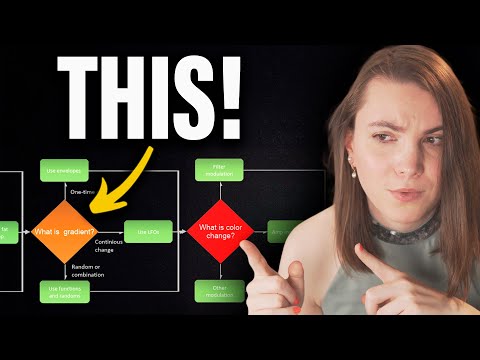
- Gradient Changes and ModulationGradient ConceptGradient means changes in the sound during time, including changes in timbre and pitch.Timbre Gradient• The sound starts bright and decays to a darker version • This is a one-time change requiring envelope modulation • Apply filter modulation with the envelope to achieve this effectPitch Gradient• The pitch wobbles continuously throughout the sound • This requires an LFO for continuous modulation • Assign the LFO to the oscillator tuning for pitch variationImplementation• Activate filter with 12 dB slope • Use envelope for filter modulation • Use LFO on voice tune for pitch modulation
- Adding Noise Layer and EffectsNoise Addition• A noise layer exists on top of the synth sound • Activate the noise layer and route it through the same filter • Reduce the noise level to maintain proper balanceEffect ProcessingEffects are not included in the subtractive synthesis framework and must be added separately through experimentation.Identified Effects• Chorus: adds pitch modulation to the sound • Reverb: creates a lush, spacious ambienceFine-Tuning• Go back and forth comparing to the original sound • Make small adjustments to attack, decay, and filter settings • Continue iterating until the sound matches closely enough