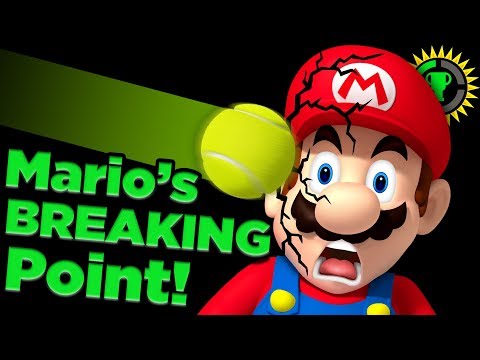
Game Theory: How DEADLY is Mario's Serve? (Mario Tennis Aces)
Is it actually possible to launch a tennis ball so hard that it can break an opponent's tennis racket?
4 chapitres
- Introduction to Mario's Athletic ProwessMario's BackgroundMario may appear as an adorable chubby plumber, but he is actually one of the most athletic characters in video game history, having appeared in 25 sports spin-off titles.Athletic Achievements• Competed in every Summer and Winter Olympic event • Mastered golf, soccer, and other sports • Participates in non-traditional athletic activitiesLatest GameMario Tennis Aces on the Nintendo Switch features zone shots, a fast-moving spike that is near-impossible to return.Research QuestionThe analysis seeks to determine if a tennis ball can actually be launched hard enough to break a racket and what other dangerous effects it could have.
- Establishing Game Measurements and ScaleScale ReferenceMario is used as a reference point at 155 cm tall to convert in-game measurements to real-life units.Court Dimensions• In-game courts are only a few centimeters apart from regulation-sized tennis courts • Regulation courts are 78 feet long (23.77 m) and 27 feet wide (8.23 m) for singles matches • The game demonstrates surprising accuracy in court sizingSpeed MeasurementsThe game provides serve speeds in miles per hour, similar to real-life televised tennis matches, though in-game radar guns read about 10% faster than actual speeds.Physics Accuracy• Gravity checks out at 9.7 m/s squared, close to real-life 9.8 • Nintendo is accurate on multiple physics measurements • Mario Tennis Aces is among the most realistic Mario games ever made
- Analyzing Racket Breaking MechanicsGame DepictionDuring successful zone shots, the racket breaks at the handle, the thick part where the player is holding it.Real-World Difference• In real life, rackets almost always break at the strings, frame, or neck • These weakest parts are where force is first applied • Nintendo shows Luigi's racket breaking correctly in promotional images but not in actual gameplayPhysics ProblemThe game's inaccurate breaking point will yield absurd numbers for force calculations compared to realistic scenarios.ImplementationIt appears the unrealistic breaking mechanics were chosen for simplicity in gameplay implementation rather than physical accuracy.
- Calculating Impact Force Using ImpulsePhysics MethodImpulse, equal to force times time, is used to determine the force transferred by the projectile and whether it can break the racket.Key Variables• Ball mass: regulation tennis ball at 58.5 grams • Speed before impact: 96 miles per hour (43 m/s) • Speed after impact: 28 miles per hour (12.7 m/s) • Impact time: 3 frames at 60 fps = 0.05 secondsMomentum ChangeThe ball's velocity changes direction, requiring one velocity to be positive and the other negative, resulting in a total velocity change of 55.7 meters per second.Professional Level• The 0.05 second contact time indicates Mario and crew are professional-level tennis players • Professionals use tight-string rackets to shorten impact time for spin and trick shots • Some professionals keep multiple rackets with different tensions for mid-game strategy changes