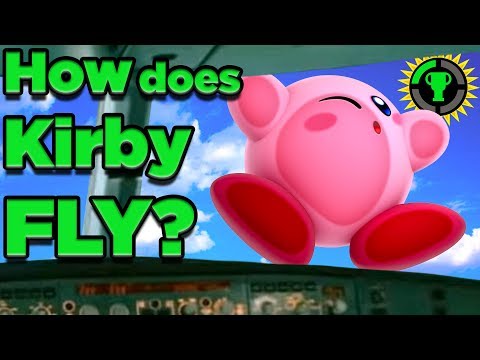
Game Theory: How Does Kirby Fly?
9 chapitres
- Episode Context and Topic ShiftOriginal PlanThe episode was originally meant to be the second half of a theory exploring why Kirby is a threat to Dreamland, including how he kills a father searching for his lost daughter in Planet Robobot.Intended RevealThe theory would have revealed that Kirby's origin dates back to an ancient god of destruction that reincarnates, with past iterations being Dark Matter and Zero.Community Feedback• Much of the Kirby community already knew about the lore connections • Many viewers were unhappy with how the theory was developing • MatPat decided to change directions based on audience responseNew DirectionThe episode shifts from Kirby lore to the science of Kirby, specifically focusing on how Kirby is able to fly.
- Introduction and Previous AnalysisCreator RecommendationMatPat recommends the channel Meteors for in-depth Kirby lore analysis, praising their thorough and fair approach to analyzing previous theories.Prior Science WorkIn previous episodes, the show covered Kirby's elastic body, arm nubbles capable of grabbing things, and his lack of a skeleton.Previous ConclusionKirby was determined to be a highly sophisticated amiibo-like creature based on physical analysis.Missing AnalysisOne essential ability was skipped over in the previous analysis: Kirby's ability to fly, which truly defines him as a character.
- The Flying Problem and Air InhalationGame History• Flying ability wasn't in Kirby's debut game, Kirby's Dreamland • Flying first appeared in Kirby's Adventure for the NES one year later • Kirby has been flying longer than he has been using his copy abilityOfficial MechanismAccording to Kirby's Dreamland instruction manual, Kirby presses up on the control pad to take in a big gulp of air and fly through the skies. Without this air, he falls like a rock.The Physics ProblemIf Kirby inhales air from the atmosphere, he becomes heavier, not lighter, because air has weight. Adding the weight of the inhaled air to his own body mass should prevent him from floating.Balloon DemonstrationA physical experiment with two balloons shows that an inflated balloon is heavier than a deflated balloon because air has mass, proving that inhaling air would not make an object lighter.
- The Mechanics of Kirby's FlightFlight Process• First button press on the ground causes a regular jump • Second button press while airborne causes him to swell but he still falls • Third button press causes him to ascend and rise further • Continuous button pressing keeps him floating, and stopping causes him to descend slowlyThe ParadoxKirby is heavier when expanded with air, yet he falls more slowly in his expanded form than when deflated, which contradicts the expectation that added weight should increase falling speed.Why Slower FallThe answer lies in air resistance, also known as drag, which affects how quickly falling objects descend through the atmosphere.Air Resistance ConceptAir resistance is the force felt when sticking your head out a moving car window or demonstrated in Galileo's gravity experiment comparing feather and bowling ball descent rates.
- Understanding Air Resistance and DragHow Drag Works• Air resistance affects any falling object including feathers, bowling balls, pianos, and deflated Kirby • For light objects, drag significantly slows descent; for heavy objects, gravitational force overpowers the drag • Parachutes intentionally create huge drag forces to slow descentReal-World Examples• Drag racing cars deploy parachutes after acceleration to slow down • Felix Baumgartner jumped from 24 miles high, reached 833 miles per hour, and slowed to less than 20 mph after deploying his parachute due to drag forceGame Design InsightIn Kirby's Epic Yarn, Kirby cannot fly normally and instead uses a parachute to descend slowly, suggesting game makers understand the physics of drag-based descent.Scientific ApplicationDrag force calculations are complex and depend on air density, viscosity, and compressibility. The key principle is that drag force is directly proportional to the area of the object experiencing the force.
- Kirby's Surface Area and Drag IncreaseSkydivers' TechniqueSkydivers can slightly slow their descent by spreading out their arms and legs to increase body area exposed to air. Parachutes create much larger area than the person, producing greater drag.Kirby's ExpansionWhen Kirby inflates himself, he increases his exposed horizontal area, which increases the drag force acting on his body.Pixel Measurements• In Kirby's Dreamland, Kirby's radius increases by 41%, increasing horizontal area to 198% of original size • In Kirby Superstar, the increase is 225% of original area • In Squeak Squad, the increase is 201% of original area • Each game shows approximately double the drag force when inflatedArea CalculationDrag acts in one direction, so when Kirby falls, the relevant area is the circle formed from below (pi r squared), not the full sphere surface area formula, explaining why area roughly doubles despite sphere geometry.
- King Dedede and Flight TrainingDedede's EvolutionIn recent games, King Dedede borrows Kirby's moves by poofing himself up to ascend through the air using the same drag-force technique.Training OriginAccording to King Dedede's Super Smash Brothers Melee trophy description, he learned to suck in air and fly like Kirby after being bested by Kirby and undertaking vigorous training.Lore ExplanationThis explains why Dedede doesn't fly in earlier Kirby games—poofing yourself up to epic proportions is an acquired skill, especially for a penguin with existing biology.Similar MechanicsBoth Kirby and Dedede use the same method: suck in air, flap little winglets, and let drag force oppose gravity.
- The Flying Solution and ConclusionThe AnswerKirby is able to fly not by becoming lighter through air inhalation, but by using drag force. He inflates himself to increase surface area, which dramatically increases air resistance and slows his descent.Kirby's Nature• Kirby is a giant amoeba creature • Kirby is a sentient balloon with flappy wings • His flying ability relies on air resistance, not buoyancyFinal TheoryThe scientific explanation is that by dramatically increasing his cross-sectional area when inflated, Kirby increases the drag force enough to make his descent slow significantly, creating the illusion of flight despite gaining weight from inhaled air.Series SignatureAs always, 'this is just a theory, a Game Theory.'
- Post-Credits SegmentKirby's True NatureMatPat reveals his lingering concern that Kirby is actually a god of destruction, despite his innocent appearance.Security ConcernsMatPat expresses that Kirby has infinite power and should not be trusted with power comparable to a nuclear arsenal button.Comedic ActionIn frustration, MatPat literally pops the Kirby balloon he used in demonstrations with scissors, nearly stabbing his foot in the process.Self-ReflectionMatPat jokes that giving him scissors is a dangerous idea, referencing his accidental near-injury with the scissors during the balloon popping.