Game Theory: How DEADLY Is Mario's Blue Shell? (Mario Kart 8)
How deadly is this weapon of mass destruction?
6 chapitres
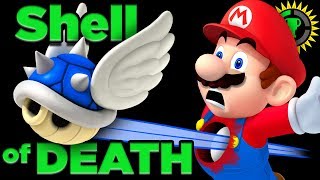
- Introduction and ContextHost BackgroundThe host shares a personal anecdote about nearly failing their driver's test in Ohio, particularly struggling with the maneuverability test and parallel parking.Previous ResearchIn a previous Game Theory video, the host calculated that Mario Kart 8 collisions are as powerful as 2000 times the force of gravity, occurring multiple times per game.Focus TopicToday's episode examines the Blue Shell, Mario Kart's most feared weapon, which targets the first-place racer and explodes into a fiery inferno.Research GoalThe analysis will use physics textbooks to calculate the exact lethality and destructive force of the Blue Shell weapon.
- Physics FundamentalsMomentum Concept• Momentum is calculated by multiplying mass times velocity • A light mass at slow speed has minimal momentum • A heavy mass at fast speed has maximum momentumReal-World ExampleThe host uses bowling as an analogy: throwing a light 8-pound ball quickly or a heavier 16-pound ball slowly yields roughly the same momentum and knocks down the same pins.Impulse PrincipleImpulse is the total momentum transferred by an action, calculated by multiplying force times time. Two different forces applied for different durations can produce equal impulse.ApplicationThese physics concepts are essential for calculating the Blue Shell's destructive force and momentum change it causes to target racers.
- Dry Bowser's SpecificationsFastest ConfigurationThe fastest character/kart combination is Dry Bowser in the B Dasher with Slick Wheels and a Super Glider, traveling at 180 km/h or 50 m/s (over 110 mph).Weight Calculation• Mario Kart 8 uses hidden statistics including weight • Mario weighs 6 weight units, approximately 89.94 kg or 198 pounds • Each weight unit equals approximately 15 kgKart ComponentsStandard kart weighs 2 units, standard wheels weigh 2 units, super glider weighs 1 unit, totaling 5 units or 75 kg—matching real-world go-kart weight.Total MassDry Bowser weighs 9 units, B Dasher 3 units, Slick Wheels 3 units, Super Glider 1 unit, totaling 16 units or 239.84 kg combined.
- Blue Shell Impact ForceMomentum Before ImpactDry Bowser at max speed with a momentum of 11,992 Newton-Seconds comes to a complete stop upon Blue Shell impact.Frame DataMario Kart 8 Deluxe runs at 60 frames per second, and it takes 33 frames for a Blue Shell to stop a racer, calculating to 0.55 seconds of impact time.Head-On ForceThe Blue Shell requires 21,803 Newtons of force to stop the speeding Dry Bowser in a direct head-on impact.Angled ImpactThe Blue Shell dives at a 60-degree angle, requiring double the force of 43,607 Newtons—approximately 20 times more powerful than Bullet Bills and reaching nearly 4,000 gs.
- Explosion AnalysisBlast RadiusUsing pixel measurements, the maximum blast radius of the Blue Shell explosion is 3.1 meters.Pressure Calculation• Blast pressure is 11,616 pascals from the impact force • Atmospheric pressure is 101,325 pascals • Hemisphere volume calculation yields 62.39 cubic metersEnergy EquivalentUsing Brode's method formula, the Blue Shell explosion has an energy of 17,617 kilojoules, equivalent to 4 kg of TNT.Health Consequences• Within 15 meters: ruptured eardrum • Within 5.9 meters: lung damage • Within 3.5 meters: death
- Conclusions and ImplicationsWeapon ClassificationBlue Shells are effectively heat-seeking missiles disguised as fun turtle shells that kill on direct impact and within a 3.5-meter radius.Real-World ConcernsThe TSA prohibits hand cream on flights while Mario characters can bring TNT-equivalent weapons into Sunshine Airport without raising red flags.Safety RecommendationsPlayers in first place receiving a Blue Shell should take those final seconds to make peace with their maker. Life insurance is necessary for competitive Mario Kart racing.Strategy InsightThe true winners of Mario Kart are the survivors who race in the middle positions, avoiding both the lead and the blue shell's devastating blast radius.