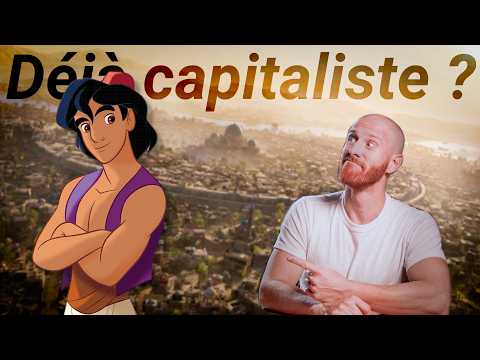
C'est quoi le capitalisme ? Ca vient d'où ? Il y avait quoi avant ?
Why doesn't Aladdin have a job? A nephew's question that leads to an exploration of what capitalism really is, its origins, and what existed before.
12 chapters
- Aladdin, the Middle Ages, and market dependencyStarting pointA question from the author's nephew, "why doesn't Aladdin have a job?", raises the question of whether Aladdin already lived under capitalism. Answer: no, the story takes place around the 10th century, amid feudalism in Europe and imperial rule in present-day Iraq.Objective• Define capitalism • Compare with the medieval era • Explain why capitalism emerged in 16th-century England • Explain why it became the global normDefinitionCapitalism begins when the entire population, not just part of it, depends on the market for survival: housing, food, and clothing are purchased with money.AladdinAladdin lives in market dependency, but it is not capitalism as long as this dependency does not apply to the entire population.
- Before capitalism: sharing and rankVillage economyIn an ancient or medieval village, tasks are divided and production is shared according to custom, without going through the market. Villagers do not buy from one another.ParticipationOne must participate in village life, on pain of social exclusion and loss of access to production. Work does not earn money but grants the right to a share of collective production.Role of rank• The share obtained depends on what is available, work capacity, gender and age, and rank • Before capitalism, rank depends on birth • Children adopt the social function of their parents • Noble functions are inaccessible to commoners: Aladdin would probably never have become princeCapitalismIt is a world where everything is bought, with competing enterprises, owners seeking profit, and workers selling their time for wages.
- Society's circle and market's squareKey imageBefore capitalism, the market's square is inscribed within society's circle: only a small part of the population, mostly urban, depends on the market. Capitalism begins when society's circle is inscribed within the market's square.NuanceWithin a family, children do not buy food from their parents, which falls under norms and customs. But no household survives without financial resources.Town versus village• A rural village lives in self-consumption, which makes sharing possible • The medieval city is an administrative, political, and military center that does not produce raw materials • It therefore depends on itinerant merchants • In Baghdad, some things were shared: fountain water, healthcare, schools, innsRole of moneyA village produces a surplus used to pay taxes, often in kind, and to sell to merchants. Money also allows hiring specialized workers from outside. Market and sharing therefore coexist.
- Wood, Brenner, and Braudel's theoriesDisagreementMarket-dependent cities and communes with sharing do not make capitalism. Historians do not all agree on its definition, which encompasses generalized market, competition, pursuit of profit, private ownership of means of production, capital accumulation.Wood's thesisAccording to Robert Brenner and especially Ellen Meiksins Wood, there is a clear break: capitalism is born in 16th-century England, with market generalization as the criterion.Braudel's thesis• No clear break but gradual reinforcement of capitalist logic • Imposed by merchants seizing power • Florence, Siena, Venice, then Amsterdam (1600–1700), then London and industrial revolution • Merchants must gain political power or obtain concessions and protectionProfit constraintFor Wood, capitalism is characterized by the profit constraint rather than the love of profit. Merchant cities, despite developed trade and financial innovations, did not make countryside dependent on the market.
- Political coercion versus economic coercionHypothesisAccording to Wood and Brenner, the ruling class, having lost access to political coercion, wagered everything on economic coercion. This occurred only in England in the 16th century.Feudal domination• Lords hold political power and write laws • Their power is validated by religious belief • They force peasants to work for free, sometimes using slaves, and command armiesWealthA lord is rich because he commands the labor of others, not because he has money. Money is necessary only for specific needs, such as stone from another kingdom or skilled workers.ExampleThe builders of the pyramids were not slaves but were not paid in the modern sense: they were given shelter and food, and worked during the Nile flood.
- Enclosures and English private propertyEnglish contextSince William the Conqueror (11th century), English lords gradually ceded authority to the king in exchange for economic power based on private property. They no longer made laws or commanded armies.Customary rights• Fields were open to glean leftovers after harvest • Commons served for pasture, wood, peat, hunting, fishing, and foraging • Without them, everything must be bought on the marketEnclosuresWalls block access to land, including commons. Wool sold well, increasing lords' surplus and peasant dependence. Lords also gain expulsion rights for unpaid rent.ResultLand becomes exclusively and wholly private property. The countryside depends on the market, where lords have the advantage because they own the land.
- Why only England?ElsewhereIn other kingdoms and empires, lords kept direct political domination. Market domination is indirect, requires changing many laws and customs, and is risky because dominants lose power if they lose money.English accident• William the Conqueror established a strong crown and more submissive lords • Their military power was nearly suppressed in the 15th century after the Wars of the Roses • English lords stumbled onto capitalism without inventing itCommon lawA national law enforced by the crown gradually makes private property exclusive and individual, whereas it had been collective. Previously, the lord had the right to a fee but peasants had use of the land.ClarificationRoman law also had great influence, but common law helped pave the way to modern private property.
- Downton Abbey: market risk for the dominantSeriesThe detour through Downton Abbey, inspired by the Unlearning Economics channel, follows Lord Grantham's family in the early 20th century, with servants and recurring financial troubles.BeforeBefore full capitalism, aristocratic life did not rely solely on money: servants not free to leave, rents paid in kind, surpluses sold without obligation.With the market• Revenue must match expenses • Servants must be paid, so rents must be collected • Peasants who do not pay are evicted • Profitability is enforcedUncertaintyPrices depend on supply and demand, laws, technical progress, the state, global trade, and geopolitics. Hence the constant need for profits and reinvestment, whereas the old system rested on custom.
- Economic fear, capitalism's engineCentral thesisAccording to Wood, constant financial fear and stress are the fundamental cause of modern capitalism's characteristics, notably productivity gains.Mechanism• Market dependency creates competition between peasants and among lords • One must be more efficient than others to cover costs • This creates economic growthBefore capitalismInnovation existed but was not essential. Innovating risked disrupting social order, attracting higher taxes, and creating inequality. Political systems favored stability.ReinvestmentThe heart of capitalist logic is reinvesting surplus to produce ever more. For Wood, this is a constraint, not a choice, and he does not say it is the best way to achieve growth.
- From industrial revolution to global capitalismComfort and stressMaterial comfort increased, but for Wood this is an indirect effect, with state regulation and intervention as well. Capitalism first creates fear of losing market access.IndustrializationAgricultural yields rise from the 16th century onward, so fewer workers are needed. Unemployed workers without land access move to cities to work in factories, launching the industrial revolution.Pomeranz's contribution• In the 18th century, the Yangtze River Delta could have sparked the industrial revolution • England had luck: coal near cities and colonies for agricultural production • In the Yangtze Delta, land was saturatedDiffusionNeighboring countries adopted market dependency to avoid falling behind, whereas China did not. Capitalism then spread via European colonial domination.
- Techno-feudalismIdeaTech giants (Google, Amazon, Facebook, Apple, Microsoft) behave like lords rather than capitalist enterprises.Cédric DurandAccording to the economist, these companies no longer fear being replaced and their platforms are so entrenched they no longer need growth. They increase power by taking from others without creating anything in return.Rent and profit• Profit assumes surplus and wealth increase • Rent is simple wealth appropriation, a zero-sum game • Wood judges Renaissance merchants were rather rent-seekers • Rent has always existed, even under capitalismPower and politicsDigital lords also seek to impose their worldview, less constrained than elected politicians. Research mentions authoritarianism, rejection of democracy and racism, and links to fascism.
- SummaryAladdin answerAladdin is poor because he is young, his father died before training him, and his mother has no income. He lives in a city where everything is bought because nothing is produced locally.Wood's thesis• Capitalism begins in 16th-century England • Before, life is possible without the market, especially in the rural world • The key to the transition is rural: countrysides had to become market-dependentChain of events• English lords strengthen private property and evictions through enclosures • Fear of economic failure drives reinvestment of surplus • Productivity becomes essential and sparks growth and industrial revolution • Other European countries adopt the method and capitalism becomes globalTodaySome large tech companies no longer fear competition and seek rent rather than profit. Their leaders also seek power, with ideas described as fascist, increasingly documented.
![10 ANS DE MACRON : L’HEURE DU BILAN [ARGENT MAGIQUE]](https://img.youtube.com/vi/MFy5VnJ2PPE/mqdefault.jpg)
![PEUT ON AVOIR CONFIANCE DANS NOS MÉDIAS [ARGENT MAGIQUE]](https://img.youtube.com/vi/5p4J97mQHo8/mqdefault.jpg)