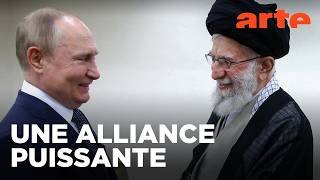
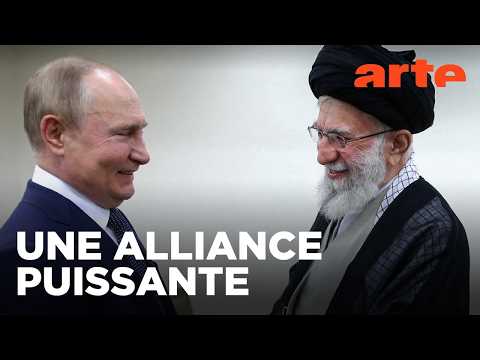
Russie, Chine, Iran : la revanche des empires | Documentaire | ARTE
17 chapitres
- Army Games and the Russia-China-Iran AllianceMilitary DemonstrationVladimir Putin organizes Army Games each year since the 2014 invasion of Ukraine, featuring tank fire, biathlon, obstacle courses, relay races, mine clearance exercises, and dance competitions.International CoalitionIn August 2022, Putin gathered 34 friendly nations, almost all under international sanctions, for the games held in Venezuela during the Ukraine war.Key SupportersChina and Iran emerged as Russia's most faithful supporters, particularly visible during the early months of the Ukraine conflict.United FrontThese three nations formed a close cooperation against Western dominance, recognizing that individual countries are too weak to face American hegemony alone.
- Russia's Invasion and the Pivot EastUkraine OffensiveOn February 24, 2022, Russia invaded Ukraine, marking the return of war to the European continent. Putin justified the invasion by citing NATO expansion and the need to protect Russian interests.Putin's ObjectivesSince taking power in 2000, Putin aimed to restore Russia's status as a great power, believing Russia must control what it considers its legitimate historical territories.NATO ConcernsPutin portrayed NATO expansion as encirclement and threats to Russia, though in reality, it was former Soviet countries choosing to move toward the West and Europe.Initial StrategyThe Kremlin expected a 72-hour victory, with the objective to replace the government rather than occupy the country, deploying paratroopers to eliminate or imprison the existing leadership.
- China and Iran's Decisive SupportUN AbstentionOn March 2, 2022, 52 out of 193 UN countries did not condemn Russian aggression, with China and Iran notably abstaining, shocking Western expectations of their condemnation.Iranian Military Aid• Iran sent military advisors to Russia to explain how to circumvent sanctions accumulated over decades • Iranian Revolutionary Guards deployed to Crimea and Russia to train Russian forces on drone usage • Iran provided affordable conventional weapons and drones critical to Russian military operationsChinese Strategic InterestChina refused to call the conflict a war, adopting Russian terminology. Chinese interests center on Russia's stability and Putin remaining in power to maintain their alliance.Partnership DeclarationIn February 2022, Putin and Xi Jinping declared a friendship 'without limits and without precedent' during the Beijing Winter Olympics, establishing a historic partnership against the West.
- Economic Circumvention and Ghost FleetsSanctions EvasionIran, under sanctions for decades, sent advisors to Russia to teach how to manage and circumvent international sanctions using parallel markets invisible to Western scrutiny.Ghost Fleet Strategy• Russia created phantom tanker fleets with no Western company links, insurance, or maritime transport connections • No Western currency used in these transactions to avoid detection • Approximately 600 tankers transport Russian oil products worldwide without detectionIllicit TradeAt least 20 ships used by Iranians serve for illegal Russian oil exports, with China becoming the primary buyer, increasing purchase volumes by 40% in 2023.Economic ResilienceThrough these circumvention methods, the Russian economy resisted collapse and continued supporting its war effort, proving sanctions less effective than Western nations anticipated.
- The Shanghai Cooperation Organization SummitFormal IntegrationIn September 2022, the Shanghai Cooperation Organization summit in Samarkand, Uzbekistan formalized the China-Russia-Iran triangle after seven months of the Ukraine invasion.Anti-Western CoalitionCreated in 2001 as an alternative to existing international institutions, the SCO brought together nations rejecting American-led world vision and rules.Iron Triangle ConceptChinese state media celebrated Iran's admission as forming an 'iron triangle' between China, Russia, and Iran, described as the most stable and indestructible geometric form.New International OrderThe three nations revealed the foundations of their own international legal system, presenting their model as alternative to universal Western principles of human rights and democracy.
- Rewriting International Law and Human RightsUniversal vs. ParticularThe joint declaration attacked universalism by redefining human rights as Western-imposed concepts, arguing each country has legitimate right to promote its own human rights approach.Authoritarian DefenseWhen authoritarian regimes violating human rights position themselves as defenders, this creates confusion that can mislead other nations about true human rights standards.Partnership StrengthXi Jinping and Vladimir Putin met more frequently than any other world leaders in the past decade, indicating true camaraderie and shared vision for global reorganization.Alliance Benefits• China gains economic resources and military partnership with major power • Russia secures economic and technological support for its isolating position • Iran emerges from pariah status to become strategic regional player
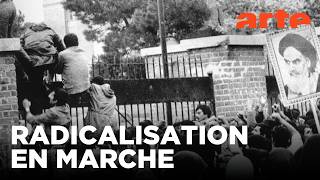
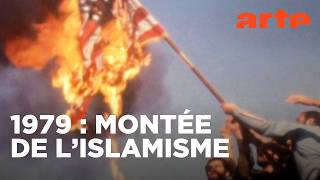
- Historical Grievances and Imperial AmbitionsIran's HumiliationIn 1953, the CIA orchestrated a coup against Prime Minister Mossadegh when he attempted to nationalize Iranian oil fields, creating lasting anti-American sentiment foundational to the Islamic Republic.China's ShameBritish-led Opium Wars in the 19th century created dependency and humiliation, with unequal treaties allowing Western and Japanese fleets to navigate Chinese rivers and access ports.Russia's Recent CollapsePutin experienced the Soviet Union's dissolution while serving in the KGB in East Germany, viewing this as a profound geopolitical catastrophe and identity shock for Russian people.Shared NarrativeEach neo-empire exaggerates, mythologizes, and instrumentalizes historical grievances to justify confrontation with the West, creating ideologies based on nationalism, revenge, and imperialism.
- The Formation of the Strategic TriangleEarly AlignmentIn 1996, China and Russia buried past conflicts to form common front against Western influence, launching the Shanghai Group, barely noticed by the West.Iran's PathAfter being designated part of the 'Axis of Evil' by George W. Bush in 2001, Iran pivoted toward Asia, establishing strategic triangle concepts with Russia and China.Syria's Catalyst• In 2012, Syria's civil war became the first major coordinated action between Iran and Russia • Iran deployed militias while Russia conducted intensive bombing campaigns • Both countries feared regime change operations targeting their own regimesUN Veto StrategyRussia and China executed coordinated obstruction strategy at the UN Security Council, vetoing 11 consecutive resolutions condemning Bashar al-Assad's actions, preserving his regime.
- Putin and Xi: The BromanceMeeting of MindsPutin and Xi Jinping met during Putin's 60th birthday celebration in 2012, discovering shared interests in reorganizing the international system away from Western democracies.Mutual AdmirationBoth autocrats mutually admired how the other managed internal affairs and maintained power, viewing democracy as destabilizing to public order and a Western imposition on the world.Geopolitical VisionThey recognized unprecedented world changes offered opportunity to reshape the entire geopolitical landscape, replacing Western-determined global order with new empires.True CamaraderieUnlike Putin's friendly but formal relations with previous Chinese leaders, Xi relationship became one of true comrades who understood each other, trusted, and shared identical world views.
- The Information Warfare CampaignHybrid WarfareFrom the late 1990s, three powers launched hybrid war against the West across all visible and invisible fronts, with objective to sow chaos in democracies.Active Measures• Putin revived KGB tactics called active measures to destabilize democracies internally • Includes information warfare using disinformation • Cyber operations attacking and collecting intelligence • Economic warfare, corruption, and covert financingInformation BattlefieldInformation became the primary battlefield of modern warfare between the three authoritarian states and Western democracies, a permanent war beneath perception described as 'warfare without smoke.'Coordinated NetworksRussia, China, and Iran deployed international media in multiple languages, cyber warriors, trolls, and online influencers relaying propaganda on Western social networks daily.
- The COVID-19 Disinformation CampaignUnified NarrativeFor the first time, the three regimes truly aligned on common disinformation campaign during the 2019 COVID-19 pandemic declared in Wuhan, China.False Origin Theory• Russian media claimed COVID-19 was an American biological weapon targeting enemies • Chinese Foreign Ministry spokesman amplified Russian conspiracy on March 12, 2020 • Iranian Supreme Leader repeated the false claim on March 22, 2020Credibility TechniquePropagandists cited Fort Detrick biomedical research center as evidence, connecting to KGB's 1980s false claim that AIDS originated there, building on existing conspiracy theories.Echo Chamber EffectRussian and Chinese officials cited each other's false claims, creating diabolical echo chamber where lies reverberated, spreading infodemic that killed, according to WHO observations.
- Destabilizing Sweden and the NATO QuestionSwedish TargetSweden, exemplary democracy and pacifist nation, became target of all three authoritarian states due to geographic position in strategically important Baltic and Arctic regions.Qur'an Burning IncidentIn early 2023, a Swedish right-wing extremist burned a Qur'an before Turkish embassy, filmed by pro-Russian journalist, organized as active measure to block Sweden's NATO entry.Amplification Strategy• Russian, Chinese, and Iranian media spread images to Arab countries • Provoked strong reactions from Islamic world against Sweden • Turkey momentarily withdrew NATO support, delaying Swedish membershipDemocratic FragilityAuthoritarian regimes seek spectacle of democracy weakened by divisions, movements, violence, and slow destruction of cohesion and institutional trust, strengthening themselves in return.
- Digital Surveillance and Technological ExportChinese TechnologyChina possesses industrial, technological, and financial means unavailable to Russia and Iran, serving as provider of technology, expertise, engineers, and infrastructure to allied regimes.Surveillance Toolkit• China developed control system blocking 99.82% of foreign information • Russia sought to study Golden Shield Chinese internet control system in 2017 • Russia launched own system called Oulus in 2023 based on Chinese modelFacial Recognition TechChinese company Hikvision developed AI cameras detecting ethnicity and race, producing Tiger Chair interrogation devices used globally, sold to Iran's Revolutionary Guards and security agencies.Iranian ImplementationIran planned installing 15 million surveillance cameras in 28 cities with data transferred to control centers in Tehran and China, deployed against protest movements including women's movement.
- Infiltrating the UN Human Rights CouncilCouncil TakeoverChina and Iran successfully infiltrated the UN Human Rights Council in Geneva, an institution that regularly condemned them, eventually gaining influential positions within it.Uyghur Vote ReversalIn September 2022, when 25 countries requested investigation into Uyghur Muslim persecution, China convinced 11 countries to abstain and 19 to vote against investigation using supporting letter.GONGO StrategyChina created fake NGOs called GONGOs controlled by state power to monopolize speaking time, discussing non-threatening topics like poverty reduction while ignoring human rights violations.Values RedefinitionChina promoted alternative human rights definition prioritizing prosperity over individual freedoms, arguing each nation determines own rights concept based on development, traditions, and history.
- The BRICS Expansion and De-dollarizationIran's Historic VictoryIn August 2023, BRICS summit in Johannesburg saw Iran integrated alongside four other emerging powers, validating Iran's policy toward China and Russia after decades of isolation.Expanded Coalition• Five new countries joined BRICS: Iran, Saudi Arabia, UAE, Egypt, Argentina • BRICS now represents almost half of world population and one-third of global wealth • New candidacies continue from multiple countries seeking membershipDollar ChallengeDe-dollarization emerged as central BRICS theme, with plan for nations to establish parallel economic and financial space protected from dollar dominance and American sanctions.Strategic AdvantageFor China, alternative financial mechanisms would immunize against Western sanctions during potential Taiwan annexion around 2030 when China becomes likely dominant economic power.
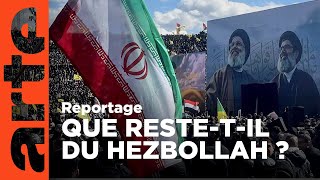
- Regional Hegemonies and the Middle EastOctober 7 AdvantageIran benefited from October 7 Hamas attack and Gaza conflict by positioning itself center of Middle Eastern game, while Russia and China benefit from international attention shifting from Ukraine and Taiwan.Axis of Resistance• Iran supports Hamas, Hezbollah, and Yemen Houthis as proxy forces • These militias became more important regional actors through conflict • Future regional architecture must account for these resistance group positionsThree-System WorldThe three powers envision fragmented world with regional systems: Iran-led Middle East system, Russia-led Eurasian system, China-led South Asian system, each with own regional hegemon.European UncertaintyEurope confronts question of strategic independence as it faces U.S.-led bloc, China-led bloc, and developing economies bloc, uncertain whether to remain dependent on America or emerge as fourth autonomous bloc.
- NATO Preparations and Democratic DefenseMilitary MobilizationNATO organized largest military exercises since Cold War's end in 2023, mobilizing 90,000 soldiers from 31 allied countries in response to three-power challenge.Peace Illusion EndedAlliance members acknowledged peace was not guaranteed and maintained military plans, recognizing that between war and peace exist intermediate positions of shadow warfare.European Stakes• If Putin wins Ukraine war due to American and European disengagement, sends catastrophic message to other dictatorships • Europe must demonstrate it is military power capable of defense, not only economic marketplace • Europe must reinvest in democracy and articulate universal values worth defendingDemocratic ResilienceAuthoritarian regimes must overcome their own fragility and control populations expressing desire for freedom and democracy, while Western democracies must choose between remaining engaged or allowing authoritarian expansion.