Les milieux humides et aquatiques
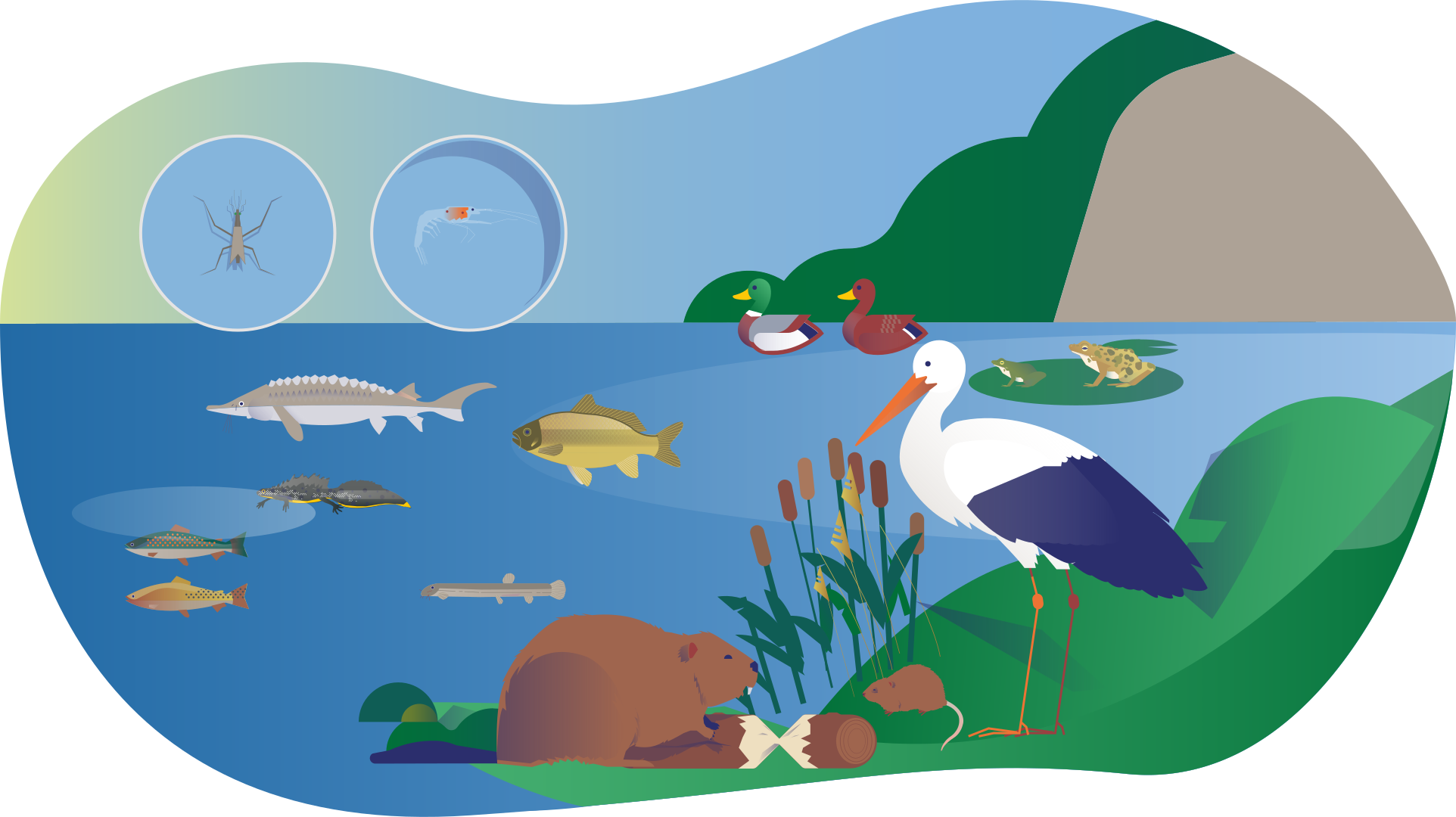
Les milieux humides et aquatiques continentaux sont variés, naturels ou artificiels. La présence d’eau peut être permanente ou temporaire : cours d’eau, étangs, marais, canaux, retenues d’eau, etc. L’eau peut y être stagnante ou courante, douce ou salée.
Inland wetlands and aquatic environments are varied, whether natural or artificial. Water presence may be permanent or temporary: rivers, ponds, marshes, canals, reservoirs, etc. Water may be stagnant or flowing, fresh or saline.
- What is a "wetland"?Definition and faunaWetlands are identifiable by the presence of water on the surface or in the soil. Fauna and flora adapted to these environmental conditions develop there. These species contribute to the formation of highly diverse ecosystems.Area and formsToday, no study provides a precise assessment of the area of wetlands across mainland France and overseas territories. The most recent surveys estimate that wetlands cover approximately 23% of mainland territory, or nearly 13 million hectares, roughly 8 times the size of Brittany. Wetlands take different forms: marshes, peatlands, mudflats, and floodplain forests.
- The benefits of wetlandsWater regulation and quality• Wetlands play a role in storing and improving surface water quality. They save the equivalent of €2,000 per hectare annually in drinking water treatment costs. Vegetation in these ecosystems participates in the water cycle through roots that cause water to evaporate or infiltrate. According to the latest national assessment of emblematic wetland sites from 2010-2020, 86% of sites evaluated in 2020 provided water regulation and supply services. Their degradation could compromise the services these environments offer to society. • Wetlands experience seasonal flooding necessary for their proper functioning. Wetlands also help reduce flood intensity. Wetlands buffer the effects of climate change. They replenish groundwater and watercourses, delaying drought effects and preserving water. Every year in France, services provided by wetlands and aquatic environments in nitrogen retention save taxpayers 2 billion euros.Peatlands and carbonFor example, peatlands are wet areas containing peat, a spongy material formed from decomposed vegetation and protected from air. Peatlands are carbon sinks. They cover only 0.2% of mainland France but store 0.5 tons of CO₂ per hectare annually, equivalent to the emissions of a television. Disruption or degradation of peatlands would release into France a stock estimated at 3,214 tons of CO₂ per hectare destroyed, equivalent to emissions from 6,400 Paris-New York round trips by plane. These environments must therefore be protected, at the risk of releasing very large quantities of greenhouse gases into the atmosphere.Biodiversity and fishing• Inland wetlands and aquatic environments are places of rest, reproduction, and feeding for a wide diversity of animals. It is estimated that more than one-third of metropolitan species benefit from these habitats. Among them, 80 fish species found in French rivers and over 90 nesting bird species depend on them. • Fishing for wild species in inland wetlands and aquatic environments (mainly fish) represents an annual commercial value of approximately 240 million euros. Professional freshwater fishing is an activity practiced today by nearly 400 professionals in France and generated revenue of approximately 27.7 million euros in 2020.Recreation and green tourismThese environments also offer multiple recreational activities, such as swimming, fishing, and water sports. In 2022, over 1.4 million fishing licenses were issued in France. There is also green tourism that is currently thriving. The Loire à Vélo initiative, for example, offers a non-polluting cycling experience to discover natural heritage across 900 km of cycling trails. This destination attracted 1.8 million cyclists in 2022 and generated 54.5 million euros in direct returns to the regions traversed.
Further reading
- Indicateur ONB : Présence des espèces exotiques envahissantes sur les sites humides emblématiques entre 2010 et 2020notre-environnement.gouv.fr
Article en ligne sur le site naturefrance, portail public du Système d’information sur la biodiversité (SIB)- Avril 2021.
- Indicateur ONB : Zones humides dont les espèces protégées se portent biennotre-environnement.gouv.fr
Article en ligne sur le site naturefrance, portail public du Système d’information sur la biodiversité (SIB) - Janvier 2022.
- Rapport "L’environnement en France - édition 2019"notre-environnement.gouv.fr
L’édition 2019 du "Rapport sur l'état de l’environnement en France" est constituée d'un rapport de synthèse et de deux focus thématiques, dont la vocation est d'aborder des problématiques transversales, plébiscitées par les usagers.
- Quelle évolution des sites humides emblématiques entre 2010 et 2020 ?notre-environnement.gouv.fr
À l'interface des milieux terrestres et aquatiques, les milieux humides fournissent de multiples services. L'altération de leur état met en péril ces fonctions et la pérennité même de ce patrimoine naturel. La dernière évaluation nationale dresse un bilan mitigé de l'état global des sites humides emblématiques et révèle que 41 % des sites évalués en métropole et dans les Outremer ont vu leur état se dégrader entre 2010 et 2020.
- Etude et documents - Résultats de l’enquête nationale à dire d’experts sur les zones humides (État en 2010 et évolution entre 2000 et 2010)notre-environnement.gouv.fr
Etude et documents - Résultats de l’enquête nationale à dire d’experts sur les zones humides (État en 2010 et évolution entre 2000 et 2010)
- L’évolution des zones humides entre 2000 et 2010 – Des pressions toujours fortesnotre-environnement.gouv.fr
L’évolution des zones humides entre 2000 et 2010 – Des pressions toujours fortes
- Peu de zones humides échappent à la colonisation par des espèces envahissantes et proliférantes entre 2000 et 2010notre-environnement.gouv.fr
Peu de zones humides échappent à la colonisation par des espèces envahissantes et proliférantes entre 2000 et 2010
- L’évaluation française des écosystèmes et des services écosystémiques : les milieux humides et aquatiques continentauxnotre-environnement.gouv.fr
L’évaluation française des écosystèmes et des services écosystémiques : les milieux humides et aquatiques continentaux
- 856 000 plans d’eau en France : un inventaire indispensable pour l’avenir de l’eaunotre-environnement.gouv.fr
L’inventaire national des plans d’eau, un outil précieux pour la gestion de l’eau douce, la préservation de la biodiversité et l’adaptation au changement climatique.
- Donnez votre avis sur l’avenir de l’eau en Francenotre-environnement.gouv.fr
Les citoyens sont invités à participer à une consultation publique sur la gestion de l'eau et les risques d'inondation, jusqu’au 25 mai 2025.
- Les 10 messages clés de l’évaluation nationale 2010-2020 des sites humides emblématiques de Francenotre-environnement.gouv.fr
À l'interface des milieux terrestres et aquatiques, les milieux humides fournissent de multiples services. L'altération de leur état met en péril ces fonctions et la pérennité même de ce patrimoine naturel. La dernière évaluation nationale dresse un bilan mitigé de l'état global des sites humides emblématiques et révèle que 41 % des sites évalués en métropole et dans les territoires ultramarins ont vu leur état se dégrader entre 2010 et 2020.
- Les zones humides en France — Synthèse des connaissances en 2022notre-environnement.gouv.fr
Article Web, Service des données et études statistiques, décembre 2022
- EFESE — Les milieux humides et aquatiques continentauxnotre-environnement.gouv.fr
Théma, Commissariat général au développement durable, mars 2018
- Données et études statistiques - Écosystèmes aquatiquesstatistiques.developpement-durable.gouv.fr
Les écosystèmes aquatiques continentaux d'eau douce (stagnante, courante ou souterraine) constituent des milieux complexes où les espèces animales et végétales interagissent et cohabitent. Parmi ces écosystèmes, les zones humides, zones de transition entre le milieu terrestre et le milieu aquatique représentent des réservoirs de biodiversité uniques mais menacés qui jouent un rôle dans la régulation de l'eau et de son épuration.
- Les indicateurs de l’Observatoire national de la biodiversité (ONB)indicateurs-biodiversite.naturefrance.fr
L'Observatoire national de la biodiversité (ONB) informe sur l’état de la biodiversité en France, ainsi que sur les mesures et actions prises pour sa protection.
- Système d’informations sur la biodiversité (NatureFrance)naturefrance.fr
Site d'information sur les données sur la biodiversité.
- Les agences de l’eaulesagencesdeleau.fr
Site général d’information des agences de l’eau et accès aux agences régionales
- Indicateur ONB - Évolution de l’état général des zones humidesnaturefrance.fr
Indicateur ONB - Évolution de l'état général des zones humides