Comprendre le changement climatique et ses conséquences
À cause des activités humaines et de leur utilisation d’énergies fossiles (charbon, pétrole, gaz), les émissions de gaz à effet de serre augmentent rapidement. Cela renforce l’effet de serre et réchauffe la Terre : le climat se modifie et avec lui les températures, les précipitations (pluie, neige, grêle) et les vents. 2024 a ainsi été l’année la plus chaude jamais enregistrée au niveau mondial. Si cela se traduit de façon différente selon les régions et les saisons, l’humanité fait aujourd’hui face à un bouleversement climatique, avec des conséquences déjà visibles dans de nombreux domaines.
Due to human activities and their use of fossil fuels (coal, oil, gas), greenhouse gas emissions are increasing rapidly. This intensifies the greenhouse effect and warms the Earth: the climate is changing and with it temperatures, precipitation (rain, snow, hail), and winds. 2024 was thus the hottest year ever recorded globally. While this manifests differently depending on regions and seasons, humanity is today facing a climate upheaval with already-visible consequences in many sectors.
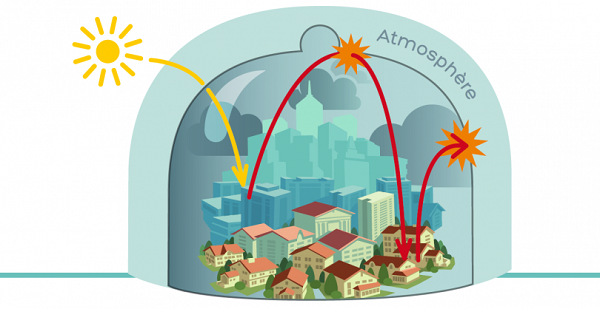
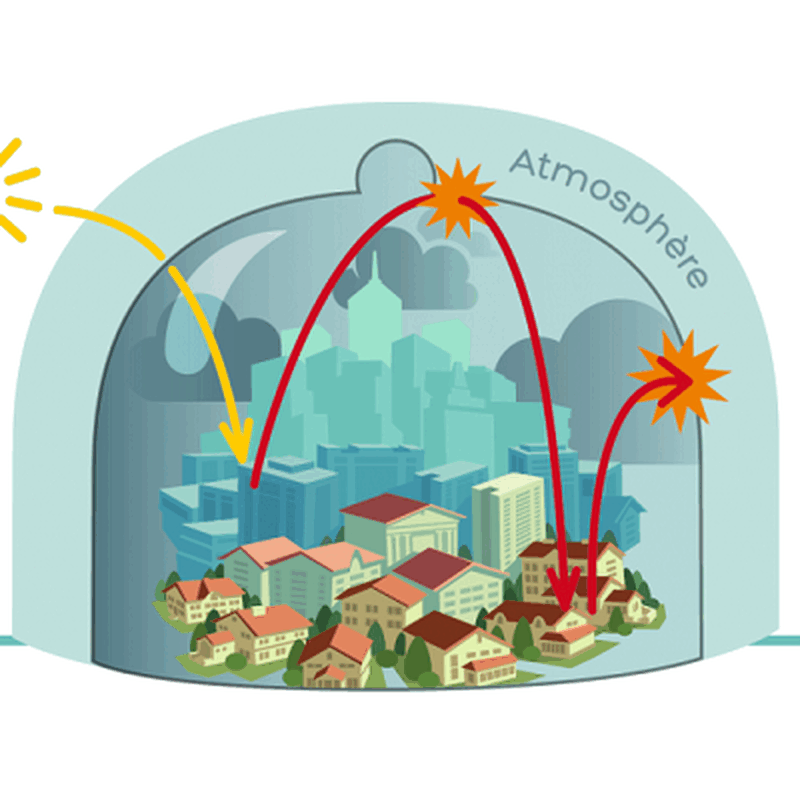
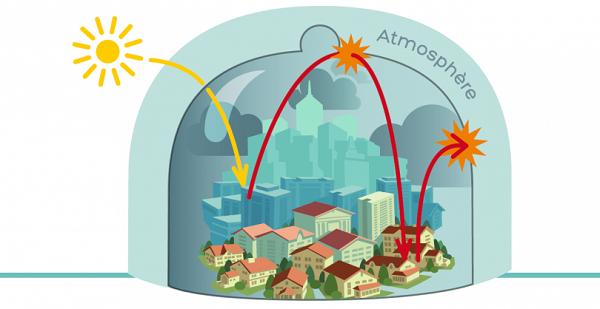
- What is climate change?Greenhouse gases, main cause• Thanks to greenhouse gases naturally present in the atmosphere (water vapor, carbon dioxide, methane…), Earth absorbs part of the energy it receives from the Sun, while the rest is reflected back into space. This natural phenomenon, called the greenhouse effect, makes life on Earth possible: without it, the planet's average temperature would indeed be freezing, around -18 °C. These gases therefore play an important role in regulating the climate. • In recent decades, the concentration of greenhouse gases in the atmosphere is increasing rapidly due to human activities and the combustion of fossil fuels (oil, natural gas, coal). This intensifies the greenhouse effect and traps a larger portion of the heat received from the Sun in the atmosphere, causing a rise in Earth's temperature: this is global warming.Direct consequences of warming• The consequences of climate change are multiple: changes in temperatures at Earth's surface, rising sea levels, melting snow and ice, disruption of precipitation (rain, snow, hail), and multiplication and intensification of extreme weather events (e.g., floods, droughts, hurricanes…). • Rising sea levels are primarily due to changes in the temperature of seas and oceans: as heat increases, water expands and occupies a larger volume. It is also due to the melting of land ice or freshwater-based ice (ice sheets, glaciers, etc.) as temperatures rise. • The melting of mountain glaciers, sea ice, and polar ice caps is caused by rising temperatures at Earth's surface and in seas and oceans. • Precipitation levels (rain, snow, hail) are also changing. A warmer atmosphere can carry up to 7% more humidity (and therefore water) per degree of warming, and the more humid the atmosphere, the greater the probability of rainfall. • Climate change also alters the intensity, frequency, duration, and distribution of extreme phenomena such as floods, storms, droughts and heat waves, hurricanes, tornadoes, cyclones, typhoons, wildfires…. For example, droughts will be more frequent, more intense, and longer due to increased evaporation linked to rising temperatures. • > Weather vs. climate: what's the difference? > Weather is what happens each day around us: hot or cold conditions, rain, snow, wind, etc. Climate, on the other hand, is an average of meteorological conditions over a long period (several decades). It is therefore normal to continue observing occasional cold spells: weather is by nature different each day, and this does not call into question the overall trend of climate change in the long term.Global problem with regional effects• Climate change is a problem affecting the entire planet. However, the level of warming and its effects manifest differently depending on each geographic area: hot or cold regions, humid or desert climates, continental or coastal areas, rural or urban, economically wealthy or poor, etc. • The increase in average global temperature compared to the pre-industrial era (period between 1850 and 1900) is already 1.1 °C. The Paris Agreement aims to keep this increase below 2 °C and ideally below 1.5 °C. This international agreement was adopted in 2015 at the 21st Conference of the Parties (COP21) of the United Nations on climate change, in Paris.
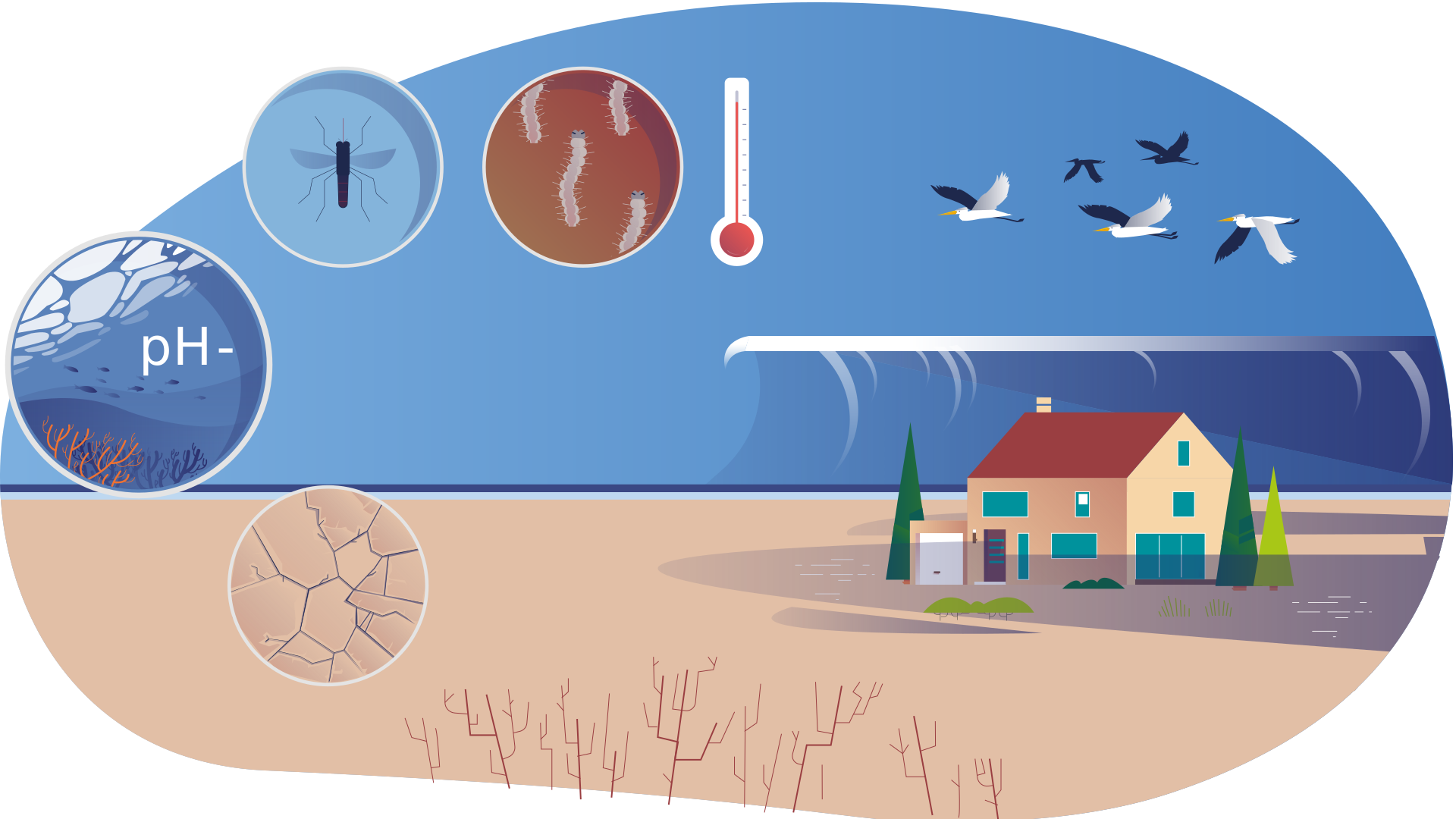
- Already-felt consequences across many sectorsWarming observed in France• In mainland France and French overseas departments, temperature increases have been particularly pronounced since the 1980s. Over the period 1959-2009, the trend is approximately +0.3 °C per decade. In 2022, the average annual temperature across the country reached 14.5 °C, making it the hottest year since measurements began in 1900, followed by 2023 (14.4 °C), 2020 (14.1 °C), 2018 (13.9 °C), and 2024 (13.9 °C). • The number of summer days (with temperatures exceeding 25 °C) has increased significantly, while frost days (with minimum temperatures below 0 °C) have decreased. In Agen, for example, there were 43 frost days per year during 1960-1970 compared to 30 during 2010-2020. Extreme rainfall in France's Mediterranean southeast is becoming increasingly intense. • In mountains, major monitored mainland glaciers have retreated 31.4 meters in 21 years. Snow cover is also declining. At Col de Porte (Chartreuse), winter snow depth during 1990-1991 and 2019-2020 is 38 cm less than during 1960-1961 and 1989-1990.Impacts on biodiversity and agriculture• Climate change also has consequences for water and biodiversity, as evidenced by the advance of bird migration dates, the expansion of pine processionary caterpillars, rising water temperature in Lake Geneva, increased areas affected by annual droughts in mainland France, etc. • In agriculture, grape harvest dates, an indicator of vegetation's response to climate change, occur on average 18 days earlier than 40 years ago. Corn and wheat crops are also adapting to changing environmental and climatic conditions, with an overall earlier sowing date.Social, economic and geopolitical impacts• More broadly, society and the economy are affected: increased climate risks (heat waves, floods, cyclones, etc.) and health risks (vector-borne diseases, etc.), economic losses (lost work days, reduced agricultural yields, lower tourism, material damage, etc.). • France could also experience the consequences of climate change in other countries. Indeed, the emergence of geopolitical crises (migration, conflicts, etc.) generated by tensions over resource access (food, water) is a risk highlighted by the IPCC and considered in international and national strategic thinking. • > The IPCC and its reports: international scientific references > Created in 1988 by the World Meteorological Organization and the United Nations Environment Programme, the IPCC (Intergovernmental Panel on Climate Change) comprises 195 member states. Its objective is to assess and synthesize the available scientific, technical, and socio-economic information on climate change. > The work of the IPCC leads to the regular publication of reports, aimed at building consensus within the scientific community while also identifying limits in knowledge or interpretation of results. Understanding the scientific basis of climate change caused by human activities enables the implementation of adaptation and mitigation strategies. • > Precise monitoring of impacts in France through ONERC > Created by the law of February 19, 2001, the National Observatory on the Effects of Global Warming (ONERC) has the main missions of collecting and disseminating information on risks linked to global warming, as well as formulating recommendations on adaptation measures to consider in order to limit the impacts of climate change. It works closely with the IPCC for this purpose. > To describe the state of the climate and its impacts across the entire French territory, ONERC has equipped itself with a panel of indicators, each associated with a phenomenon and allowing it to indicate the change over time in an objective manner.
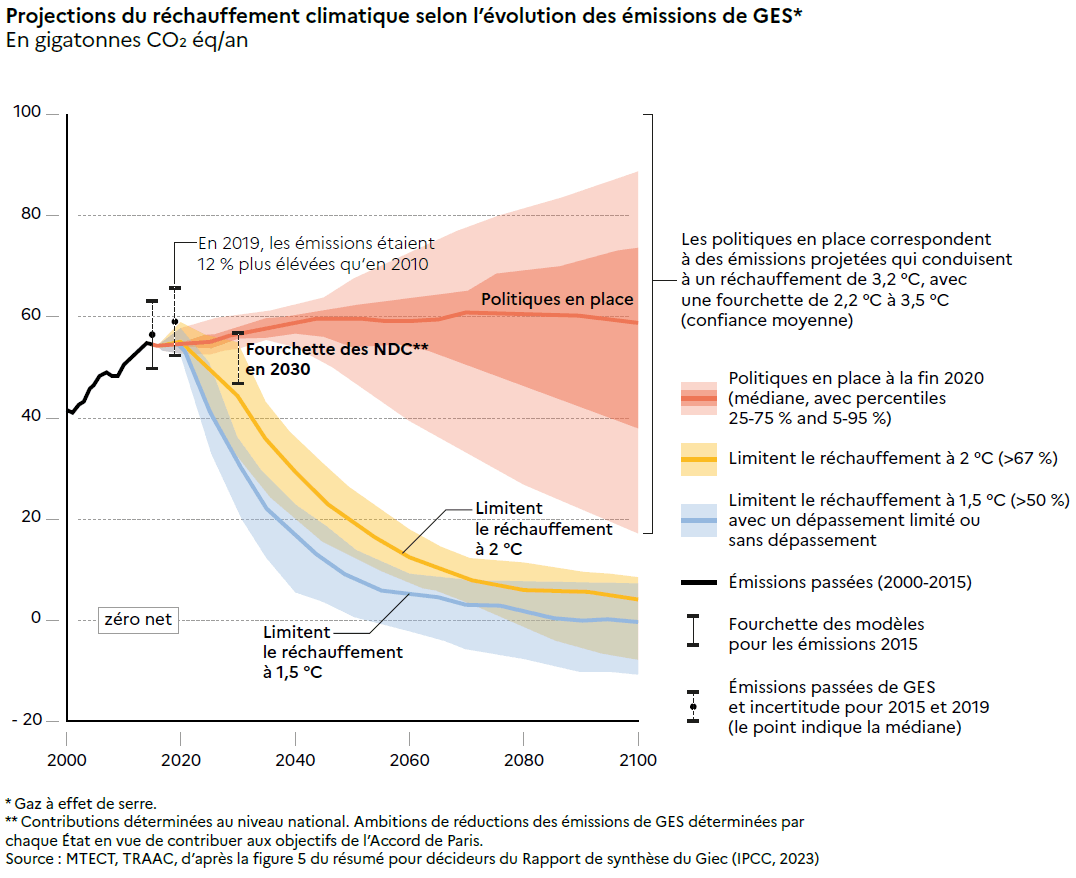
- Worrying future prospectsWarming dependent on future emissions• The future climate is determined by greenhouse gases (GHG) already emitted into the atmosphere and by new emissions in the years to come. To predict climate warming, the IPCC relies on economic development scenarios with human societies that emit more or less GHG. These scenarios lead to temperature increases ranging from +1.4 °C to +4.4 °C globally by the end of the century compared to the pre-industrial era. • Meeting the Paris Agreement scenario (+1.5 °C by 2100) requires humanity to stop CO2 emissions within approximately 30 years and significantly reduce other GHGs. If each country's climate policies remain at their current level, global warming is expected to reach approximately +3 °C by the end of the century. Some impacts are also already irreversible. This is the case with rising sea levels, which will continue for several centuries, and polar ice melting.Climate risks increasing rapidly• The IPCC's work predicts that exceptional climate events (droughts, heat waves, heavy precipitation, cyclones) will be more frequent and/or more intense in the future. Globally, a drought episode that occurred on average once every ten years in 1900 could occur four times more frequently by 2100 with global warming of +4 °C. An exceptional precipitation episode (in one day) could occur two to three times more often. • Global warming of +3 °C will correspond to approximately +4 °C warming in mainland France by 2100 compared to the pre-industrial era. Temperature increases will be stronger in summer, with more frequent heat waves, particularly around the Mediterranean, in the Rhône Valley and the Garonne Valley. Extreme rainfall is also expected to increase, particularly in northern France. This will not prevent rivers from often having very low levels in summer, with water shortage situations likely to multiply throughout France. • Excessive warming will cause irreversible damage: rising oceans, biodiversity loss, etc. For example, at +2 °C warming, coral reefs will disappear even though they shelter 30% of marine biodiversity. Meanwhile, beyond a critical threshold, warming could trigger cascading events with catastrophic consequences: the collapse of ice sheets would cause sea levels to rise several meters, disruption of ocean currents would cause profound climate changes, permafrost thaw would release enormous quantities of methane and greatly increase the greenhouse effect, etc. • Impacts abroad could also have repercussions for France. Crop losses abroad, induced by climate warming, will for example affect French food supplies.
Further reading
- Des événements climatiques extrêmes de plus en plus fréquentsnotre-environnement.gouv.fr
Inondations, grêle, sécheresse, feux… plus le climat se réchauffe, plus les événements climatiques extrêmes sont fréquents, notamment en France.
- Les émissions de gaz à effet de serre et l’empreinte carbone de la Francenotre-environnement.gouv.fr
Les activités humaines émettent des gaz à effet de serre, responsables de l’accélération du réchauffement climatique. L’empreinte carbone permet de calculer leur impact sur le climat.
- La lutte contre le changement climatiquenotre-environnement.gouv.fr
Pour atteindre l’objectif de maintenir le réchauffement du climat sous les 2 °C, des stratégies sont mises en œuvre au niveau français, européen et international.
- Chiffres clés du climat - France, Europe et Monde - Édition 2025statistiques.developpement-durable.gouv.fr
Cette publication a pour ambition d’informer sur le changement climatique, ses mécanismes, causes et effets ainsi que sur les dispositifs mis en place pour le circonscrire, aux échelles internationale, européenne et nationale. Datalab – Service des données et études statistiques – novembre 2025
- Ce qu’il faut retenir du 6e rapport d’évaluation du GIECecologie.gouv.fr
Cette synthèse présente les principaux points du 6e rapport d’évaluation du GIEC, publié le 20 mars 2023. Gouvernement – mars 2023
- Climat : le GIEC publie son dernier guide de survie pour la planètenews.un.org
Article publié sur le site de l’ONU, mars 2023
- Drias, les futurs du climatdrias-climat.fr
Présentation de l’évolution future du climat en France et des objectifs du Plan national d’adaptation au changement climatique. Ministère de la Transition écologique & Météo France
- Pourquoi le niveau de la mer augmente avec le réchauffement climatique ?insu.cnrs.fr
Infographie de vulgarisation scientifique publiée sur le site du CNRS, juin 2021
- Observatoire national sur les effets du changement climatique (ONERC)ecologique-solidaire.gouv.fr
L’ONERC a pour missions principales de collecter et diffuser les informations sur les risques liés au réchauffement climatique, formuler des recommandations sur les mesures d’adaptation à envisager pour limiter les impacts du changement climatique et être en liaison avec le GIEC. Ministère de la Transition écologique
- Groupe d’experts intergouvernemental sur l’évolution du climat (GIEC)ipcc.ch
Site officiel du Groupe d’experts intergouvernemental sur l’évolution du climat (GIEC), ou IPCC en anglais.
- Tous les rapports et publications du GIECipcc.ch
Page regroupant l’ensemble des publications du GIEC : rapports d’évaluation, rapports spéciaux, rapports méthodologiques et documents techniques.
- La disparition des glaciers plus importante que prévuecnrs.fr
Article de décryptage publié sur le site du CNRS, janvier 2023
- Émissions de gaz à effet de serre : en hausse ou en baisse ? Un podcast pour comprendre.notre-environnement.gouv.fr
Ce podcast revient sur les dernières évolutions des émissions dans le monde, en Europe et en France avec Malo Herry, coordinateur de la publication des Chiffres clés du climat, et Colas Robert, pour le Centre interprofessionnel technique d’études de la pollution atmosphérique (Citepa).
- Changement climatique : l’homme modifie le climatyoutu.be
Première d’une série de 3 vidéos réalisées en 2018 par Météo France pour expliquer le processus du changement climatique, ses impacts d’ici 2100, et les moyens d’agir.
- Les gaz à effet de serre : description, sources, et impacts radiatifscanal-u.tv
Dans cette vidéo, Philippe Bousquet propose un aperçu général de la diversité des gaz à effet de serre, de l'évolution de leurs émissions dans l'atmosphère, de leur impact en matière d'effet de serre additionnel et des activités humaines qui en sont à l'origine.
- Gaz à effet de serre et climat futurcanal-u.tv
Le chercheur Laurent Bopp met en relation les émissions de gaz à effet de serre avec l’évolution du climat. Il met en évidence l’existence de rétroactions.
- L’adaptation au changement climatiquecanal-u.tv
Université Virtuelle Environnement et Développement durable (UVED)