Les émissions de gaz à effet de serre et l’empreinte carbone de la France
La combustion d’énergies fossiles, comme le pétrole ou le charbon, est l’activité humaine qui émet le plus de CO2, un gaz à effet de serre qui réchauffe l’atmosphère. Elle est cependant loin d’être la seule activité à émettre du CO2 et le CO2 n’est pas le seul gaz à effet de serre. Avec la concentration des différents gaz dans l’atmosphère, l’effet de serre se renforce, et le réchauffement climatique s’accélère. L’indicateur nommé « empreinte carbone » permet de mesurer les émissions liées aux consommations finales de notre pays et ainsi de connaître l’impact du mode de vie des Français.
The combustion of fossil fuels, such as oil or coal, is the human activity that emits the most CO2, a greenhouse gas that warms the atmosphere. However, it is far from being the only activity that emits CO2 and CO2 is not the only greenhouse gas. With the concentration of different gases in the atmosphere, the greenhouse effect strengthens, and climate warming accelerates. The indicator called "carbon footprint" makes it possible to measure emissions linked to the final consumption of our country and thus to understand the impact of the lifestyle of the French.
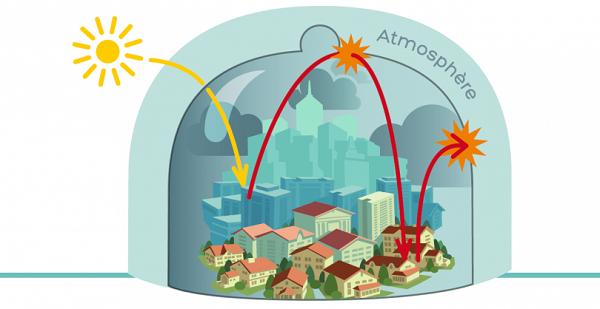
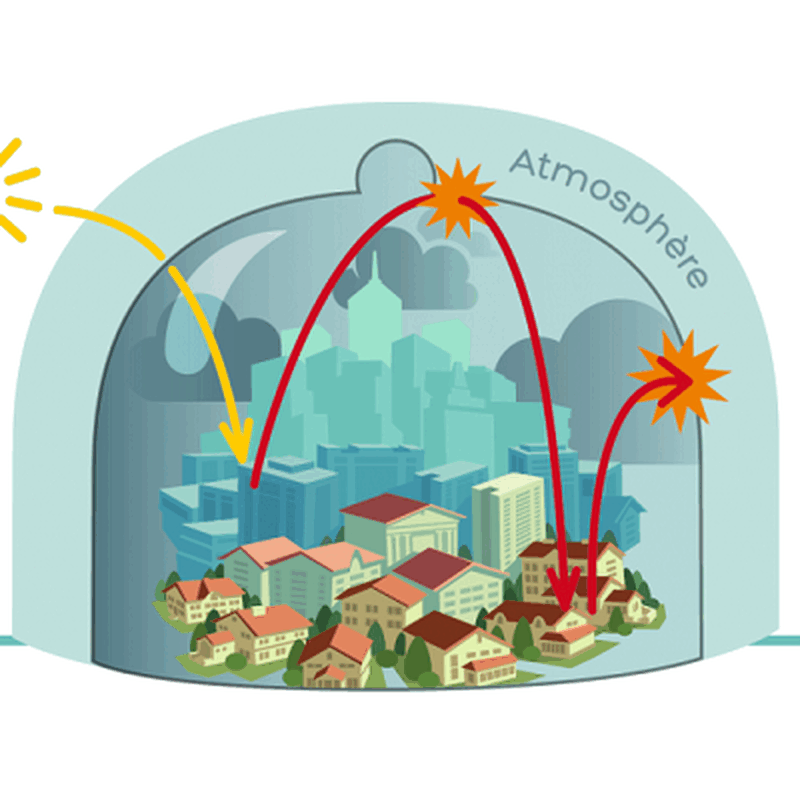
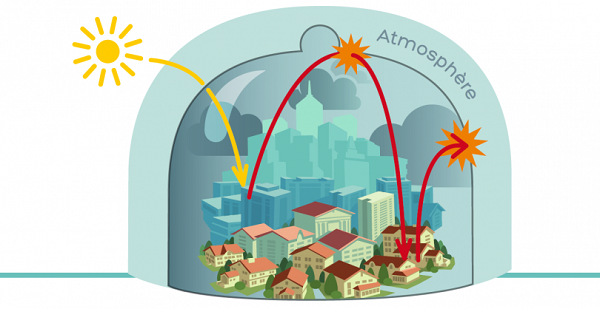
- The greenhouse effect, at the root of climate warmingGreenhouse mechanism• A greenhouse gas is a gas that traps part of the heat from the sun's rays. Some of these gases are naturally present in the atmosphere. Thanks to them, the Earth absorbs part of the energy it receives from the Sun, and the rest is sent back into space. This natural phenomenon, called the greenhouse effect, makes life possible on Earth: without it, the average temperature of the planet would be around -18°C. These gases therefore play an important role in regulating the climate.Current warmingHowever, the rapid increase in the concentration of these gases in the atmosphere results in an accelerated rise in its temperature: this is the climate warming we are currently experiencing, caused by human activities.
- Human activities that emit greenhouse gasesMain gases emitted• The main human activities that emit greenhouse gases are: combustion of fossil fuels, industrial processes such as cement production, agricultural livestock and waste treatment, use of agricultural fertilizers, use of solvents, refrigeration and air conditioning. • CO2 (carbon dioxide): Combustion of fossil energy, cement production and tropical deforestation • CH4 (Methane): Landfills, agriculture, livestock and industrial processes • N2O (Nitrous oxide): Agriculture, industrial processes, fertilizer use • Fluorinated gases: HFCs (hydrofluorocarbons, family composed of different molecules): Sprays, refrigeration, industrial processes • PFCs (perfluorocarbons, family composed of different molecules) • SF6 (sulfur hexafluoride) • NF3 (nitrogen trifluoride): Electronic component manufacturing • These different gases do not all contribute equally to the greenhouse effect. To be able to compare them with each other, we evaluate the capacity of each gas to redirect energy toward the ground (the "radiative forcing") relative to CO2. The contribution of each gas to the greenhouse effect is then measured by its global warming potential: this depends on its ability to intercept and redirect solar radiation, and its lifetime. • Methane (CH4) for example has a global warming potential 25 times greater than CO2. This rises to 298 for nitrous oxide (N2O) and up to 23,900 for sulfur hexafluoride (SF6).
- Emissions from different sectors in France
- France's carbon footprintCountry carbon footprint• A country's carbon footprint represents the amount of greenhouse gas due to the consumption of households, public administrations, non-profit organizations, and investments. This includes goods and services produced on national territory and those that are imported, regardless of their origin. A country's carbon footprint therefore reflects the impact of lifestyles on the climate. It is different from greenhouse gas emissions released on national territory. • The calculation is done as follows: carbon footprint = domestic emissions + foreign emissions linked to imports - emissions linked to exports • The carbon footprint of a good or service includes all the greenhouse gases necessary for the production of that good or service, such as extraction of materials, production of raw or intermediate materials, industrial processes, transport or marketing. • France's carbon footprint has decreased by 13% since 1990 overall and by 26% per capita, taking into account population growth.France's carbon footprint• In 2023, France's carbon footprint is estimated at 644 million tonnes of CO2 equivalent (Mt CO2eq), or 9.4 tonnes per capita. Emissions associated with imports account for nearly half (56%) of the footprint. For comparison, this figure would need to be limited to 2 tonnes of CO2 per capita on the planet to succeed in limiting Earth's warming to 1.5°C according to the objective set by the Paris Agreement. • France's carbon footprint (644 Mt eq CO2) is 60% higher than national greenhouse gas emissions (403 Mt CO2 eq), that is to say emitted on our soil. This shows that France imports more emissions than it exports. • Foreign emissions come from different economic activities: extraction and production of fossil fuels, electricity production, agriculture, metallurgy, manufacturing of non-metallic minerals, transport and chemical industry. • These foreign activities are part of the production chain of goods and services consumed by the French, such as fuels, agri-food products, manufactured goods, construction, transport services, commercial and public services. • The Data and Statistical Studies Service (SDES) of the General Commission for Sustainable Development (CGDD) estimates France's carbon footprint. The results and detailed methodology for its calculation are available on the SDES website.
Further reading
- Comprendre le changement climatique et ses conséquencesnotre-environnement.gouv.fr
En raison des gaz à effet de serre émis par les activités humaines, le climat sur Terre se réchauffe rapidement avec de nombreux impacts déjà observables.
- Les émissions françaises de gaz à effet de serrenotre-environnement.gouv.fr
Dans le cadre des engagements pris par la France, revue de détails de ses émissions de gaz à effet de serre, de leur évolution depuis 1990, et de la contribution de chaque secteur.
- Les différents formats des données d’émissions de gaz à effet de serrenotre-environnement.gouv.fr
Les inventaires de gaz à effet de serre (GES) ont pour objet de quantifier les GES émis par un pays, et de relier ces émissions à des activités humaines.
- Les facteurs d’émission de gaz à effet de serrenotre-environnement.gouv.fr
Les énergies n’émettent pas toutes la même quantité de pour un même niveau de consommation. L’Ademe diffuse des facteurs d’émissions de GES qui (…)
- Les émissions de gaz à effet de serre de l’agriculturenotre-environnement.gouv.fr
L’agriculture a émis 19% des émissions de gaz à effet de serre (GES) de la France en 2019, soit le 2ème poste d’émissions national.
- Les émissions de gaz à effet de serre des transportsnotre-environnement.gouv.fr
Détail des émissions de gaz à effet de serre du secteur des transports en France et de leur évolution, selon le mode de transport (voitures, poids lourds, aérien…)
- Les émissions de gaz à effet de serre du secteur de l’industrie manufacturièrenotre-environnement.gouv.fr
Le secteur de l’industrie manufacturière est le quatrième contributeur d’émissions de gaz à effet de serre (GES) en France.
- Les émissions des gaz à effet de serre du secteur du traitement centralisé des déchetsnotre-environnement.gouv.fr
Le traitement centralisé des déchets contribue aux émissions GES. En 2017, le traitement des déchets, par stockage ou incinération, ainsi que le traitement des eaux usées représentent 3 % du total des émissions de GES de la France.
- Les émissions des gaz à effet de serre du secteur résidentielnotre-environnement.gouv.fr
En 2017, les résidences des ménages sont à l’origine de 58 Mt CO2e, soit 12% du total national.
- Les émissions des gaz à effet de serre du secteur tertiairenotre-environnement.gouv.fr
En 2017, le secteur résidentiel-tertiaire est le deuxième poste d’émissions de GES de la France (20 % du total national).
- Consommation d’énergie et émissions de gaz à effet de serre du secteur résidentielnotre-environnement.gouv.fr
Après avoir légèrement augmenté entre 1982 et 1992, la consommation finale d’énergie du secteur résidentiel est globalement stable jusqu’en 2010.
- Résultats et méthodologie détaillée du calcul de l’empreinte carbone en Francestatistiques.developpement-durable.gouv.fr
- Chiffres clés du climat - France, Europe et Monde – Édition 2025statistiques.developpement-durable.gouv.fr
Datalab - Service des données et études statistiques - Novembre 2025.
- Chiffres clés du climat - France, Europe et Mondestatistiques.developpement-durable.gouv.fr
Datalab - Service des données et études statistiques - novembre 2024
- Union postale universelle - Solutions pour le climatupu.int
Page de l'Union postale universelle, agence de l'ONU proposant des initiatives et recommandations visant à réduire l'empreinte carbone du secteur postal
- L’empreinte carbone de la France de 1995 à 2023statistiques.developpement-durable.gouv.fr
Datalab - Service des données et études statistiques - novembre 2024
- Chiffres clés du climat : l’essentiel en infographienotre-environnement.gouv.fr
Service des données et études statistiques – mars 2025
- Les principaux aspects du changement climatiquenotre-environnement.gouv.fr
Aujourd'hui, l'influence de l'homme sur le réchauffement climatique de la Terre est clairement établie. Des changements sont observés dans toutes les composantes du climat, atmosphère, océan, glaces, végétation, et dans toutes les régions du monde.
- Comprendre le changement climatiquenotre-environnement.gouv.fr
L’augmentation de la température à la surface du globe est en marche. Elle sera probablement supérieure à 1,5 °C à la fin du siècle par rapport à l’époque préindustrielle (1850-1900). La biodiversité, le littoral, l’océan, la santé et même le patrimoine culturel sont concernés par les impacts de ce changement climatique. Tel est en substance le message délivré par le 5e rapport du Groupe d’experts intergouvernemental sur l’évolution du climat (GIEC) publié en 2014.
- Les impacts du changement climatique en Francenotre-environnement.gouv.fr
Afin de décrire l’état du climat et ses impacts sur l’ensemble du territoire français, l’ONERC s’est doté d’un ensemble varié d’indicateurs. Un indicateur est une information, associée à un phénomène, permettant d’en caractériser l’évolution dans le temps.
- Qu’est-ce qu’un gaz à effet de serre ?notre-environnement.gouv.fr
Par gaz à effet de serre, on entend un gaz présent dans l’atmosphère qui retient une partie de la chaleur reçue par le solaire dans l’atmosphère. L’augmentation de la concentration des gaz à effet de serre dans l’atmosphère se traduit par une hausse de sa température.
- Le Groupe d’experts intergouvernemental sur l’évolution du climat (GIEC)ipcc.ch
Le Groupe d’experts intergouvernemental sur l’évolution du climat (GIEC) fournit des évaluations détaillées de l’état des connaissances scientifiques, techniques et socio-économiques sur les changements climatiques, leurs causes, leurs répercussions potentielles et les stratégies de parade.
- L’Agence européenne pour l’environnementeea.europa.eu
L’Agence européenne pour l’environnement (AEE) est l’agence de l’Union européenne qui fournit des informations et des données à l’appui des objectifs européens en matière d’environnement et de climat.
- La décomposition de l’empreinte carbone de la demande finale de la France par postes de consommation : transport, alimentation, habitat, équipements et servicesstatistiques.developpement-durable.gouv.fr
Document de travail, Service des données et études statistiques, Juillet 2022
- La mobilité bas-carbone : choix technologiques, enjeux matières et opportunités industriellesnotre-environnement.gouv.fr
Rapport, Commissariat général au développement durable – Service de l’économie verte et solidaire, février 2022
- Vidéo sur l’empreinte carbone des Français en 2021geo.dailymotion.com
Vidéo - Service des données et études statistiques - Novembre 2022
- Changement climatique : l’homme modifie le climat / quels impacts d’ici 2100 ? / comment agir ?notre-environnement.gouv.fr
En 10 000 ans, les températures moyennes ont augmenté de 5 °C à la surface du globe. Et si le climat de la Terre change depuis des millions d'années, désormais tout va très vite et ce réchauffement de 5 °C pourrait se produire en 200 ans seulement. Les températures moyennes ont déjà augmenté de 1 °C depuis 1900 !
- Changement climatique : quels impacts d’ici 2100 ?notre-environnement.gouv.fr
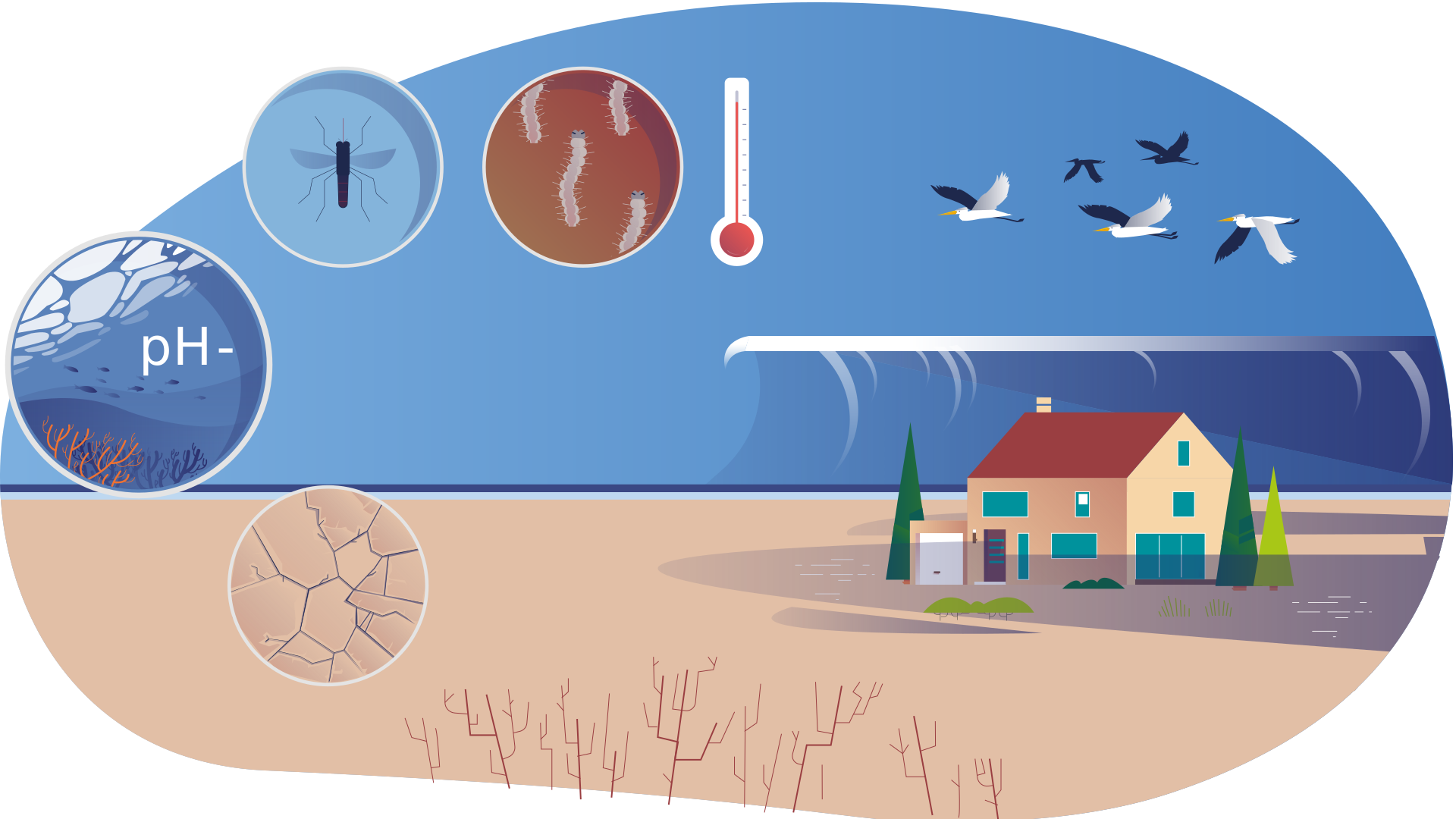
Si nous ne faisons rien, les températures moyennes à l'échelle de la planète seront supérieures de 3 à 6 °C d'ici la fin du siècle. Ce réchauffement aura pour conséquences l'élévation du niveau de la mer, l'aggravation des inondations, l'extension des feux de forêt, la baisse des ressources en eau… Avec un impact majeur sur la santé des populations.
- Changement climatique : comment agir ?notre-environnement.gouv.fr
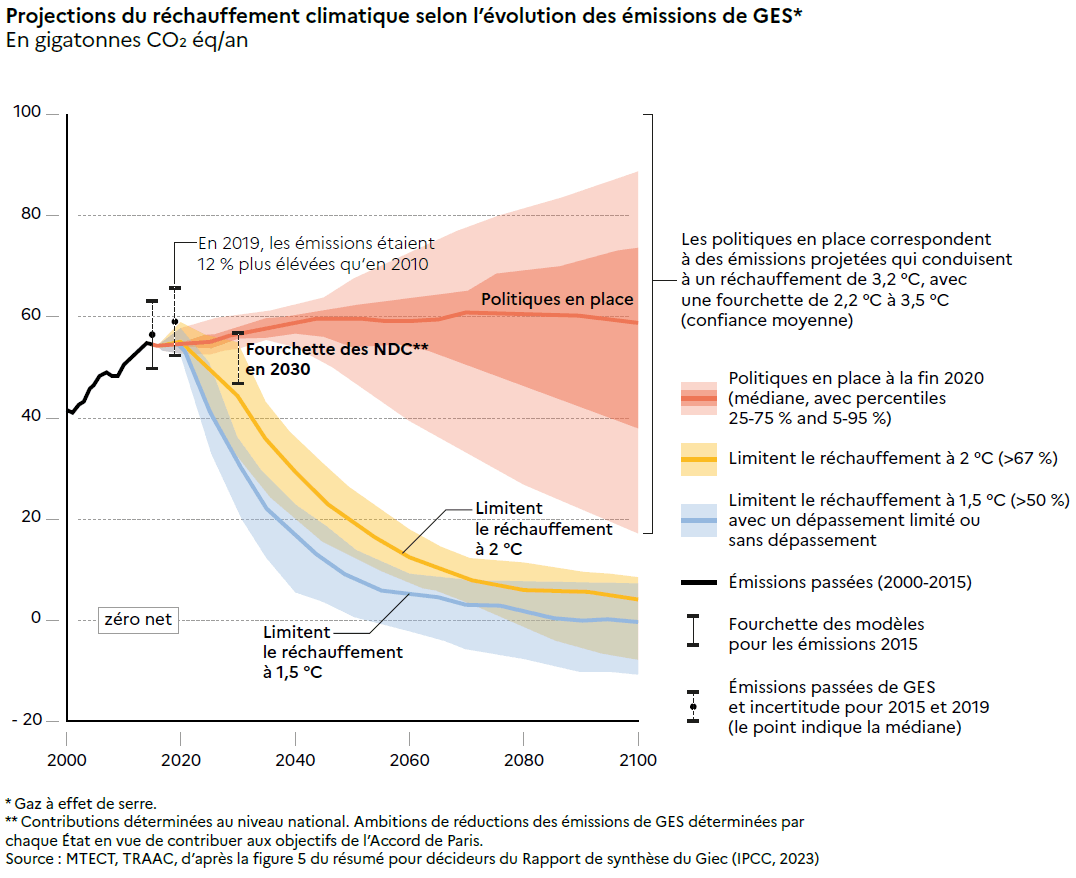
Sans politique climatique, les températures moyennes à l'échelle de la planète augmenteront de 3 à 6 °C à la fin du siècle. La quasi-totalité des pays se sont fixé comme objectif de limiter le réchauffement climatique mondial à 2 °C à l'horizon 2100. Atteindre cet objectif nécessite de réduire le niveau global d'émissions de gaz à effet de serre. Cette réduction passe par le développement des énergies renouvelables, le reboisement, le captage du gaz carbonique, le recyclage…
- L’adaptation au changement climatiquecanal-u.tv
Université Virtuelle Environnement et Développement durable (UVED)
- Changement climatique et développementcanal-u.tv
Dans cette vidéo, Gaël Giraud discute de la relation entre le changement climatique et le développement. Il évoque les outils économiques à mettre en œuvre pour convaincre et aider les pays du Sud, particulièrement exposés au changement climatique, à mettre en place leur transition énergétique.
- Les gaz à effet de serre : description, sources, et impacts radiatifscanal-u.tv
Dans cette vidéo, Philippe Bousquet propose un aperçu général de la diversité des gaz à effet de serre, de l'évolution de leurs émissions dans l'atmosphère, de leur impact en matière d'effet de serre additionnel et des activités humaines qui en sont à l'origine.
- Le rôle de l’effet de serre sur le climatnotre-environnement.gouv.fr
Dans cette vidéo, Jean-Louis Dufresne présente le mécanisme de l'effet de serre, et discute de ses relations avec les émissions de gaz à effet de serre.
- Gaz à effet de serre et climat futurcanal-u.tv
Le chercheur Laurent Bopp met en relation les émissions de gaz à effet de serre avec l’évolution du climat. Il met en évidence l’existence de rétroactions.