La lutte contre le changement climatique
À cause des émissions de gaz à effet de serre liées aux activités humaines, le climat change rapidement. Signé en 2015 par 195 États, l’Accord de Paris prévoyait de maintenir le réchauffement d’ici 2100 sous les 2 °C (si possible sous 1,5 °C) par rapport à la période 1850-1900. À l’heure actuelle, les efforts internationaux restent pourtant insuffisants pour y parvenir. Retour sur cet objectif et sur sa signification, ainsi que sur les stratégies mises en œuvre pour l’atteindre en France, en Europe et dans le monde.
Due to greenhouse gas emissions from human activities, the climate is changing rapidly. Signed in 2015 by 195 countries, the Paris Agreement aimed to keep global warming through 2100 below 2°C (ideally below 1.5°C) compared to the 1850-1900 period. Currently, however, international efforts remain insufficient to achieve this. Here is an overview of this goal and its meaning, as well as strategies being implemented to achieve it in France, Europe, and around the world.
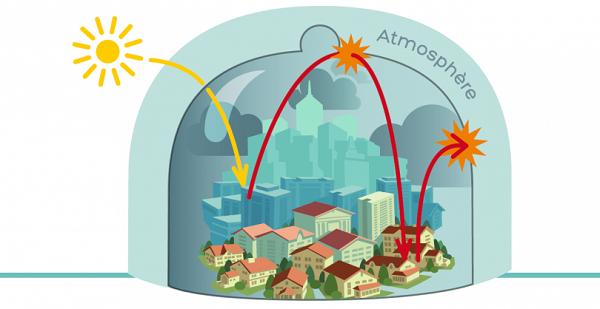
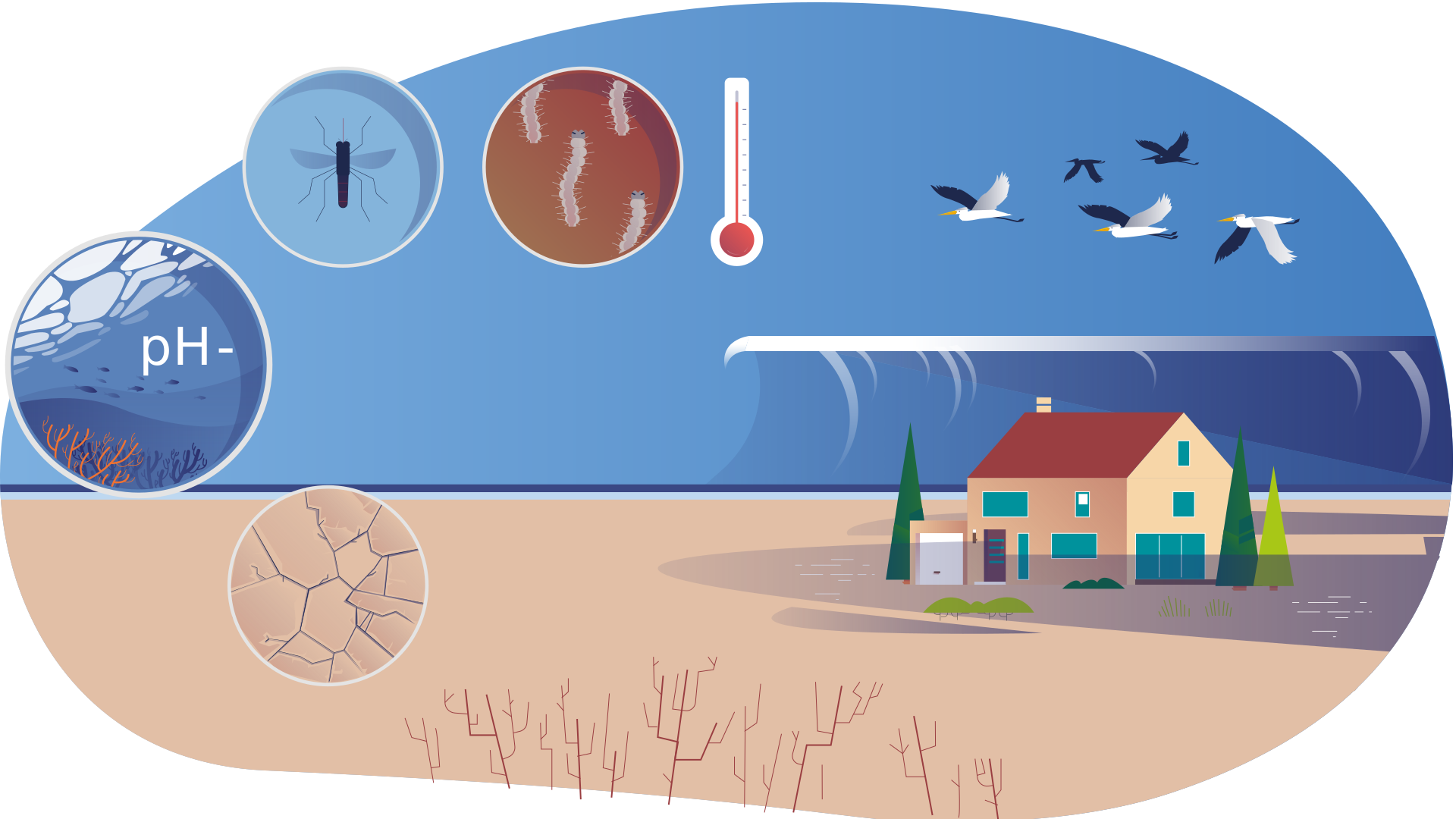
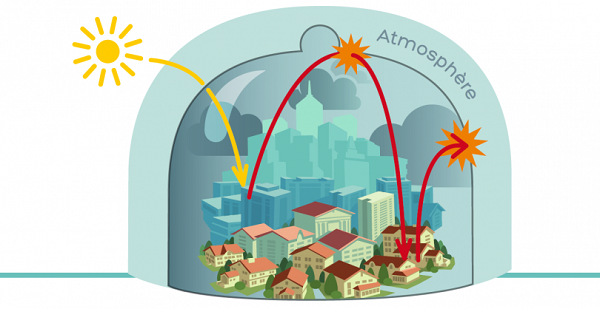
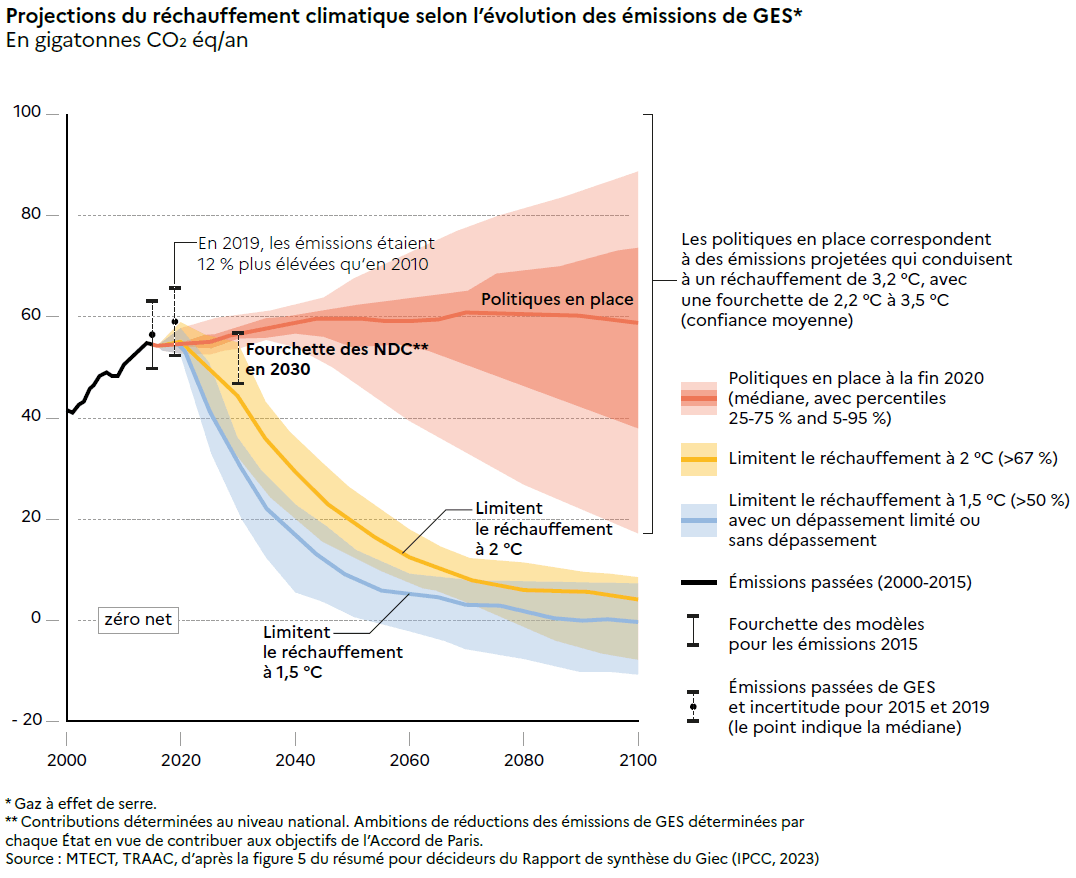
- Goal: limit warming to 2 degrees or 1.5 degrees if possibleWhere do we stand today?• Global warming currently stands at +1.1 degrees compared to the pre-industrial era (period between 1850 and 1900). This is a global average, including both land and oceans. Temperature increases on continents have already reached +1.6°C. It has never been as warm on Earth in 125,000 years, and certainly not this rapidly. • This rapid temperature increase already has many consequences. Extreme weather events such as heat waves, droughts, floods, and cyclones are becoming more intense and frequent. Rising sea levels have reached an average of 20 cm globally. This rise has never been as rapid in at least 3,000 years, while glacier retreat is unprecedented in at least 2,000 years (source).Common goal, different scenarios• All of this is linked to human activities and their greenhouse gas (GHG) emissions: the current concentration of carbon dioxide in the atmosphere is the highest in at least 2 million years. This is why nearly all countries in the world have now signed and ratified the 2015 Paris Agreement (Explanations on vie-publique.fr). Its goal is to keep the average global warming well below 2 degrees (ideally 1.5 degrees) and to reduce global GHG emissions accordingly. • To achieve this, the IPCC (Intergovernmental Panel on Climate Change) has calculated different levels of global warming depending on future greenhouse gas emissions. According to the measures implemented, the scenarios established by the IPCC show a very different future climate: continuing current policies would lead, for example, to warming of 3.2°C by 2100. • The goal instead is to reach carbon neutrality as quickly as possible—that is, a balance between greenhouse gases emitted by human activities and those naturally absorbed by oceans, forests, and soils (but also potentially through technological solutions – see box below). Achieving this neutrality (or "net-zero emissions") would mean that GHG concentration in the atmosphere stops increasing, and therefore the climate stops warming. • > Carbon capture and sequestration under debate > Carbon capture and storage (CCS) technologies are now integrated into the greenhouse gas emission scenarios proposed by the IPCC. This involves both capturing and storing CO₂ at the source (for example at factory outlets to reduce emissions) and directly extracting CO₂ already present in the atmosphere, that is, in ambient air. > These technologies are not all at the same stage of development, and they have impacts in terms of energy, water, chemicals, and land use that must be taken into account. This is why the High Council for Climate explains in its 2023 opinion on this subject that "the use of CCS should be reserved as a priority for reducing residual emissions that cannot be eliminated at the source, in addition to energy efficiency and conservation measures." These CO₂ removal technologies, while potentially necessary, should only be a "last resort solution to achieve net-zero GHG emissions by 2050."
- Do our part: all actors in a low-carbon societyShared responsibilities• Climate disruption and its consequences have become increasingly prominent concerns in recent years. International commitments, as well as the national policies that follow from them, are becoming more ambitious, in response to regular assessment reports from the IPCC and successive COPs, the UN's annual climate conferences. • However, the concrete implementation of necessary transformations and GHG reduction actions is sometimes slowed by the search for the most effective level of action, based on determining each actor's "responsibility" for emissions. It is common to see consumers, businesses, local authorities, and the state identified as the main culprits.Limits of individual action• While it is true that individual action has significant impact, the commitment of individuals and households to decarbonize their lifestyles remains insufficient on its own to achieve the goals. Indeed, according to a Carbone 4 study, three-quarters of the necessary reduction in the individual carbon footprint of French people depends on the system in which they operate—that is, the political and economic framework, which depends on the state and businesses. • Reducing emissions from mobility and housing involves actions at both individual and collective scales (public transport supply, territorial planning, thermal renovation subsidies, etc.). While every action counts, individual action must also rely on deeper, collective shifts toward a low-carbon society.Climate financing• > Significant investments, but still insufficient > The Institute for Climate Economics (I4CE) evaluates in its Climate Finance Overview the amount invested in France to mitigate climate change (excluding adaptation spending). > In 2022, these investments, from households, businesses, and public administrations, are estimated at 100 billion euros (€B), or 3.8% of France's gross domestic product (GDP). This represents roughly twice the budget of the French military, for example. They cover low-carbon transport infrastructure, equipment and vehicles (€33.9B), energy performance in new buildings (€23.7B), building energy renovation (€22.1B), and decarbonized energy production (€20.1B). > However, climate investment needs based on the national low-carbon strategy and the multi-year energy plan are estimated at approximately €160B annually for each year from 2024 to 2030.
- Strategies at European and international levelsInternational level: COPs and the Paris Agreement• In 1992, the United Nations and its member states, alerted to the severity of global warming by the scientific community, decided to take action at the global level. They adopted a United Nations Framework Convention on Climate Change, the UNFCCC, marking the start of enhanced climate change monitoring. • Since 1995, a COP (Conference of the Parties) has been held every year—an international negotiation among states that are signatories to the UNFCCC. France participates in these international negotiations. France notably hosted the 21st Conference of the Parties (COP21) in 2015, which concluded with adoption of the Paris Agreement. • This agreement remains the international reference for climate action today. Although it is legally binding, it provides no sanctions if signatory states fail to take necessary measures. Implementation efforts therefore remain difficult relative to stated objectives.European level: Green Deal and implementation• The European Union's strategy to combat climate change is the European Green Deal, or "Green Deal," presented in 2019 by the European Commission. This framework aims to make Europe the world's first carbon-neutral continent by 2050. To do so, it seeks to adapt EU policies on climate, energy, transport, and taxation to reduce net greenhouse gas emissions by at least 55% by 2030 (compared to 1990 levels). • This goal became legally binding in 2021 with the European Climate Law, followed by a set of measures ("Fit for 55") intended to reach the 2030 targets. Among these flagship measures: reform of the Emissions Trading System (ETS), a carbon border tax (Carbon Border Adjustment Mechanism – CBAM), strengthened renewable energy and energy efficiency targets, and an end to sales of new internal combustion vehicles by 2035.
- France's strategy against climate changeFrom Paris Agreement to carbon neutrality by 2050• Since the early 2000s, France has pursued energy and climate policies to reduce emissions. It has set the goal of achieving "carbon neutrality" by 2050, which requires cutting gross GHG emissions by at least six times compared to 1990. • As a signatory to the Paris Agreement, France committed to reducing emissions to limit temperature increase to 2°C, ideally 1.5°C. To turn this international agreement into French reality, the Ministry for Ecological Transition presented France's Climate Plan in 2017. It set more ambitious new targets for the country, including reaching carbon neutrality by 2050. • With the 2019 Energy-Climate Law, this goal became legally binding. The law establishes the framework, ambitions, and targets of France's energy and climate policy. It focuses on four main areas: • progressive phase-out of fossil fuels and development of renewable energy; • combating energy-inefficient buildings; • establishing new tools for steering, governance, and evaluating climate policy; • regulating the electricity and gas sectors.How to reach carbon neutrality?• France's Energy and Climate Strategy outlines how to achieve carbon neutrality by 2050 while ensuring society adapts to climate change impacts. It will be regularly updated and will draw on: • the 3rd edition of the National Low-Carbon Strategy (SNBC3); • the 3rd edition of the National Plan for Adapting to Climate Change (PNACC3); • the 3rd edition of the Multi-Year Energy Plan (PPE3). • To reach carbon neutrality, the National Low-Carbon Strategy (SNBC) sets emission reduction targets for French territory over the next 15 years: carbon budgets. These are emission caps not to be exceeded, expressed as annual averages over a 5-year period, in millions of tonnes of CO₂ equivalent. They are broken down by economic sector and by greenhouse gas. • In 2022, the state launched national-level ecological planning. Its goal is to coordinate stakeholders to address major environmental challenges: ecological transition, combating climate change, preserving biodiversity and natural resources, reducing pollution, developing a circular economy, and adapting to climate change.Implementation in territories• At the local level, inter-municipal authorities and regions have tools to coordinate ecological transition: territorial climate-air-energy plans (PCAET), regional climate-air-energy schemes (SRCAE), and regional planning, sustainable development, and territorial equality schemes (SRADDET). • Since 2023, the "territorialization of ecological planning" approach has been launched to facilitate and strengthen the application of national targets at the local level, in line with existing plans and schemes. The PlanET method (Planning Territorial Emissions) was developed to help regions and inter-municipal authorities quantify GHG emission reductions enabled by their plans and verify they match national targets.
- Some measures against climate change1st example: 4 per 1,000 in agriculture• Climate policies exist in all sectors: public subsidies for energy renovation or purchasing less CO₂-emitting vehicles, thermal regulations in buildings, emissions trading systems in industry, etc. Here are three examples of public climate policies concerning agriculture, nature, and tax and regulatory incentives. • The topsoil of French land contains 3,580 million tonnes of carbon, divided among forests (38%), permanent grasslands (22%), and large-scale crops (22%). This makes it the second-largest carbon sink (storage site) after the oceans. Scientists agree that an annual increase of 0.4% in carbon content in the top 30 centimeters of soils would halt the rise in atmospheric CO₂ concentration. • It was in this context that the "4 per 1,000" (or 0.4%) initiative on soils for food security and climate emerged at COP21 in 2015. Increasing soil cover or enriching soils with organic matter increases their carbon content. Thus, extending cover crops (grown between main crops and the next planting) can increase total additional soil carbon storage potential by 35%, intra-field agroforestry (integrating trees into fields) by 19%, and the insertion and extension of temporary grasslands by 13%. • The effectiveness of these measures requires a parallel reduction in soil sealing—a process that releases carbon into the atmosphere. In 2019, without land-use change and without modifying agricultural and forestry practices, the National Institute for Agricultural Research (Inrae) estimates evolution of carbon stocks in French soils at +2.3‰ per year.2nd example: nature-based adaptation solutions• The concept of "Nature-Based Adaptation Solutions" is relatively recent, even though it sometimes corresponds to already long-established, even ancestral, practices. According to IUCN (International Union for Conservation of Nature), it involves protecting and restoring natural ecosystems to harness their functioning for adapting to climate change, while benefiting biodiversity. • For example, a river that regains its natural meanders and vegetated banks can overflow its bed and absorb upstream floods while creating spawning grounds for fish. • The long-term cost-to-benefit ratio of these solutions is generally more favorable than that of artificial infrastructure, which also more easily leads to "maladaptation" (ineffectiveness or worsening risk). The economic benefits of nature restoration have been estimated at eight times their costs. • Natural ecosystems actively participate in absorbing and storing CO₂ from human activities. Their preservation or restoration is therefore also beneficial in mitigating climate disruption.3rd example: effective carbon pricing• In France, energy and waste taxation, as well as European emissions quotas, create an incentive to reduce these emissions, as well as accounting for negative effects (air pollution, noise, infrastructure wear, road accidents, etc.) depending on uses. • In OECD terms, these policies constitute "effective carbon pricing." This concept allows representation of the incentive to reduce emissions created by these policies. The higher the effective carbon price, the greater the incentive to reduce emissions. • In France, in 2023, greenhouse gas emissions are subject to effective carbon pricing of €91 per tonne of CO₂ equivalent on average, of which €75 comes from excise taxes (that is, indirect taxes) on energy and waste and €16 from European emissions quotas. This average level, however, masks significant variations across sectors and actors.
Further reading
- Comprendre le changement climatique et ses conséquencesnotre-environnement.gouv.fr
En raison des gaz à effet de serre émis par les activités humaines, le climat sur Terre se réchauffe rapidement avec de nombreux impacts déjà observables.
- Des événements climatiques extrêmes de plus en plus fréquentsnotre-environnement.gouv.fr
Inondations, grêle, sécheresse, feux… plus le climat se réchauffe, plus les événements climatiques extrêmes sont fréquents, notamment en France.
- Les émissions de gaz à effet de serre et l’empreinte carbone de la Francenotre-environnement.gouv.fr
Les activités humaines émettent des gaz à effet de serre, responsables de l’accélération du réchauffement climatique. L’empreinte carbone permet de calculer leur impact sur le climat.
- Les émissions françaises de gaz à effet de serrenotre-environnement.gouv.fr
Dans le cadre des engagements pris par la France, revue de détails de ses émissions de gaz à effet de serre, de leur évolution depuis 1990, et de la contribution de chaque secteur.
- Chiffres clés du climat – France, Europe et Monde – Édition 2024statistiques.developpement-durable.gouv.fr
Cette publication a pour ambition d’informer sur le changement climatique, ses mécanismes, causes et effets ainsi que sur les dispositifs mis en place pour le circonscrire, aux échelles internationale, européenne et nationale. Datalab – Service des données et études statistiques – novembre 2024
- Ce qu’il faut retenir du 6e rapport d’évaluation du GIECecologie.gouv.fr
Cette synthèse présente les principaux points du 6e rapport d’évaluation du GIEC, publié le 20 mars 2023. Gouvernement – mars 2023
- Une tarification des émissions de gaz à effet de serre inégale selon les secteursecologie.gouv.fr
Publication expliquant le fonctionnement de la tarification des gaz à effet de serre en France et en Europe, ainsi que leur inégalité selon les secteurs. Ministère de la Transition écologique – décembre 2024
- La Convention-cadre des Nations unies sur le changement climatique (CCNUCC)unfccc.int
Cette page explique ce qu’’est la CCNUCC et quelle est son origine.
- Groupe d’experts intergouvernemental sur l’évolution du climat (GIEC)ipcc.ch
Site officiel du Groupe d’experts intergouvernemental sur l’évolution du climat (GIEC), ou IPCC en anglais.
- Pacte Vert (Green Deal) européencommission.europa.eu
Présentation de la stratégie phare pour lutter contre le changement climatique au niveau européen.
- Agence européenne pour l’environnement (AEE)eea.europa.eu
L’AEE fournit des informations fiables et indépendantes sur l’environnement au grand public ainsi qu’aux professionnels des politiques environnementales.
- Stratégie Nationale Bas-Carbone (SNBC)ecologie.gouv.fr
Cette page reprend l’ensemble des informations et documents relatifs à la SNBC, ainsi qu’aux différents budgets carbone de la France.
- Haut Conseil pour le Climathautconseilclimat.fr
Le Haut conseil pour le climat (HCC) est un organisme indépendant chargé d’évaluer l’action publique en matière de climat, et sa cohérence avec les engagements européens et internationaux de la France, en particulier l’Accord de Paris.
- Tous les rapports et publications du GIECipcc.ch
Page regroupant l’ensemble des publications du GIEC : rapports d’évaluation, rapports spéciaux, rapports méthodologiques et documents techniques.
- Les facteurs d’évolution des émissions de CO₂ liées à l’énergie en France (1990-2020)statistiques.developpement-durable.gouv.fr
Cette publication vise à identifier les rôles respectifs de l’activité économique, de l’efficacité énergétique et du bouquet énergétique dans l’évolution des émissions de CO₂ liées à l’énergie, pour chacun des grands secteurs émetteurs. Datalab - Service des données et études statistiques - Septembre 2022
- Émissions de gaz à effet de serre : en hausse ou en baisse ? Un podcast pour comprendre.notre-environnement.gouv.fr
Ce podcast revient sur les dernières évolutions des émissions dans le monde, en Europe et en France avec Malo Herry, coordinateur de la publication des Chiffres clés du climat, et Colas Robert, pour le Centre interprofessionnel technique d’études de la pollution atmosphérique (Citepa).
- Changement climatique : l’homme modifie le climatyoutu.be
Première d’une série de 3 vidéos réalisées en 2018 par Météo France pour expliquer le processus du changement climatique, ses impacts d’ici 2100, et les moyens d’agir.
- La transition énergétique : pourquoi et comment ?notre-environnement.gouv.fr
Dans cette vidéo (11'04), Patrick Criqui, Directeur de recherche au CNRS, discute des quatre grandes trajectoires qui sont imaginées afin de réduire les émissions de gaz à effet de serre d'un facteur 4 à l'horizon 2050 : sobriété, efficacité, diversité, décarbonisation. Il montre où peut être située la Loi sur la transition énergétique et propose une lecture internationale de cette problématique.