
What Jumping Spiders Teach Us About Color
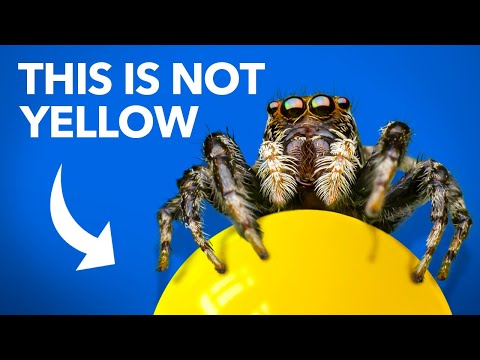
What does yellow even mean?
10 capitulos
- The Nature of Color PerceptionHow We See• Screens display color using only red, green, and blue subpixels • Yellow on a screen is actually a mix of red and green light • Human eyes have cone cells sensitive to red, green, or blue wavelengthsBrain vs RealityWhen yellow light enters the eye, it stimulates red and green-sensitive cone cells equally, causing the brain to perceive yellow even though the eye only detects red and green.Philosophical Question• Aristotle believed color is a property of objects • Galileo believed color is a phenomenon of the mind • The same object can appear different colors depending on the observer's sensory capabilitiesColor Across SpeciesDifferent animals see color differently - dogs cannot distinguish red from green, while birds, butterflies, fish, and jumping spiders have superior color vision to humans.
- Introduction to Jumping SpidersBasic Characteristics• About 6,000 species of jumping spiders are known • They are harmless creatures that rarely get large enough to threaten humans • Species display diverse appearances: furry, shiny, striped, spotted, red, green, and blueHunting AbilitiesJumping spiders are active daytime hunters that can take down prey two or three times their own body size, earning the Chinese nickname 'fly tiger.'Vision Advantages• Unlike most nocturnal spiders, jumping spiders have excellent eyesight • Different species possess different forms of color vision • They split visual functions across eight eyes: motion detection and light sensitivity in some, color vision and fine detail in othersEye StructureJumping spiders have two large principal eyes in front that are built like Galilean telescopes, with a long fluid-filled tube between two lenses that magnifies the image and increases detail perception.
- Exceptional Vision CapabilitiesVisual Acuity• Principal eyes can see pattern detail nearly as well as sharp-sighted pigeons • Secondary eyes see the world about as well as the best insect eyes • Jumping spiders break the rule that bigger eyes function better - their small secondary eyes rival dragonfly visionNarrow FocusJumping spiders can only see fine detail and color in a very narrow slice of the world, approximately the width of a thumb held at arm's length.Visual Scanning Process• Secondary eyes provide 360-degree black and white vision • Spiders swivel principal eyes to look at moving objects of interest • They paint additional details about color and pattern moment by moment as they scanColor Variations• Most jumping spiders are dichromats with two types of color-sensitive cone cells • Some species are trichromats with three types of cones like humans • Others are tetrachromats with four types of cones like birds
- Evolution of Color VisionRepeated Evolution• Color vision ability has evolved multiple times independently in jumping spiders • This is unlike primates where trichromatic vision evolved once and remained stable • The ability to see red has evolved several times across different jumping spider speciesResearch Methods• Researchers use microspectrophotometry to measure wavelengths absorbed by individual cone cells • They examine ultra-thin slices of jumping spider retinas • Species classification as dichromat, trichromat, or tetrachromat requires this analysisBehavioral Testing• Scientists show spiders moving shapes that differ in color but not brightness • Spiders are held in place with tiny magnets to control what they see • They stand on a ball monitored to track which direction they attempt to lookGenetic Basis• Color vision depends on opsin genes that encode color-sensitive proteins • Animals achieve color vision by having different copies of opsin genes • Gene variations produce proteins sensitive to different colors of light
- Mechanisms of Red VisionGene Duplication• Some jumping spiders see red when their green-sensitive opsin gene accidentally duplicates • The new copy evolves to shift sensitivity toward longer red wavelengths • This same process occurred in human eyes to create red-sensitive visionFilter SolutionOther jumping spider species evolved internal filters on some green-sensitive cone cells that cut out green light, forcing those cells to respond only to longer wavelengths like red.Widespread MechanismAmong 45 measured jumping spider species, researchers found as many as 12 independent changes in color vision, showing jumping spiders constantly evolve new expanded forms of color vision.Diverse SolutionsDifferent species have acquired new visual capabilities in very different ways, demonstrating multiple evolutionary pathways to enhanced color perception.
- Feeding Behavior and Color AdvantagePrey DetectionExpanded color vision helps jumping spiders find more prey and discriminate toxic prey from safe prey, as many small insects advertise toxicity through bright colors.Experimental Setup• Red-painted termites are treated with Bitrex, the most bitter substance known • Gray-painted termites remain tasty and untreated • Spiders are trained to associate color with palatability in a buffet setupLearning ResultsHabronattus pyrrithrix spiders successfully learn that red termites taste bitter and gray termites taste good, demonstrating effective color-based learning.Performance Gains• Spiders with color cue access lay eggs sooner • They are heavier at the end of experiments • Species without red vision show no advantage from these color cues
- Courtship and Optical IllusionsUnexpected FindingMale Mexigonus jumping spiders display bright red colors during courtship, yet females cannot actually see red, possessing only UV and green-sensitive cone cells.Retinal Structure• Jumping spider retinas have four translucent layers stacked on top of each other • Unlike human single retinas, this layering corrects for chromatic aberration • The bottom two layers are both sensitive to green lightDepth Perception• Chromatic aberration causes short wavelength light to bend more strongly than long wavelength light • Jumping spiders position color-sensitive cells at correct depths for proper focus • This system normally creates accurate depth perception using focus discrepanciesRed as Illusion• Red coloration may create depth illusion by appearing looming or close • Males displaying red might confuse females about distance, disrupting attacks • Females paying attention longer to confusing displays may benefit male courtship success
- Prey Evasion and Sensory DeceptionEscape StrategyPrey items displaying red coloration might appear closer to jumping spiders than they actually are, improving escape chances through optical illusion rather than toxicity warning.Complex Patterns• Small insects display red and blue patterns that create complicated visual illusions • These patterns baffle jumping spiders and slow distance judgment • Even a split second delay in perception gives prey time to escapeColor Vision AdvantageA jumping spider that can discriminate red from green would be harder to fool by optical illusions, creating another surprising benefit of color vision beyond predation.Further ResearchResearchers need high-resolution measurements of retinal and lens distances in live animals to determine if the optical illusion hypothesis is plausible.
- Advanced Research with X-Ray TechnologyNovel TechniqueThe Advanced Photon Source particle accelerator provides high-resolution X-ray videos through spider exoskeletons to observe eye tubes moving in live animals.Retinal Movements• Spider retinas can move in horizontal and vertical planes • They travel approximately 50 to 60 degrees in range • Retinas can twist to change field of view orientationImpact on Perception• Retinal movements change how spiders experience depth • They affect how spiders perceive color • These movements modify what spiders can focus onResearch DelayThe Advanced Photon Source shut down for over a year for upgrades, delaying answers about how retinal movements affect spider vision and color perception.
- What Color Really IsLessons Learned• Jumping spiders have taught us how and why color vision evolves • They show how many forms color vision can take within a single animal group • Their visual experience of color might be three-dimensional in ways different from human perceptionEvolutionary DanceColor emerges through evolution of the eyes that see the world and the world that the eyes see, a continuous evolutionary dance between sensory capabilities and environmental features.Broader Perspective• The universe humans perceive with technology is only a sliver of what exists • Jumping spiders demonstrate the richness of alternative sensory experiences • Extinction means losing unique ways of experiencing the world we cannot imagineFinal QuestionColor is neither purely an intrinsic object property nor purely mental phenomenon, but emerges through millions of generations of evolutionary interaction between observer and world.