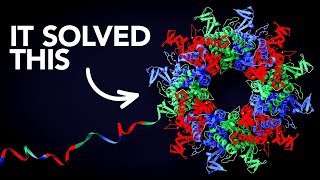

AlphaFold - The Most Useful Thing AI Has Ever Done
What if all of the world's biggest problems from climate change, to curing diseases, to disposal of plastic waste, what if they all had the same solution?
7 capitulos
- The Protein Folding ProblemThe ChallengeDetermining protein structure has been described as equivalent to Fermat's last theorem but for biology. It has been one of the biggest problems of the last century.How Proteins Work• Proteins start as strings of amino acids bonded together • Through electrostatic forces, hydrogen bonds, and solvent interactions, the string coils and folds into a 3D structure • This 3D shape determines the protein's specific function and purposeTraditional Methods• X-ray crystallography involves creating protein crystals and exposing them to x-rays • John Kendrew took 12 years to determine the first protein structure using whale meat to obtain large crystals • The process is expensive (tens of thousands of dollars per protein) and slowThe Scale ProblemOver six decades, tens of thousands of biologists determined the structure of only 150,000 proteins. Even a short 35-amino-acid protein chain can fold in astronomical ways that would take 200 times the age of the universe to compute through brute force.
- Early Attempts and CASP CompetitionWhy Prediction Failed• Evolution didn't design proteins from the ground up; they're complex and hard to describe • Proteins lack clear mathematical patterns beyond basic secondary structures like helices and sheets • Biochemists could not figure out reliable patterns for determining final protein structuresCASP InitiativeIn 1994, MIT professor John Moult started CASP (Critical Assessment of Protein Structure Prediction), a competition where teams designed computer models to predict protein structure from amino acid sequences. A perfect match scored 100, with anything above 90 considered solved.Early Algorithms• Rosetta, created by David Baker at University of Washington, was the early frontrunner • Baker innovated by pooling computing power from idle computers through Rosetta at Home software • He created the game Fold It, where gamers could manipulate proteins and solved an HIV enzyme structure in three weeksThe PlateauBy CASP 8, performance from top competitors including Rosetta had plateaued. Even with faster computers and more protein structures in databases, predictions weren't good enough to meet the threshold of 90.
- DeepMind and AlphaFold 1The VisionDemis Hassabis, a former child chess prodigy and Fold It player, founded DeepMind and started AlphaFold after AlphaGo beat world champion Lee Sedol at Go. He initiated the project to use AI to advance science and solve protein folding.Key Inputs• Amino acid sequences of proteins • Evolutionary tables showing how proteins are conserved across species • Co-evolution patterns that identify which amino acids are close to each other in final structuresHow It WorkedAlphaFold 1 was a standard deep neural network trained on protein structures from the protein data bank. Instead of directly producing 3D structure, it predicted a 2D pair representation showing distances and torsion angles between amino acids, which a separate algorithm then folded into the final structure.Initial ResultsAt CASP 13, AlphaFold 1 was the clear winner with a score of 70. However, this fell short of the CASP threshold of 90, requiring significant improvements.
- AlphaFold 2 Architecture and BreakthroughThree Key Elements• Maximum compute power from Google's tensor processing units • Large and diverse datasets (though data alone wasn't the bottleneck) • Better AI algorithms and machine learning approachesEVO Former Architecture• Used transformer architecture (the T in ChatGPT) with attention mechanisms • Contained two towers: biology tower for evolutionary information and geometry tower for pair representations • A bridge connected towers that conveyed biological and geometry clues back and forth • The system refined information 48 times until both towers were optimizedInnovative Mechanisms• Triangular attention applied triangle inequality to triplets of amino acids, constraining their distances • Structure module positioned each amino acid separately as a 'bag of amino acids' rather than enforcing chain constraints • The final 3D output was recycled at least three more times through the EVO Former for deeper understandingCASP 14 SuccessIn December 2020, AlphaFold 2 returned to CASP and achieved victory. For many proteins, predictions were virtually indistinguishable from actual structures, and it finally exceeded the gold standard score of 90.
- Real-World Impact and ApplicationsStructural Discoveries• Over six decades, scientists found about 150,000 protein structures • In one breakthrough, AlphaFold unveiled over 200 million protein structures • This covers nearly all proteins known to exist in nature • In just a few months, AlphaFold advanced research labs worldwide by several decadesMedical Breakthroughs• Directly helped develop a vaccine for malaria • Enabled breaking down of antibiotic resistance enzymes, making life-saving drugs effective again • Helped understand how protein mutations lead to diseases like schizophrenia and cancer • Biologists studying endangered species gained access to their proteins and life mechanismsRecognition and AwardsThe AlphaFold 2 paper has been cited over 30,000 times. John Jumper and Demis Hassabis were awarded one half of the 2024 Nobel Prize in chemistry for this breakthrough.Citation ImpactAlphaFold represented a true step function leap in understanding life, fundamentally advancing the field of structural biology.
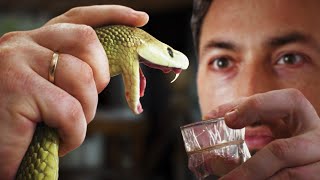
- Protein Design and Future PossibilitiesDesign InnovationDavid Baker received the other half of the 2024 Nobel Prize in chemistry, not for predicting structures with Rosetta, but for designing completely new proteins from scratch using generative AI techniques.RF Diffusion Method• Based on the same generative AI used in art programs like Dall-E • Trained by adding random noise to known protein structures and learning to remove the noise • Once trained, can produce brand new proteins for specified functions from random noise inputPractical Applications• Created human-compatible antibodies that can neutralize lethal snake venom, avoiding allergic reactions from traditional animal-derived antivenoms • Proteins in human clinical trials for cancer treatment • Working on autoimmune disease applications • Designing enzymes to capture greenhouse gases and break down plasticSpeed of InnovationResearchers can go from computer designs to amino acid sequences to actual proteins in just a couple of days, calling this approach 'Cowboy Biochemistry.' Speedups of 100,000x enable fundamentally different scientific approaches.
- Broader AI Impact on ScienceBeyond Proteins• In materials science, DeepMind's GNoME program found 2.2 million new crystals • Discovered over 400,000 stable materials that could power future technologies • Applications range from superconductors to batteriesFoundational ProblemsAI is solving fundamental problems that act as roots of knowledge trees. Unlocking solutions to these problems opens entirely new branches and avenues of discovery, enabling progress that was previously blocked.Transformative Scale• Speedups of 2x are nice but don't change fundamental approaches • Speedups of 100,000x enable scientists to rebuild their science around newly easy problems • This creates step function changes in science, not incremental improvementsFuture Potential• Even if AI doesn't advance beyond current capabilities, breakthroughs will provide benefits for decades • Potential includes curing all diseases, creating novel materials, and restoring the environment • Boundless possibilities exist as long as AI development remains aligned with human benefit