The Most Controversial Idea in Biology
If you want to know if someone really understands evolution, just ask them this one weird question.
11 capitulos
- Why Poop Smells Bad: Understanding Natural SelectionThe QuestionThe video opens with a deceptively simple question: why does poop smell bad? Most people assume it smells objectively bad, but this requires deeper understanding of evolutionary biology.Different Perspectives• Humans find poop smell repulsive because it contains life-threatening bacteria • Flies love the smell because poop is full of nutrients they use as food • The smell is a signal that differs based on which organism's perspective you takeEvolutionary LogicIf anyone ever thought poop smelled good, they would get sick, die, and not pass on their genes. Natural selection shaped our disgust response as a survival mechanism.Selection Unit QuestionThe answer leads to the central question: is natural selection about the survival of the fittest individual, the fittest species, or something else entirely?
- The Problem with Individual and Group SelectionObservable Altruism• Worker bees sting predators to protect the hive, even if it kills them • Female worker ants are sterile but work for the colony their entire lives • Monkeys adopt orphans, wolves bring meat to non-hunters, squirrels give alarm calls • These behaviors contradict the idea that natural selection favors selfish individualsWhy Not Groups?For natural selection to occur, you need replication, copying, and a pruning process. Groups and species don't typically make copies of themselves, so group selection doesn't work mechanistically.The ParadoxIf natural selection isn't about individual survival or group survival, what is it actually about? The answer requires understanding the deeper principles of replication and competition.Journey BeginsTo solve this mystery, the video takes viewers on a journey back to the earliest days of Earth to understand how the first replicators emerged and competed.
- The Origin of Replicators: Early Earth ChemistryPrimordial ConditionsIn early Earth's void, simple compounds like carbon dioxide and cyanide floated around. Energy from UV light or heat sources allowed these blobs to interact and combine into more complex compounds.Stability LawUnstable blobs fall apart and vanish. Stable ones endure. By random chance, some compound configurations became more stable than their components, and these persisted in greater numbers.First ReplicationOne unique shape developed a special property: it could attract similar blobs from the environment that snapped into position next to it. This spontaneous replication created the first replicator—one shape became two.Molecular PurposeThe replicator was a lifeless molecule with no intent or purpose. It only needed to form once before it could copy itself rapidly using available building blocks until it filled the void.
- Mutations and Competition: The Replicator Battle BeginsMutation OriginsDuring replication, errors occur when UV light hits the replicator or wrong building blocks are used. These mutations create slightly different shapes with different properties—harmful, beneficial, or neutral.Resource ScarcityAll replicators compete for limited resources. The void becomes a battleground where only the most efficient replicators survive. Traits that help with replication spread, while disadvantageous mutations decline.Evolutionary Pressure• Replicators with high replication rates have more copies • Those with low death rates persist longer • Those with low mutation rates produce faithful copies • The environment determines which combination winsEscalating ComplexitySome replicators mutate ways to attack competitors and use their building blocks. Others develop defensive barriers. This leads to increasingly complex structures and interactions over billions of years.
- From Molecules to Genes: Building Survival MachinesScaffolding DevelopmentReplicators build increasingly complex structures around themselves: propulsion mechanisms, energy storage systems, sensory organs, and ways to exchange and steal traits from each other.Indirect InteractionsOver billions of years, the replicator's interactions with the environment become extremely indirect. They construct complex survival machines whose sole purpose is to protect the replicators inside.Modern LifeThese survival machines became so expert at surviving that they exist 4 billion years later as bacteria, plants, fungi, and animals. Everything alive was built as a vessel for replicators, now called genes.Genetic CodeGenes are strands of DNA made from sequences of A, T, G, and C nucleotides. Early replicators likely were RNA molecules that evolved into the more stable DNA-protein system we use today.
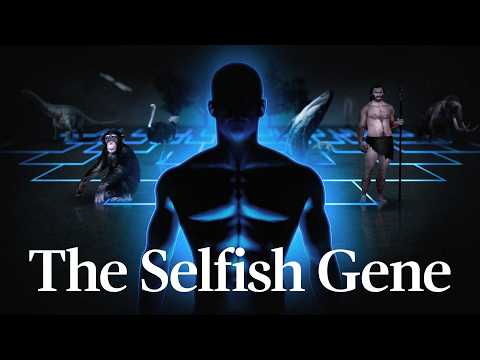
- The Gene-Centric View of EvolutionUnit of SelectionNatural selection works on genes, not individuals or groups. For something to undergo selection, it must: make near-identical copies, exhibit traits affecting environment interaction, and affect survival and reproduction probability.Why Genes?• Single nucleotides are too small to exhibit selectable traits • Chromosomes get shuffled during reproduction, so they don't stay intact • Genes are long enough to influence traits independently but short enough to be faithfully copied • Genes are the perfect unit for natural selectionSelfish Gene TheoryRichard Dawkins popularized this perspective through 'The Selfish Gene,' arguing that traits from altruism to selfishness are strategies that help genes survive and replicate, even at others' expense.Reframing EvolutionWe can view behaviors either as helping individuals or helping genes. The gene-centric perspective provides powerful insights: we are survival machines, programmed to preserve selfish molecules known as genes.
- Kin Selection: Why Relatives MatterShared GeneticsMost living things reproduce sexually. You share half your DNA with parents and children, one-quarter with grandparents and uncles, and so on. You share many genes with your immediate family.Alarm Call ExampleCalifornia ground squirrels give alarm calls when spotting predators, putting themselves at risk. If the call saves at least two relatives carrying the same genes, the genes have more copies surviving overall.Gene Benefit PrincipleFrom a gene's perspective, helping relatives can be worthwhile. It doesn't matter which individual carries the gene, only that as many copies as possible survive and replicate.Evidence in NatureMale squirrels that don't live near relatives almost never give warning calls. This demonstrates that kin selection depends on genetic relatedness—closer relatives increase the payoff of altruism.
- The Paradox of Sexual ReproductionThe ProblemSexual reproduction throws away roughly half of your genes, while asexual reproduction allows organisms to pass on all their genes. From a gene's perspective, asexual reproduction seems superior.Possible Explanations• Sexual reproduction creates genetic variation through gene shuffling, potentially advantageous • Genes that regulate sexual reproduction may benefit from replicating sexually • These genes may persist even if they're negative for other genes in the genomeUnresolved QuestionsWhy sexual reproduction evolved despite its genetic cost remains debated among evolutionary biologists. The gene-centric view raises this as a key question but doesn't fully resolve it.Gene-Level ConflictIf genes regulating sexual reproduction benefit from this strategy, they will keep promoting it, even if it's a net negative for all other genes in the genome.
- Criticisms of the Selfish Gene FrameworkGenetic Drift ProblemMany genes are invisible to natural selection because they don't exhibit meaningful traits. Yet they evolve over time through random sampling called genetic drift, not because they're selected for.Drift ExampleBlind cave fish with green or blue eyes show no survival difference. By pure chance, one eye color can eventually dominate the population across generations, despite having no selective advantage.Metaphor LimitationsThe word 'selfish' implies genes have agency, intent, and understanding—but it's just metaphor. Molecules don't decide or conspire; they react according to physics. What looks like intention is simple chemistry.Complexity Oversimplification• One gene influences many traits, one trait influenced by many genes • Genes contained within other genes exist • Genes inhibit or activate other genes • Non-coding DNA doesn't encode for anything • Environment affects gene expression significantly
- Defending Gene-Centric Selection Despite LimitationsMeasurable Effects MatterEven though genes are complicated and the pathways convoluted, if a gene has any measurable effect on its own survival and replication, it's subject to natural selection.Simplification NecessityAll theories and frameworks of nature are simplifications. The gene-centric view is simplified, but this doesn't diminish its power to help us understand evolution.Explanatory PowerThe gene perspective helps explain why we see such diverse behaviors in nature: traits increase the prevalence of associated genes. This lens reveals the fundamental truth of evolution.Baseline TruthWhether or not complete complexity is captured, thinking at the level of genes rather than individuals offers crucial insights. This gene-level perspective is the baseline truth of how evolution works.
- Reconciling Gene Control with Human AgencyThe Unsettling TruthThe idea that molecules deep in every cell drive our behavior and remove agency from us as thinking beings is fundamentally unsettling and seems grim to many people.Philosophical TensionWhile genes may control us and we may be flesh robots programmed by them, this framework doesn't align with how we actually perceive and navigate the world.Practical BalanceIt's unreasonable and unrealistic to go through life thinking every decision is governed by genes. This view doesn't benefit us practically because we perceive the world as individuals.Dual PerspectiveIt's beneficial to see yourself as your own thing, your own unit. We can hold both truths: genes drive evolution at a fundamental level, but humans operate meaningfully as individual agents.