The SAT Question Everyone Got Wrong
In 1982, there was one SAT question that every single student got wrong.
6 capitulos
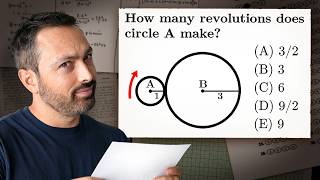
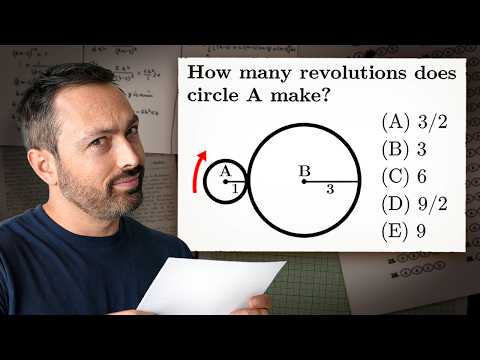
- The Famous SAT QuestionThe ProblemCircle A has a radius 1/3 that of circle B. Starting from a given position, circle A rolls around circle B. The question asks how many revolutions circle A completes to return to its starting point.Initial AnswerMost students, including the test writers, answered 3 because circle B's circumference is 3 times that of circle A, so logically it should take 3 rotations.The ErrorEvery single student got the question wrong in 1982 because the correct answer was not listed among the options A (3/2), B (3), C (6), D (9/2), or E (9).Student ResponseOnly 3 students out of 300,000 test takers—Shivan Kartha, Bruce Taub, and Doug Jungreis—wrote to the College Board to report the error with mathematical proof.
- The Coin Rotation ParadoxSimple DemonstrationTwo identical coins with the same circumference show the paradox: when one rolls around the other, it rotates twice, not once as expected.Visual ProofThe coin is right-side up at the halfway point, and after completing the circle, it has rotated twice despite the coins being identical in size.Paradox ExplanationThis is known as the coin rotation paradox—an object rolling around another completes one more rotation than intuitive logic suggests.Application to SATA to-scale model of the problem shows circle A rotates 4 times total as it rolls around circle B, making the correct answer 4.
- Understanding the Extra RotationThe Ribbon MethodUnwrapping circle B's circumference into a straight line shows circle A rotates 3 times rolling along that line. The circular path itself adds one more rotation.General SolutionFind the ratio between the circumferences of the two circles, then add one rotation to account for the circular path traveled.Alternative PerspectiveFrom the perspective of circle B looking outward, circle A rotates exactly 3 times. The 4th rotation only appears to external observers watching the circular path.Definition AmbiguityIf using the astronomical definition of revolution as a complete orbit, circle A only revolves once. This ambiguous wording allows for multiple valid interpretations.
- Mathematical Proof and PrinciplesCore PrincipleThe distance traveled by a circle's center equals the total rotation of the circle when rolling without slipping. In this problem, the center travels a circle of radius 4, covering distance 8π, resulting in 4 rotations.General Formula• Rolling around a shape: total rotations = (perimeter + circumference) ÷ circumference = N + 1 • Rolling inside a shape: total rotations = (perimeter - circumference) ÷ circumference = N - 1 • Rolling along a flat line: total rotations = length ÷ circumference = NProof MethodUsing reference frame analysis: a camera following the circle's center sees rolling without slipping. The center's velocity equals the rotational speed, so distance traveled must equal rotation amount.Universal ApplicationThis principle applies to circles rolling on any surface—polygons, blobs, inside or outside—making it fundamental to understanding rolling motion.
- Real-World Application in AstronomyThe Sidereal YearWhile we count 365.24 days per year on Earth, an external observer counts 366.24 days—the extra day accounts for Earth's one additional rotation around the Sun.Solar vs Sidereal DayA solar day (24 hours) is when the Sun returns directly overhead. A sidereal day (23 hours, 56 minutes, 4 seconds) is when a distant star returns directly overhead, excluding the orbital motion effect.Divergence Throughout YearSolar and sidereal days slowly diverge. After six months, sidereal time is 12 hours ahead, and after a full year, it's one complete day ahead.Practical Uses• Astronomers use sidereal time with telescopes to observe the same region of space each night • Geostationary satellites use sidereal time to keep orbits locked with Earth's rotation • Solar time is used on Earth because sidereal time would cause day and night to swap after six months
- Consequences and LegacyScore ImpactWith question 17 scrapped, rescored students' results moved 10 points out of 800. This 10-point shift could affect university admissions and scholarships with strict cutoff scores.Financial CostAccording to the testing service, rescoring cost over $100,000, money that came from the pockets of test takers.SAT Relevance TodayAfter COVID-19, nearly 80% of undergraduate colleges in the US no longer require standardized testing, making the SAT slowly become a thing of the past.Student SuccessOne of the three students who reported the error, Shivan Kartha, scored an 800 on the math SAT and went on to pursue mathematics through competitions and problem-solving.