
On These Math Problems, Smarter People Do Worse
8 capitulos
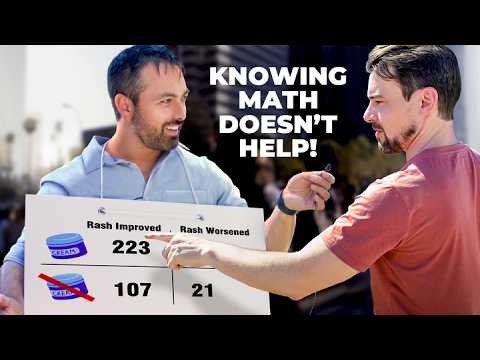
- The Skin Cream Study IntroductionResearch OverviewA research paper demonstrates that smarter people are more likely to get certain types of problems wrong, contradicting the expectation that intelligence improves accuracy.Study Setup• Participants assigned to experimental group using new cream for two weeks • Control group received no cream for the same period • Results tracked rash improvements and worsening in each groupInitial QuestionParticipants asked whether the skin cream made rashes better or worse based on numerical data presented in a table.Intuitive vs. Logical Answer• Intuitive answer: cream worked because more people improved in the cream group • Logical answer: proportional reasoning shows cream group had 3:1 improvement ratio while control group had 5:1 ratio, indicating cream actually made rashes worse
- Numeracy and Accuracy CorrelationStudy MethodologyDan Kahan recruited 1,111 Americans with diverse backgrounds and assessed their numeracy through a series of questions before presenting the skin cream problem.Numeracy DefinitionNumeracy is the capacity to reason well about quantitative information, not just the ability to use complicated mathematics.Expected ResultsHigher numeracy scores correlated with higher accuracy rates on the skin cream question, following the logical mathematical pattern.Key Finding• People with better numeracy skills successfully avoided the intuitively correct but mathematically wrong answer • Those with lower numeracy were more likely to fall for the intuitive trap
- Political Context and Bias IntroductionApolitical BaselineWhen the same proportional reasoning problem used skin cream data, both liberal Democrats and conservative Republicans showed identical performance patterns regardless of political affiliation.Political Problem Setup• Researchers replaced skin cream study with fictional gun control study • Democrats generally believe gun control reduces crime • Republicans believe gun control increases crime by disarming law-abiding citizensGun Control Study DesignCities divided into two groups: those with concealed handgun carry restrictions and those without, tracking crime rate changes over one year with identical data structure to skin cream study.Different Results PatternUnlike the skin cream study, results by political affiliation showed dramatically different performance, indicating that political beliefs influence reasoning about the same data.
- Numeracy Polarization EffectRepublican Response Pattern• When gun control data showed crime increased, numeracy improved accuracy as expected • When gun control data showed crime decreased, numeracy provided no accuracy benefitDemocratic Response Pattern• More numerate people easily recognized correct answers showing gun control reduced crime • When data showed gun control increased crime, numeracy ceased to help with accuracyCritical DiscoveryThe biggest performance drop occurred among the most numerate people when data contradicted their political ideology, showing 45 percentage points accuracy reduction compared to 25 points for low numeracy individuals.Selective Application of SkillsRather than using mathematical ability to reach correct conclusions, highly numerate people selectively applied their skills to justify beliefs they already held beforehand.
- Broader Polarization PatternsAcross Multiple Issues• Gun control regulation: polarization increases with numeracy • Fracking: same effect observed • Global warming: same polarization patternOther Cognitive Measures• High science literacy shows more polarization than low science literacy • High actively open-minded thinking shows more polarization than low • Higher proficiency in analytical thinking correlates with increased polarizationStreet InterviewsParticipants demonstrated tribal reasoning patterns, with one claiming the numbers show a pretty even playing field on gun control despite clear mathematical implications in the data.Rationality IllusionEveryone believes they are rational and could change their beliefs based on evidence, but their actual performance demonstrates they interpret data through the lens of pre-existing political beliefs.
- The Tribal Nature of BeliefEvolutionary Foundation• Humans are highly social creatures who have depended on each other for survival throughout evolution • Being ostracized from the group is psychologically almost as bad as walking off a cliffBelief Formation TruthPeople mostly believe what they believe to fit in with their tribe rather than through independent consideration of facts, which is highly rational from an evolutionary perspective.Social ConsequencesQuestioning the status quo by rejecting what those around us accept as true jeopardizes our place in society, creating incentive to maintain tribal beliefs even in face of contradictory evidence.Surprising Similarities• When people attend meetings with opposing political parties, they discover both sides sound remarkably similar • Greater cooperation could lead to extraordinary achievements if tribal thinking burdens were removed
- Solutions and RecommendationsAvoiding Partisan Language• Skip loaded terms like gun control or climate change • Focus on specific local policies instead • Avoid buzzwords that trigger tribal thinking and villainizing opposing sidesReal-World ExampleSoutheast Florida demonstrates bipartisan cooperation on sea-level rise without debating whether climate change is manmade, instead addressing existing challenges residents face.Fostering CuriosityScience-curious people are more willing to examine all evidence, including information inconsistent with their political ideology, unlike those who simply gain comprehension without curiosity.Key Insight• Increasing science comprehension usually brings increasing polarization • Increasing science curiosity does not produce the same polarization effect • Personal accountability through awareness of own biases is an important first step
- Ground News Sponsorship and ConclusionsEcho Chamber ProblemGround News tackles polarization and information echo chambers by gathering news sources from around the world in one location and showing their political leanings.Practical Example• FBI violent crime statistics: left-leaning outlets focused on 3% drop, right-leaning sources referenced different DOJ survey data • Key difference: DOJ survey couldn't include fatal crimes while FBI statistics did, explaining the apparent disagreementBias Recognition ToolsGround News provides News Bias dashboard to track personal blind spots and biases, enabling viewers to identify and correct their own potential biases through data-driven insights.Final Message• Most people's beliefs are not formed by careful consideration of data, including the speaker and viewers • Acknowledging this truth about human cognition and tribal bias is an important first step toward improvement