

How Electricity Actually Works
I made a video about a gigantic circuit with light-second long wires that connect up to a light bulb, which is just one meter away from the battery and switch
15 capitulos
- Clarifying the MisconceptionPrevious ResponseDerek's original answer was that light would appear in 1/c seconds in a circuit with light-second long wires, which generated significant criticism from viewersCommon Objections• Critics argued this would enable faster-than-light communication and violate causality • Some found the explanation misleading or unclear • The response generated widespread debate and confusionExperimental SetupA scaled-down 10-meter model was built at Caltech with oscilloscopes to measure voltage changes in the first 30 nanoseconds, with help from Richard Abbott who works on LIGOCore QuestionTesting whether significant voltage and current would appear across a resistor (representing the light bulb) when a pulse is applied at a distance
- Electron Energy Transport MisconceptionCommon BeliefMany people think electrons carry energy directly from the battery to the bulb where they dissipate their kinetic energy as heatActual Mechanism• Electrons move through the wire at very high random speeds (around 1 million meters per second) but have low average drift velocity (less than 0.1 mm/s) • Electrons collide with metal ions in the lattice and transfer kinetic energy, causing the lattice to heat up • The energy that accelerates electrons comes from the electric field, not from the battery directlyKey InsightIf a circuit has only been on briefly, electrons haven't even reached the battery yet, so they couldn't have carried energy from itEnergy SourceThe electric field in the wire accelerates electrons between collisions, and it is the field that carries energy, not the electrons themselves
- Electric Field Generation in CircuitsElectron Repulsion MythThe common misconception that electrons push each other through the circuit via mutual repulsion is incorrect; electrons don't push each otherCharge Neutrality• The charge density inside a conductor averages to zero when considering a few atoms • Negative electron charges perfectly cancel with positive atomic cores • Repulsive forces between electrons are balanced by opposite forces from positive ionsBattery Field LimitationThe electric field doesn't come entirely from the battery because the battery's field is strongest near itself; if it were the main field, moving a bulb closer to the battery would make it glow brighter, which doesn't happenSurface Charge DistributionThe electric field in wires is created by both battery charges and charges that build up on the wire surfaces, with a gradient from excess electrons on the negative side to a deficiency on the positive side
- Surface Charges and Circuit EquilibriumCharge Distribution• Starting with excess electrons on the negative terminal wire surface • Roughly zero charge in the middle section • Steepest charge gradient across the load • Deficiency of electrons (positive cores) on the positive terminal surfaceField CreationAll surface charges together with battery charges create the electric field inside wires and in the space around the wiresSetup Speed• Surface charges establish almost instantaneously when battery is connected (limited only by speed of light) • Only a slight expansion or contraction of the electron sea is needed (electrons moving by the radius of a proton) • This creates the necessary surface charge distribution very quicklyMaintenance ProcessThe battery continuously performs work to maintain the surface charge distribution by moving electrons through itself against the Coulomb force
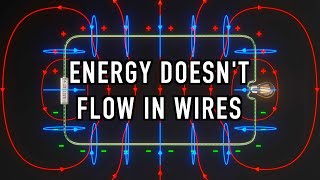
- Visual Simulation of Circuit FieldsSimulation Tools• VPython simulation from Matter and Interactions shows positive charges in red and negative charges in blue • Ben Watson used Ansys HFSS software to solve Maxwell's equations in three dimensions • Simulations visualize how charge distribution creates uniform electric field along the wireField MagnitudeInside the wire, the electric field has the same magnitude everywhere and points along the wire directionResistor Effect• A narrower wire section represents a resistor • Due to smaller cross-sectional area, electrons must move faster (higher drift velocity) to carry the same current • This requires a stronger electric field, achieved by steeper surface charge gradientsField Contributions• Far from battery: field is mostly from surface charges • Near battery: battery field has greater contribution • Surface charge field can point opposite to battery field near the battery
- Circuit Behavior SummaryKey Principles• Electrons don't carry energy from battery to bulb • Electrons don't push each other through the wire • Electrons are pushed by an electric field created by charges on the battery and wire surfacesField as ActorFields extend throughout the circuit and are the main actors, while electrons are guided by these fields like pawnsEnergy Flow Insights• Electrons leave the battery at the same rate they return, so they don't carry energy • Electric field accelerates electrons before each collision • At junctions, electrons are guided by the field throughout the circuitPractical ApplicationThese principles explain how circuits work but are often omitted from textbooks in favor of simpler voltage and current concepts
- The Big Circuit ProblemInitial State• When battery connects with switch open: excess electrons on negative side surface, deficiency on positive side surface • Surface charges rearrange until electric field is zero everywhere inside the conductor • Full potential difference of battery appears across the switchSwitch Closure• Surface charges on both sides of switch neutralize each other on contact • Electric field inside conductor is no longer zero • Current starts flowing through the switchField PropagationNew electric field from modified surface charges radiates outward at the speed of light, reaching the bulb in 1 meter/c secondsTiming• The bulb lights up in one meter divided by c seconds • Time depends on distance between switch and bulb • Change in electric field travels at speed of light
- Maxwell Equations and SimulationsSimulation Results• Electric field radiates out when switch closes • As field hits far wire, it generates current • Magnetic field appears around far wire as current flowsEnergy TransportThe simulation shows that it is the electric field, not the changing magnetic field, that creates current through the loadCausality ExplanationConnected and disconnected wires behave identically at first because both respond to the changing electric fieldKey FindingMy answer doesn't break causality because connected and disconnected wires show virtually identical response to the changing electric field initially
- Poynting Vector and Energy FlowEnergy CarrierThe Poynting vector (cross product of electric and magnetic fields) shows that energy is carried by fields, not electronsGap Crossing• Energy can travel straight across the gap between wires whether connected or not • Poynting vector points from battery across the gap to the other wire • This demonstrates that wires aren't strictly necessary for energy transferWireless Applications• Phones and toothbrushes charge without wires connecting to electron streams • Researchers demonstrated remote charging using WiFi signals • Fields enable wireless energy transferWire EfficiencyWires are useful because they channel the fields and energy from source to load, making the process more efficient
- Lumped Element ModelSimplification StrategyScientists and engineers use shortcuts instead of solving Maxwell's equations; Ohm's law is a macroscopic result of all microscopic interactionsElement Representation• Lumped element model combines spread-out multi-particle and field interactions into discrete circuit elements • Complex physics becomes simple quantities like current and voltage • Resistors represent all the interactions of surface charges and electron collisionsCircuit Diagram LimitationThe original big circuit diagram is flawed because fields between wires are important to the problem but aren't shown as circuit elementsImproved Model• Add capacitors down the wires to capture effects of charges on one wire inducing charges on the other • Add inductors to model magnetic fields that resist current changes • This creates a distributed element model showing a transmission line
- Transmission Line AnalysisCapacitor Behavior• When voltage first applied to capacitor, current flows as opposite charges build up on plates • In short time limit, capacitor acts as a short circuit like a wire • Once charged, no more current flows but next capacitor begins chargingField ExpansionCurrent loop expands outward at roughly the speed of light as each capacitor charges, representing the electric field effect from bottom to top wireCharacteristic Impedance• Defined as the square root of inductance divided by capacitance • Represents resistance to alternating current a source sees when sending signals down wires • For the circuit: measured capacitance and inductance calculated impedance of about 550 OhmsPower OptimizationTo maximize power delivered to load, its resistance should equal the sum of other impedances in the circuit; a 1.1 kilo-Ohm resistor was chosen for this experiment
- Experimental MeasurementVoltage DetectionWithin just a few nanoseconds after applying a pulse, voltage rises to around 4 volts across the resistorCurrent CalculationWith a 1.1 kilo-Ohm resistor, 4 volts corresponds to about 4 milliamps of current flowing before the signal completes the circuitPower TransferAbout 14 milliwatts of power were transferred to the load, which is visible light when using an LEDVerification• YouTuber Alpha Phoenix set up a kilometer of wire and got similar results • ZY simulated the transmission line circuit and found 12 milliwatts transferred with realistic assumptions • Multiple independent confirmations of the phenomenon
- Validation and ResponseConsensus AchievedEveryone agrees that a steady, small but significant signal flows through the load in the first second after switch closes, far exceeding leakage currentThought Experiment PurposeThe experiment was designed to reveal something normally hidden by conventional circuit thinking: that fields, not electrons, are the main actors carrying energyExpert PerspectiveRick Hartley, a veteran PCB designer, confirms that energy in circuits exists in fields, not in voltage and currentField ImportanceWhen routing circuit traces, defining the other side of the transmission line is critical because undefined fields spread out and cause problems
- Reflection and Community ResponseAcknowledgmentDerek acknowledges the original explanation could have been deeper and didn't fully address the core physics of the problemPositive Outcome• The incomplete explanation invited many electrical engineers to create response videos • YouTubers like Alpha Phoenix conducted their own experiments • Multiple quality explanations emerged from the communityCommunity ValueDespite the initial shortcoming, the resulting discussions and alternative explanations provide value and demonstrate how the community engages with complex conceptsLearning ResourceDerek recommends watching response videos from electrical engineering YouTubers to see different perspectives on how they think about and explain circuits
- Brilliant SponsorshipCourse OfferingBrilliant offers a course on electricity and magnetism that methodically introduces E&M through questions, simulations, videos, and experimentsLearning Method• Difficulty builds gradually through well-thought-out sequences • Interactive approach forces you to check understanding at each step • Hints and explanations provided when neededKey StrengthBrilliant's interactivity sets it apart, allowing you to actively learn calculus, machine learning, and computer science fundamentalsSpecial OfferFirst 200 people signing up through the link receive 20% off an annual premium subscription