The Big Misconception About Electricity
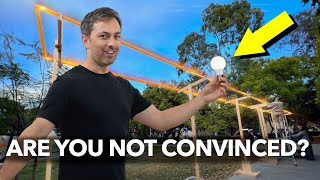
Imagine you have a giant circuit consisting of a battery, a switch, a light bulb, and two wires which are each 300,000 kilometers long.
7 capitulos
- The Thought ExperimentSetupA circuit with a battery, switch, light bulb, and two wires each 300,000 kilometers long (distance light travels in one second), reaching halfway to the moon and back, with the bulb only one meter away.The QuestionAfter closing the switch, how long would it take for the bulb to light up: half a second, one second, two seconds, 1/c seconds, or none of the above?Key Assumptions• Wires have no resistance • Light bulb turns on immediately when current passes through itConnection to RealityThis question relates to how electrical energy travels from power plants to homes.
- The Conventional ExplanationAC vs DCIn the electrical grid, electricity comes as alternating current (AC), meaning electrons in power lines just wiggle back and forth and never actually go anywhere.The Tube AnalogyPower lines are compared to flexible plastic tubing with electrons like a chain; power stations push and pull electrons back and forth 60 times per second.Energy DeliveryWhen you plug in a device like a toaster, electrons flow through it, encounter resistance in the element, and dissipate energy as heat.The Problem• No continuous conducting wire runs from power station to home • Physical gaps exist like in transformers • Electrons flow both ways but energy only goes one direction • If electrons carry energy away, they should carry it back
- Maxwell and Electromagnetic FieldsThe BreakthroughIn the 1860s-70s, Scottish physicist James Clerk Maxwell discovered that light is made up of oscillating electric and magnetic fields perpendicular to each other and in phase.Maxwell's EquationsMaxwell derived equations governing the behavior of electric and magnetic fields and the waves they create.Energy ConservationIn 1883, John Henry Poynting, one of Maxwell's former students, applied energy conservation principles to trace how energy flows through space using these fields.The Poynting Vector• Describes energy flux: how much electromagnetic energy passes through an area per second • Formula: S = (1/μ₀) × E × B • E × B is the cross product of electric and magnetic fields • Direction found using right-hand rule: fingers point with electric field, curl toward magnetic field, thumb points in energy direction
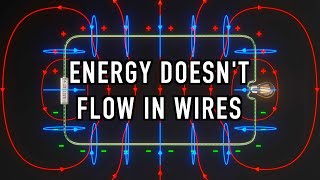
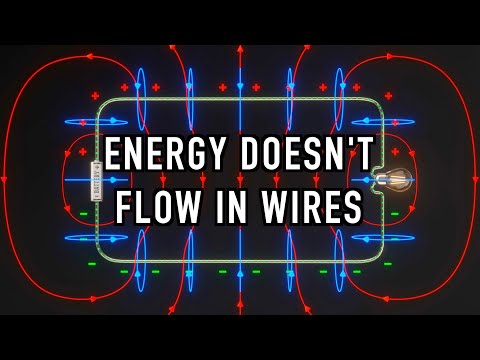
- Energy Flow in CircuitsDC Circuit AnalysisWhen a battery connects to a circuit, its electric field extends through the circuit at the speed of light, pushing electrons to accumulate on conductor surfaces creating surface charges.Field Creation• Surface charges create a small electric field inside the wires • This causes electrons to drift preferentially in one direction at extremely slow speed (around one-tenth of a millimeter per second) • Current inside wires creates a magnetic field outside the wiresEnergy PathUsing the Poynting vector, energy flows radially outward from the battery through surrounding fields, along the wires, and into the light bulb from all directions around it.Key Insight• Energy is transmitted by electric and magnetic fields, not by electrons • Even though electrons travel both directions, energy flux only goes one way • This explains why energy flows one direction in AC circuits despite electrons oscillating back and forth
- AC Power DeliveryAC BehaviorWith alternating current, the direction of current reverses every half cycle, but both electric and magnetic fields flip at the same time.Consistent Energy FlowAt any instant, the Poynting vector still points in the same direction from source to bulb, so the same analysis for DC applies to AC.Power Grid RealityInside power line wires, electrons oscillate back and forth but do not carry energy. Outside the wires, oscillating electric and magnetic fields travel from the power station to homes.Practical ImportanceThis understanding is not just academic; it was proven essential when submarine telegraph cables were laid across the Atlantic.
- Historical EvidenceThe First CableThe first Trans-Atlantic cable was laid in 1858 but only worked for about a month with enormous signal distortion.The ProblemSending signals over long distances under the sea caused pulses to become distorted and lengthened, making it hard to differentiate dots from dashes.Scientific Debate• William Thomson (future Lord Kelvin) thought signals moved like water through a rubber tube • Heaviside and Fitzgerald argued energy and information were carried by fields around wires • The field-based view proved correctThe SolutionThe iron sheath added to insulate the cable interfered with electromagnetic field propagation by increasing capacitance. Modern power lines are suspended high up with large air gaps to separate wires from ground, which acts as a conductor.
- The Answer RevealedThe AnswerAfter closing the switch, the light bulb will turn on almost instantaneously in roughly 1/c seconds, making D the correct answer.Why Not the Wire?Many people imagine the electric field must travel down the light-second-long wire, taking about one second. However, what happens around the wires matters more than what happens inside them.The Real PathElectric and magnetic fields propagate out through space to the one-meter-distant light bulb in just a few nanoseconds, which is the limiting factor for the bulb turning on.Technical DetailsThe bulb won't receive the entire battery voltage immediately but rather a fraction depending on the impedance of the lines and the bulb. Expert analysis confirmed these main points with variations in detailed calculations.