Éviter, réduire, compenser (ERC) : comment construire en préservant mieux l’environnement ?
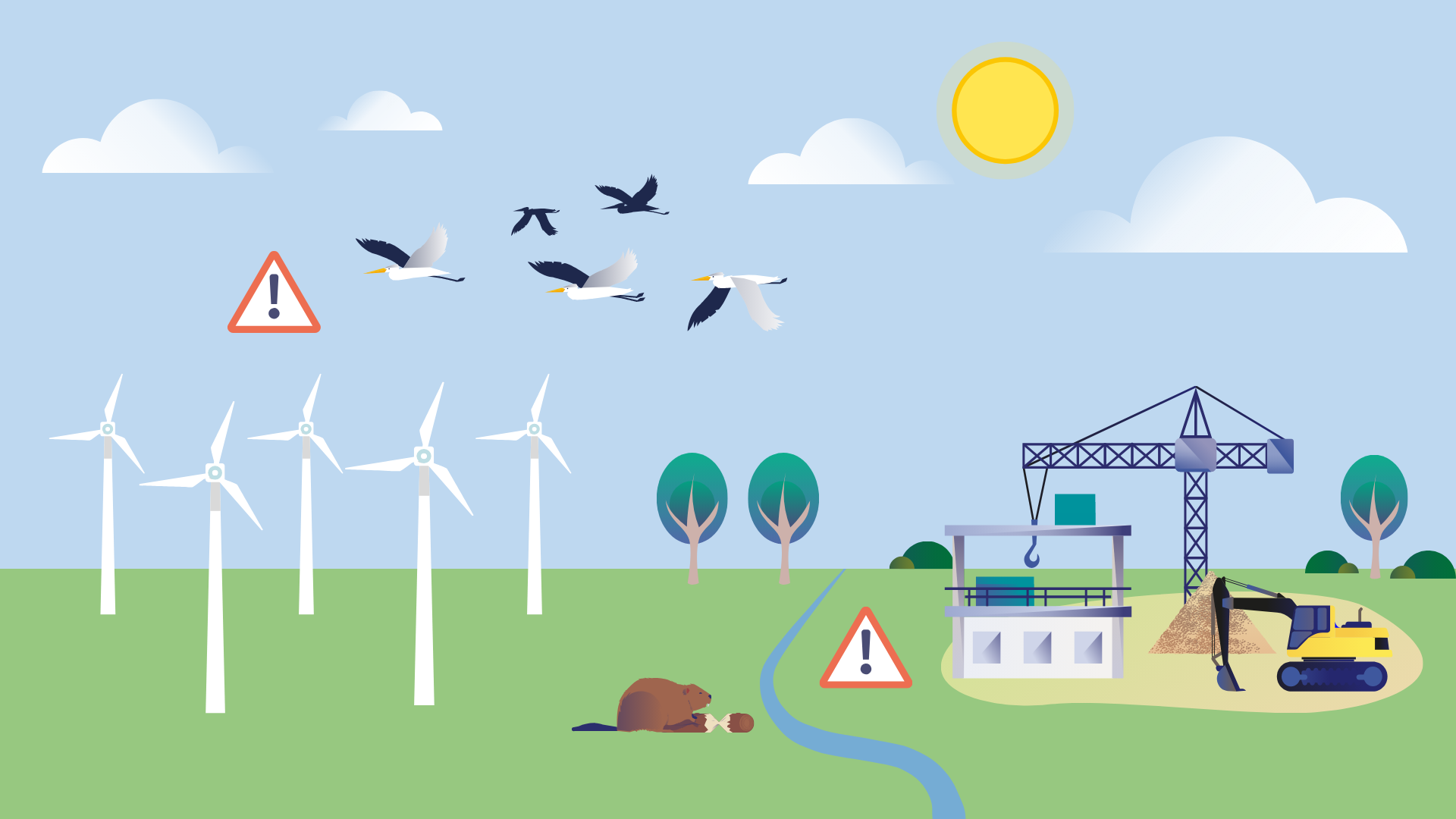
Les projets d’aménagement et de construction peuvent avoir des conséquences négatives sur l’environnement. Par exemple : la destruction d’un milieu naturel, l’artificialisation des sols, des pollutions ou des nuisances sonores. Pour améliorer ces projets et répondre aux obligations de l’évaluation environnementale, il faut éviter, réduire et compenser les conséquences négatives : c’est la démarche dite « ERC ».
Development and construction projects can have negative consequences for the environment. For example: destruction of a natural habitat, soil artificialisation, pollution, or noise pollution. To improve these projects and meet environmental assessment obligations, negative consequences must be avoided, reduced, and compensated: this is the so-called "ARC" approach.
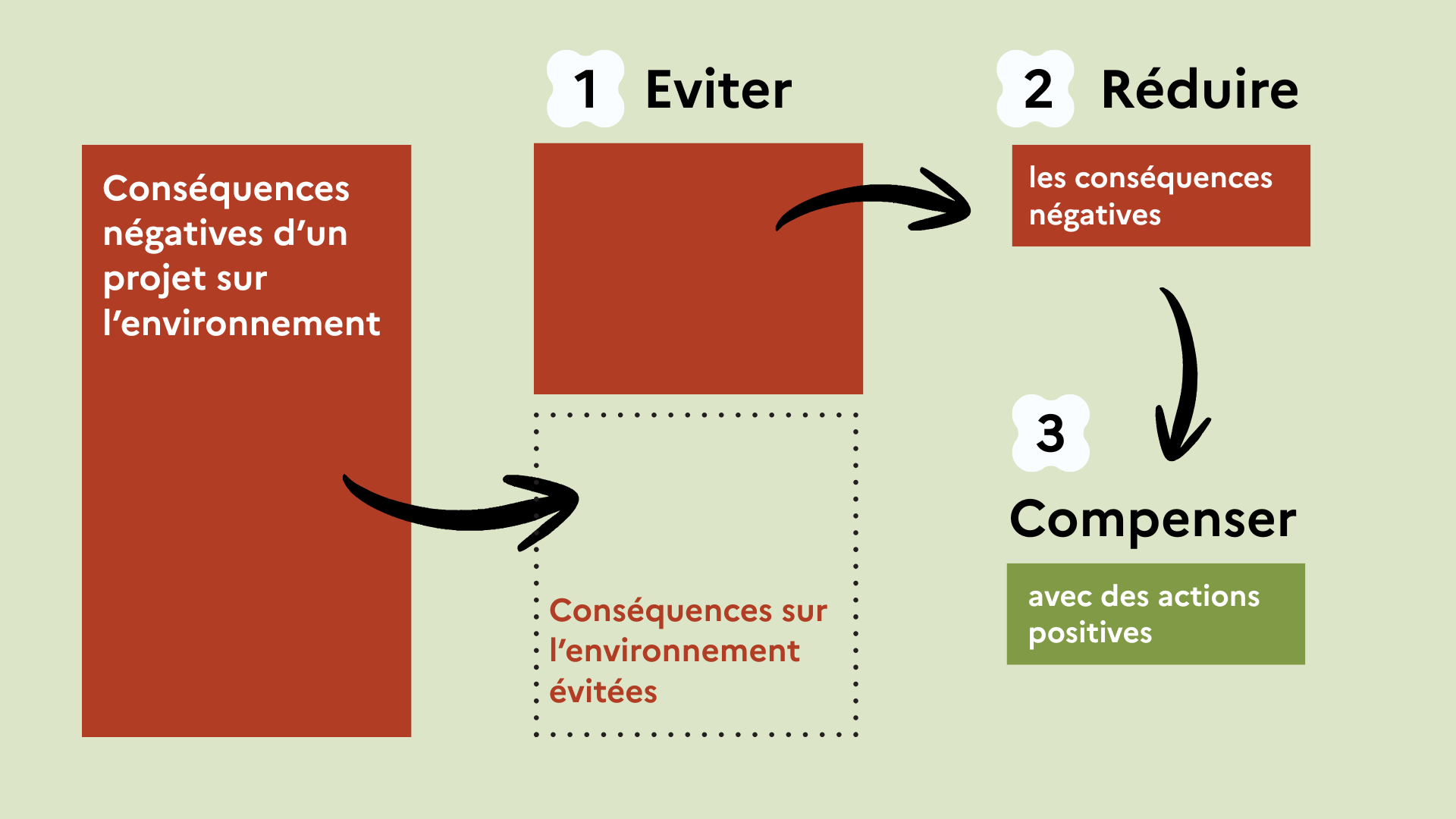
- The "avoid, reduce, compensate" approach (ARC): what is it?Objective• The objective of the "avoid, reduce, compensate" approach is to make development and construction projects more respectful of the environment. For example, building a road can lead to the destruction of certain ecosystems and the severing of ecological corridors—natural spaces connected to one another that allow species to move around. Traffic on a new road can also cause air quality degradation and increased noise pollution nearby.Three steps• According to the ARC approach, the priority is to find solutions to avoid negative impacts. Next, negative impacts that could not be avoided must be reduced. The goal is to modify the project so that harmful effects are less significant or last shorter. However, some negative consequences of a project cannot be avoided or sufficiently reduced. They must then be compensated by a positive action for the environment. • The ARC approach encompasses all aspects of the environment: biodiversity, air pollution, water and soil management, noise, and public health.Where ARC applies• The "avoid, reduce, compensate" approach applies to projects, plans, and programs that require environmental assessment. In the Environmental Code, a project corresponds to the execution of works, for example in a natural environment: such as the construction of a road or a factory. Plans and programs are planning documents decided by the State, regions, departments, or municipalities. They allow objectives to be set for land use planning or water management, for example.
- Examples of solutions to avoid, reduce, and compensateAvoiding harm• The best way to preserve natural environments is to completely avoid negative consequences of projects on the environment. There are several solutions for this. For example, select the location where your project will have the least impact. Between a wetland that shelters rare species and a site that is already relatively poor in biodiversity, it is better to build on the site. Another example: building a road through a forest means destroying part of that forest. To avoid this, it is sometimes possible to modify the road's route to bypass the woods. • There are also technical solutions to avoid certain negative consequences, such as the release of toxic substances into nature. For example, construction equipment can have oil leaks that seep into soils and pollute them. Using a protective sheet covering the ground can limit this risk. • Avoidance measures are taken in response to a negative effect identified during environmental assessment, in the impact study. They correspond to the best possible compromise while considering different environmental and feasibility issues.Reducing harm• When environmental damage cannot be fully avoided at reasonable cost, the remaining negative effects must be reduced. • For example, a project requiring the destruction of hedgerows or trees can negatively impact biodiversity. However, it is possible to reduce this impact by carrying out work in winter rather than spring, to avoid destroying bird nests. Another example: building a railway can generate noise pollution, but it is possible to reduce it by installing sound barriers or vegetation between the railway and homes. • Finally, when constructing a new residential area, streetlights should be chosen that illuminate downward, not skyward, to limit the effects of light pollution on bats or nocturnal butterflies, for example.
- Compensation measuresCompensation principle• As a last resort, when it has not been possible to avoid or sufficiently reduce certain negative consequences, they must be compensated with a counterpart for the environment. This can be an action favorable to biodiversity, such as renaturalizing an industrial brownfield. • For example, if a company must destroy a pond to build its factory, it can compensate by creating another pond nearby. However, it is sometimes difficult to relocate species from one place to another, or to know if they will survive in a different location.Ecological equivalence• To compensate for negative impacts, it is important to consider ecological equivalence. For example, planting a tree today will not replace the destruction of a century-old tree: it will take decades before the young sapling reaches maturity. Mature trees play an important ecological role: they provide food, pollen, and habitat for biodiversity, they regulate air quality, and their roots help maintain and structure soils. Trees also help cool cities in summer through evapotranspiration, absorption of sun rays, and shade from foliage.Legal principlesThe compensation principles to be followed are defined in the Environmental Code. In particular, measures must be near the damaged site and must last as long as the negative consequences they compensate.
- What laws govern the "avoid, reduce, compensate" approach (ARC)?Origins of ARC• The "avoid, reduce, compensate" approach is set out in the Environmental Code within the chapter dedicated to environmental assessment. It was introduced 50 years ago in French law, in 1976 by the law on the protection of nature. This law made environmental assessment mandatory for projects that risk degrading nature.The 2016 law and principles• The ARC approach was then consolidated and clarified in August 2016 by the law on the recovery of biodiversity, nature, and landscapes. Articles 2 and 69 of this law incorporated the ARC approach principles into the Environmental Code: • the ARC approach is defined with an order of priority: avoid, then reduce, then compensate. (L. 110-1); • the objective must be to cause no net loss of biodiversity, or even to promote a gain in biodiversity. (L. 110-1); • it must be possible to prove that compensation measures are truly beneficial for biodiversity. (L. 163-1); • compensation measures must last at least as long as the negative consequences they compensate. (L. 163-1); • compensation measures must be implemented near the damaged site. (L. 163-1); • compensation measures must be geolocated and described in a manner accessible to the public. (L. 163-5); • the project cannot be authorized if the negative consequences are not avoided, reduced, or compensated satisfactorily. (L. 163-1).
Further reading
- L’évaluation environnementalenotre-environnement.gouv.fr
L’évaluation environnementale vise à réduire l’impact négatif des projets, plans et programmes sur l’environnement.
- projets-environnement.gouv.fr, site de consultation des études d’impact environnementalesprojets-environnement.gouv.fr
La plateforme projets-environnement.gouv.fr a pour objectif de rendre accessibles au public les études d’impact des projets qui risquent d’avoir des conséquences importantes sur l’environnement.
- Guide pour l’élaboration d’un site naturel de compensationecologie.gouv.fr
Guide – Commissariat général au développement durable - Service de l’économie verte et solidaire – Janvier 2023
- Guide d’aide à la définition des mesures ERCecologie.gouv.fr
Théma Balises, Commissariat général au développement durable, janvier 2018
- Guide d’aide au suivi des mesures d’évitement, de réduction et de compensation des impacts d’un projet sur les milieux naturelsecologique-solidaire.gouv.fr
Les cahiers de biodiv, Mission économie de la biodiversité, Avril 2019
- Fiches sur l’évaluation environnementale des documents d’urbanismeecologie.gouv.fr
Théma Balises, Commissariat général au développement durable, Novembre 2019
- Guide pour la mise en œuvre de l’évitement – Concilier environnement et aménagement des territoiresecologie.gouv.fr
Guide, Commissariat au dévéloppement durable, Mai 2021
- Approche standardisée du dimensionnement de la compensation écologique – Guide de mise en œuvreecologie.gouv.fr
Guide, Commissariat général au développement durable, Mai 2021