L’évaluation environnementale
Construire une autoroute, un immeuble ou un parc éolien : les projets de construction et d’aménagement ont des conséquences sur l’environnement. Face au changement climatique, la perte de biodiversité et l’épuisement des ressources, il est nécessaire d’anticiper cet impact pour concevoir des projets plus respectueux de l’environnement. L’évaluation environnementale est un outil qui permet de guider cette démarche.
Building a highway, an office building or a wind farm: construction and development projects have consequences for the environment. Facing climate change, biodiversity loss and resource depletion, it is necessary to anticipate this impact to design more environmentally friendly projects. Environmental assessment is a tool that helps guide this approach.
- Environmental assessment to anticipate project consequencesWhat is environmental assessment?• Environmental assessment aims to reduce the negative impact of projects on the environment. The goal is to improve the project by asking at each stage of its implementation: what are the negative consequences for the environment? And how can we avoid them? • Environmental assessment must consider the environment as a whole: biodiversity, climate, water, air, soil, landscape, human health, and cultural heritage. Construction and development projects can have negative effects on all these elements. For example, destroying natural habitats to build a highway can threaten protected species. Some projects generate waste or cause air, water, or soil pollution. Noise pollution and visual pollution must also be considered.Origins of environmental assessment• The law of July 10, 1976 was a turning point for nature protection in France. It defines key principles: biodiversity protection is in the general interest and everyone has a duty to preserve natural heritage. Since this law, it has been mandatory to study the consequences of projects that risk having a negative impact on the environment. This obligation was extended in the 2000s to plans and programs with regional or national scope. • What is the difference between a project, a plan, or a program? In the environmental code, a project corresponds to the implementation of work in a natural environment: for example, the construction of a road or factory. Plans and programs are planning documents decided by the State, regions, departments, or municipalities. They allow setting objectives for land planning or water management, for example.
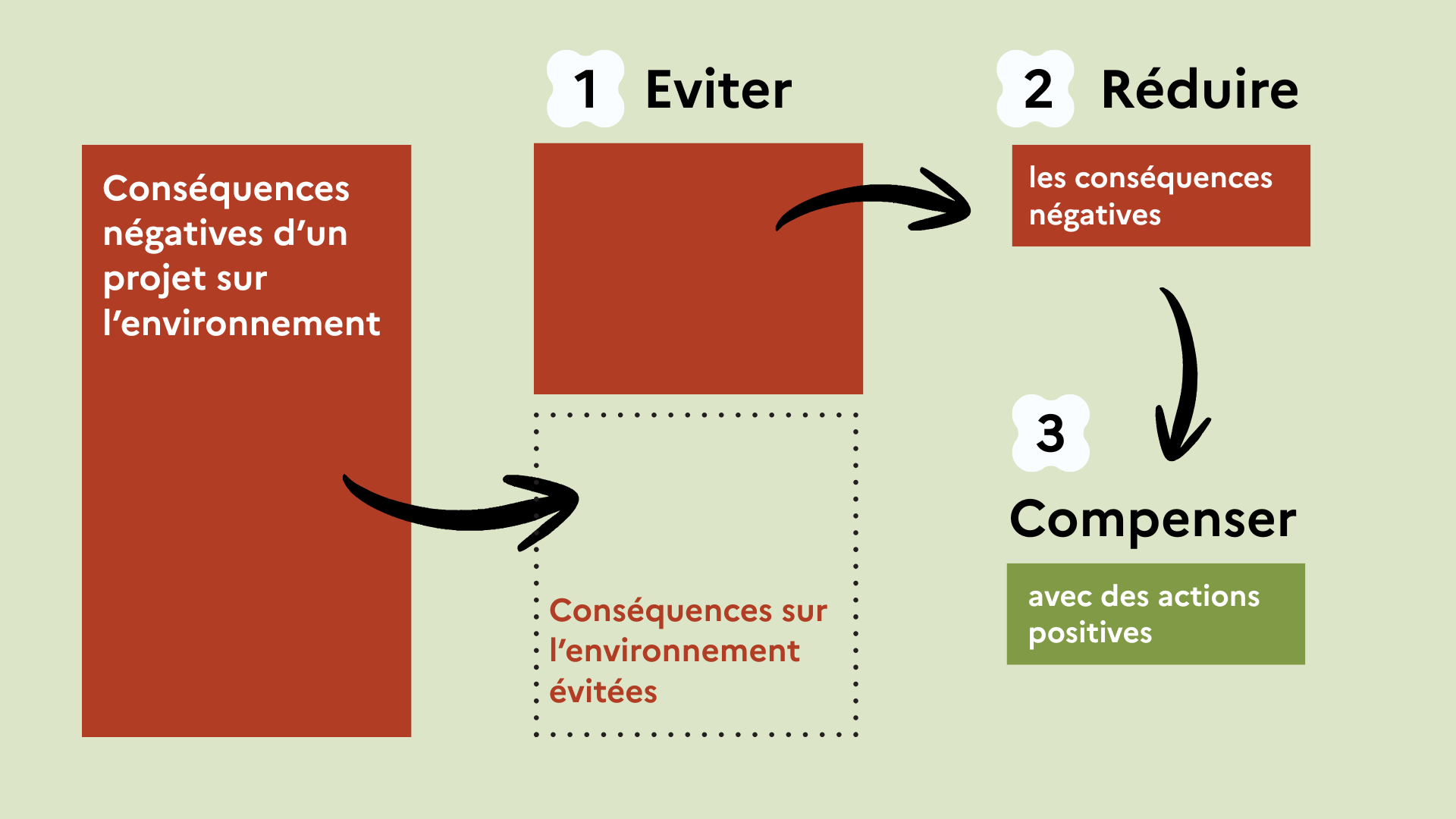
- Avoid, reduce, or offset negative impactsPrioritize avoidanceThe goal of environmental assessment is to make the project more environmentally friendly. To do this, priority must be given to finding solutions to avoid negative impacts. Next, the project proponent must seek solutions to reduce negative impacts that could not be avoided. The aim is to modify the project so that harmful effects are less significant or last shorter.The ERC strategySome negative impacts cannot be avoided or sufficiently reduced. They must then be offset by positive action for the environment. Avoid, reduce, offset: this is what we call the ERC strategy.
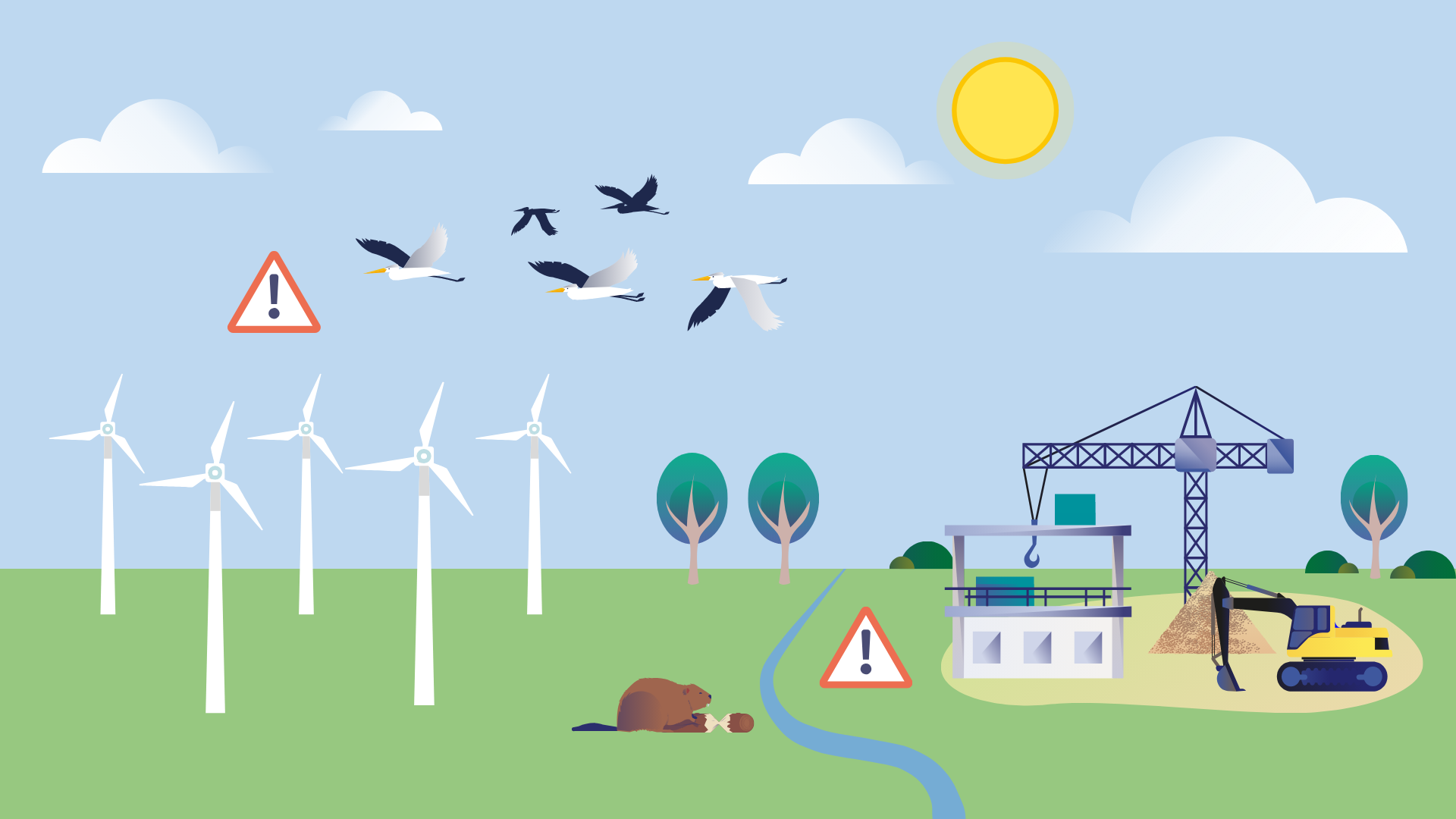
- How environmental assessment worksEarly and comprehensive approach• The environmental assessment process must begin as early as possible in project design. For example: a company wishing to build a wind farm must first find the right location for its project. Wind turbines can be dangerous for birds: it is therefore necessary to avoid choosing land where there are many birds. • Environmental assessment must include all work necessary to carry out the project. For example: a company has decided to build a stadium. To do this, it will also need to cut down trees on the site and build a road for access to the stadium. All these actions must be taken into account in the environmental assessment. • The environmental assessment process consists of four main steps:Impact assessment• The first step for the project proponent is to write a report that evaluates the consequences of their project on the environment: this is what we call an impact assessment. The project proponent is legally responsible for taking the environment into account in developing their project. In the case of a plan or program, we no longer speak of impact assessment, but of incidence report. • What is a project proponent? The project proponent is a person or group of people (such as a company) who originates the project and is responsible for implementing it.Environmental authority opinion• An environmental authority then issues an opinion on the impact assessment or incidence report. This opinion should inform the public about the quality of the impact assessment and how the environment is considered in the project. The environmental authority has two months to issue its opinion on an impact assessment, three months on an incidence report. • Who are the environmental authorities? The role of environmental authority is fulfilled by different entities depending on the projects, plans and programs. • The national environmental authority, called "Ae" for large projects such as building a high-speed rail line or a highway. It is composed of members of the General Inspectorate for the Environment and Sustainable Development (IGEDD). • The regional environmental authority missions, called "MRAe" for local plans, programs and projects. They consist of IGEDD members and benefit from support from the DREAL (regional departments for the environment, planning and housing). • The environmental authority called "AE Minister", ensured by the Ministry of Ecological Transition, for projects carried out by other ministries and their public institutions.Consultation phase• The consultation phase is necessary so that the public, stakeholders and affected territorial authorities can give their opinion on the project, plan or program. It can be carried out through public meetings, online consultations, working groups, or other participation mechanisms. • Cross-border consultations are sometimes necessary: for example, an environmental assessment was conducted on the European cooperation program Interreg between Spain, Andorra and France.Project authorizationThe project, plan or program is then examined by a competent authority (a local government or state agency), which takes into account the opinions expressed during the consultation phase. This competent authority decides whether or not to authorize the project. Its decision must be reasoned and justified, and it can prescribe measures that the project proponent must comply with.
- When must environmental assessment be conducted?Systematically required projectsFor certain types of projects, environmental assessment is always mandatory. These are projects that generally have significant negative consequences: for example, highway construction or offshore wind farms.Case-by-case examination• For other types of projects, the environmental consequences are not necessarily as large. This will depend on the project, its location and its size. For example, environmental consequences must be assessed to build an amusement park in a natural area with protected species. To determine whether environmental assessment is mandatory, a request for case-by-case examination must be made. • The same reasoning applies to plans and programs: some are automatically subject to environmental assessment while others make a case-by-case examination request.Learn more• To learn more about the environmental assessment process: • Step-by-step environmental assessment approach • Public Business Services Platform
Further reading
- Éviter, réduire, compenser (ERC) : en quoi consiste cette démarche ?notre-environnement.gouv.fr
Pour répondre à l’évaluation environnementale, il faut éviter, réduire, et compenser les effets négatifs des projets sur l’environnement : c’est la démarche ERC.
- L’évaluation environnementale et la demande d’examen au cas par casecologie.gouv.fr
Article - Ministère de la Transition écologique et de la Cohésion des territoires - Avril 2019.
- Le principe de proportionnalité dans l’évaluation environnementaleerc-hdf.fr
Théma essentiel - Commissariat général au développement durable (CGDD) - Août 2019.