La pollution de l’air extérieur
Nous respirons chaque jour 15.000 litres d’air, soit la contenance d’une piscine de jardin. Il contient surtout du de l’azote et de l’oxygène (99 %). Cet air comporte aussi des gaz ou des particules polluantes en très faibles proportions (0,05 % en moyenne) mais qui peuvent avoir un impact très important sur la santé et sur l’environnement. Cette pollution de l’air extérieur est produite par les activités humaines, comme l’industrie et les transports, mais aussi par des sources naturelles (volcans, brumes de sable, etc.). La qualité de l’air s’améliore en France depuis 20 ans. Toutefois, la pollution atmosphérique reste le principal risque environnemental pour la santé. Des mesures plus ambitieuses sont donc nécessaires. Quelles sont les substances polluant l’atmosphère ? Quels sont leurs conséquences ? Comment évoluent-elles ?
We breathe 15,000 liters of air every day, the equivalent of a garden pool. It contains mostly nitrogen and oxygen (99%). This air also contains polluting gases or particles in very small proportions (0.05% on average) but which can have a very significant impact on health and the environment. This outdoor air pollution is produced by human activities, such as industry and transport, but also by natural sources (volcanoes, sand haze, etc.). Air quality has been improving in France for 20 years. However, atmospheric pollution remains the leading environmental risk to health. Therefore, more ambitious measures are necessary. What substances pollute the atmosphere? What are their consequences? How are they evolving?
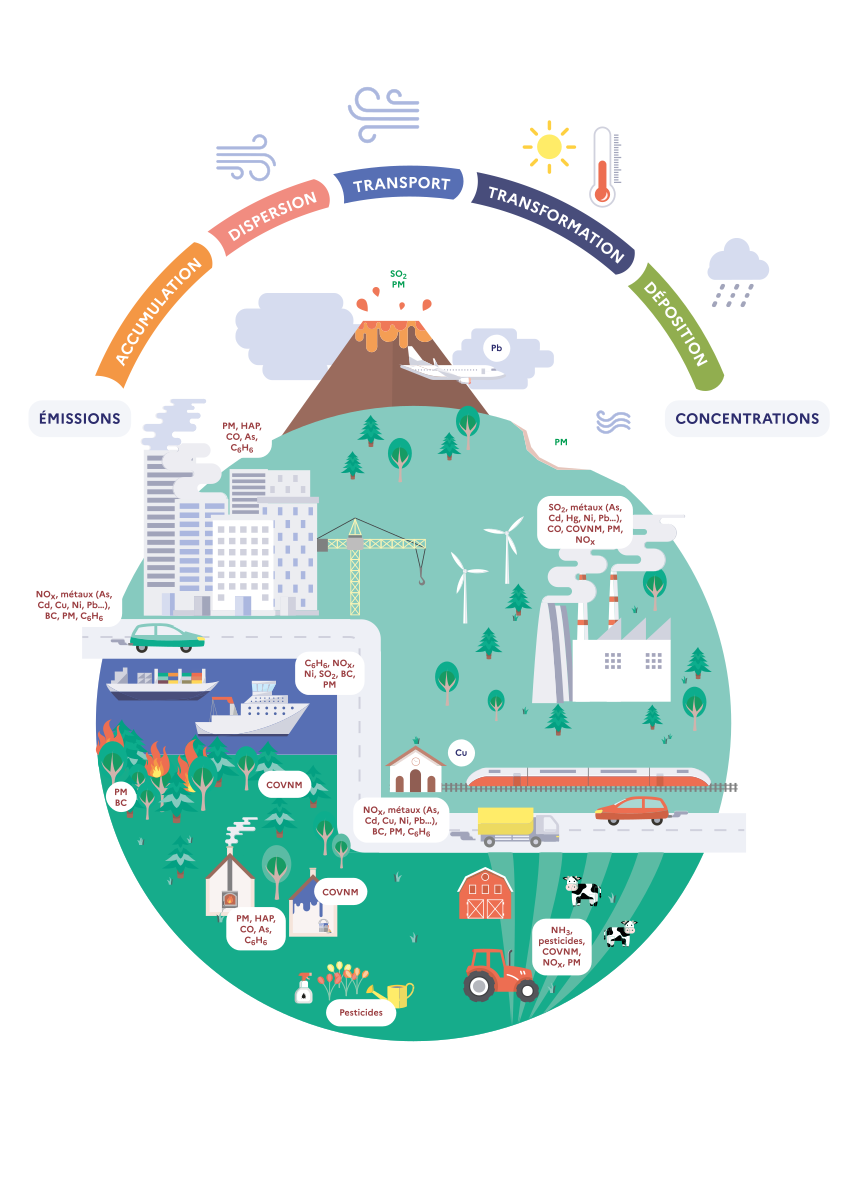
- What pollutants are present in the atmosphere?Primary and secondary pollutants• Air is polluted when its natural composition is altered by substances that have negative effects on human health and the environment. • There are so-called "primary" pollutants that are emitted directly into the air by natural phenomena or human activities, and "secondary" pollutants resulting from chemical reactions of one or more primary pollutants. • When pollutants end up in the air, they can be transported by winds over varying distances. Thus, it is common to observe the arrival of polluted air masses from other countries.Primary pollutants• The main primary pollutants are: • nitrogen monoxide (NO), emitted by heating, vehicle engines, industries, fertilizers and by natural elements such as volcanoes, lightning and dry natural soils; • sulfur dioxide (SO2), emitted by the combustion of fossil fuels, industry and naturally by volcanoes; • carbon monoxide (CO), emitted by the combustion of wood, gasoline or fuel oil, which accumulates due to poor ventilation in enclosed spaces (traffic jams in tunnels, idling engines in parking lots, residential buildings…) and poor evacuation of combustion products; • heavy metals, naturally present in the Earth's crust and released into the air by activities such as mining and lead combustion, and by natural phenomena such as erosion and wildfires; • volatile organic compounds (VOCs), emitted 90% by natural elements but whose concentration can increase in urban areas due to wood combustion and automobile exhaust gases; • polycyclic aromatic hydrocarbons (PAHs), resulting from incomplete combustion, the use of solvents, degreasers and automobile tank and tanker filling products; • primary particles emitted by industry, transport and agriculture as well as certain natural phenomena such as soil erosion, pollen and biomass fires; • ammonia is a gas essentially linked to agricultural activities, resulting from spreading.Secondary pollutants• The main secondary pollutants are: • ozone, a gas naturally present in the upper atmosphere and forming the "ozone layer" which protects terrestrial life from the sun's ultraviolet rays. In the lower layers of the atmosphere, it is created by the effects of solar radiation with certain primary pollutants (benzene, nitrogen oxide…); • nitrogen dioxide, resulting from the contact of nitrogen monoxide with air. • Secondary particles, formed in the atmosphere following reactions that may include sulfur dioxide, nitrogen oxides or volatile organic compounds, or primary particles.
- What are the consequences of pollutants in the air?Health consequences• Over the period 2016-2019, Public Health France estimates that each year nearly 40,000 deaths are attributable to exposure of people aged 30 and over to fine particles. • Prolonged exposure to these two pollutants is estimated to have caused each year up to 40,000 new cases of respiratory diseases in children and up to 78,000 new cases in adults (asthma, cardiovascular disease, diabetes). The study emphasizes that if pollution levels respected the recommendations of the World Health Organization (WHO), 75% of diseases related to fine particles and 50% of those related to nitrogen dioxide could be avoided. For example, nearly 30,000 cases of asthma in newborns and young people up to 17 years could be prevented each year. • There are first immediate effects, after short-term exposure. This can manifest through irritation of the eyes or respiratory tract, asthma attacks, worsening of cardiovascular and respiratory disorders that can lead to hospitalization, and in the most severe cases to death. • Long-term effects are also observed, after lifelong exposure. Air pollutants cause excess mortality and a reduction in life expectancy. They can contribute to the development or aggravation of chronic diseases such as cancers, cardiovascular and respiratory pathologies, neurological disorders or developmental disorders. • It is long-term exposure that leads to the most significant health consequences. • Air pollution has particularly significant consequences for vulnerable or sensitive people such as children, the elderly, smokers, people with heart or lung disease or asthmatic people. • To understand the consequences of each pollutant on human health:Environmental consequences• The high concentration of certain pollutants has serious consequences on nature and soils. • Excessive inputs of nutrients lead to proliferation of vegetation or algae and thus depletion of oxygen, which is called eutrophication. Persistent pollutants contaminate plants, animals and soils. High concentration of sulfur dioxide in contact with other pollutants leads to acidification of water and soils. • > Acid pollution is the deposition on the ground of acidic compounds under the effect of winds and rain. It can alter the chemical balances of natural environments such as rivers, lakes, soils and forests.Building consequencesPolluted air can also create problems on buildings such as soiling and deterioration of facade materials in stone, cement, glass and even old stained glass. This can have very significant costs for society.Economic consequences• According to a study by Public Health France, exposure of the French population to ambient air pollution has a very significant negative economic impact. It is estimated at 12.9 billion euros for fine particles, or almost 200 euros per year per resident, and at 3.8 billion euros for nitrogen dioxide, or 59 euros per year per resident. • Agriculture is the source of certain pollutants but it is also a victim of air pollution with a reduction in the quantity and quality of its products. • > What are the differences between air pollutants and greenhouse gases? > Air pollutants have local consequences on health and the environment. Greenhouse gases act on the climate across the entire planet. > However, the two are linked because the substances involved have common origins such as industry, transport or fossil fuels. • Some air pollutants can act on climate, such as ozone or particles, and climate change can worsen ozone pollution due to increased temperatures and heat waves.Real national decrease in air pollutants• For several years, action plans in different activity sectors have been implemented to combat outdoor air pollution. As a result, human activities have generally emitted less polluting gas and particles and air quality has improved between 2000 and 2022. • Sulfur dioxide concentration has decreased by 85% since 2000. Sulfur dioxide emissions are primarily due to industry. This sharp decline is explained by the regulation of industrial emissions, the sulfur content of fuels and combustibles and improved industrial efficiency. The development of renewable energies and energy conservation efforts also contributed to this decrease. • Nitrogen dioxide concentration has decreased. In urban areas it dropped from 29 to 13 micrograms per cubic meter. Near urban traffic, concentration fell by half over the period, from 53 to 24 micrograms per cubic meter. It remains twice as high as in urban areas because the majority of emissions come from internal combustion vehicle engines. Technical advances in road transport have greatly helped reduce nitrogen dioxide emissions. • All activity sectors have made progress in reducing their particle emissions. Fine particle concentrations in cities have decreased by half. The closure of open and underground mining operations and improved performance of biomass combustion installations, for example, allowed this reduction. • Ammonia emissions, coming mainly from agriculture, decreased by only 19%. • Ozone is the only atmospheric pollutant whose concentration continues to increase. Between 2000 and 2023, ozone concentrations have risen in cities. They are 44 micrograms per cubic meter in 2000 and 55 micrograms per cubic meter in 2019 and 2023, exceeding the regulatory limit. Ozone emissions are favored by heat, particularly during heat waves made more frequent by accelerated climate warming. • For detailed data on the evolution of pollutant presence:Uneven regional air quality improvement• Air quality has generally improved since 2000 in France. However, pollution peaks that exceed regulatory limits are still observed in certain areas and during certain periods. • In 2023, high concentrations of sulfur dioxide were measured on certain days near industries, ports and airports, mainly in the regions of Le Havre, Bordeaux, Saint-Nazaire and in Réunion following volcanic activity. • Nitrogen dioxide emissions, originating mainly from road traffic and industrial activities, exceeded the regulatory standard in 2023 in three metropolitan areas: Lyon, Paris and Montpellier. However, these exceedances and the number of exposed people have decreased significantly since 2018. • Ozone concentrations are rising in France, but especially in the South-East. Ozone emission is more significant during summer and heat waves. Over the period 2019-2023, the Auvergne-Rhône-Alpes, Grand Est, Occitanie and Provence-Alpes-Côte d'Azur regions are most affected by exceedances followed by Bourgogne-Franche-Comté and Île-de-France. Fine particle peaks are recorded in most major metropolitan areas because they are mainly emitted by wood heating and road traffic. These peaks have sometimes broader consequences in certain highly industrialized regions with intense traffic such as Auvergne-Rhône-Alpes, Grand Est, Hauts-de-France, Île-de-France, Normandy and Provence-Alpes-Côte d'Azur.National pollution episodes• France regularly experiences pollution episodes that affect the entire country. • A pollution peak or episode is defined by an excessively high amount of one or more pollutants in the air, which can pose a short-term risk to health and the environment. They then exceed regulatory thresholds and are considered national in scale when they extend over three or more regions and last two consecutive days or more. • The year 2023 was marked by two national ozone pollution episodes during summer. The first occurred on June 14 and 15 and particularly affected Île-de-France and Centre-Val de Loire. The second was observed on September 6 and 7 during the early September heat wave mainly in Île-de-France, Centre-Val de Loire and Normandy. In February, March and early September, three national-scale fine particle pollution episodes were observed in metropolitan France. The Caribbean islands and French Guiana regularly face pollution episodes due to inputs of desert and volcanic dust. • > Learn more about the complete assessment of outdoor air quality in France in 2022: > - Status of outdoor air quality in France in 2022 > - Ozone pollution: still a concerning situation despite progress > - Emissions of pollutants into the air: supplementary results from the assessment of outdoor air quality in France in 2022 > - Levels of pollutants in the air: detailed data from the assessment of outdoor air quality in France in 2022 > - Emissions and concentrations of pollutants in the air in Europe between 2000 and 2022 • > Learn more about the air quality monitoring system in France
Further reading
- La pollution de l’air extérieur et ses effets sur la santénotre-environnement.gouv.fr
Les polluants dans l’air, particules fines, oxyde d’azote, ozone, benzène, dioxyde de souffre, HAP, métaux lourds ont des effets néfastes pour la santé humaine.
- Les niveaux de polluants dans l’air : données détaillées du bilan de la qualité de l’air extérieur en France en 2022statistiques.developpement-durable.gouv.fr
- Bilan de la qualité de l’air extérieur en France en 2023statistiques.developpement-durable.gouv.fr
Bilan, Service des données et études statistiques, octobre 2024
- La pollution de l’air en dix questionslibrairie.ademe.fr
Publication de l'ADEME (Agence de la transition écologique).
- Les polluants de l’air : situation, impacts et encadrementecologie.gouv.fr
Ministère de la Transition écologique et de la Cohésion des territoires.
- Bilan de la qualité de l’air extérieur en France en 2022statistiques.developpement-durable.gouv.fr
Datalab - Service des données et études statistiques - Décembre 2023
- Infographie : indicateurs clés de la qualité de l’air en France – Données 2022statistiques.developpement-durable.gouv.fr
Infographie - Service des données et études statistiques - Octobre 2023
- Bilan de la qualité de l’air extérieur en France en 2021notre-environnement.gouv.fr
Datalab - Service des données et études statistiques - Octobre 2022
- Bilan de la qualité de l’air extérieur en France en 2020notre-environnement.gouv.fr
Collection Datalab - Commissariat général au développement durable - Octobre 2021
- Pollution à l’ozone : une situation encore préoccupante malgré des progrèsnotre-environnement.gouv.fr
Datalab, Service des données et études statistiques, Juillet 2022
- Les mégafeux menacent-ils la reconstitution de la couche d’ozone ?notre-environnement.gouv.fr
Grâce au Protocole de Montréal adopté en 1987, la couche d’ozone, qui protège la vie sur Terre, a commencé à se reconstituer depuis l’an 2000. Mais les mégafeux, de plus en plus fréquents, risquent de ralentir cette reconstitution.
- Programme des Nations unies pour l’environnement - La pollution de l’airunep.org
Plateforme de l'ONU fournissant des informations et solutions pour lutter contre la pollution de l'air.
- Zero pollution monitoring and outlook 2025eea.europa.eu
Rapport de l’Agence européenne pour l’environnement (AEE) et de la Commission européenne.
- Un air surveillénotre-environnement.gouv.fr
En France, la surveillance de la qualité de l'air est obligatoire depuis 1996. Le ministère du Développement durable définit les réglementations relatives aux polluants atmosphériques et met en œuvre cette surveillance conformément aux dispositions européennes.
- La qualité de l’air en France en 2021 : l’essentiel en infographienotre-environnement.gouv.fr
Infographie - Service des données et études statistiques - Octobre 2022
- Les polluants atmosphériquesnotre-environnement.gouv.fr
Aujourd'hui, les polluants atmosphériques sont nombreux dans notre environnement. Trois sont particulièrement problématiques en raison du dépassement récurrent des normes de qualité de l'air.
- La vallée de l’Arve protège son atmosphèrenotre-environnement.gouv.fr
La vallée de l'Arve, en Haute-Savoie, est particulièrement sensible à la pollution atmosphérique. L’exposition de la population y est renforcée par la concentration des activités humaines et pas la situation en zone de montagne.
- Les émissions liées au transportnotre-environnement.gouv.fr
Le secteur des transports est responsable à lui seul de la majeure partie des émissions d'oxyde d'azote (NOx) et d'un quart des émissions de particules PM2,5.
- Les émissions du secteur résidentielnotre-environnement.gouv.fr
Le secteur domestique est la première source d'émissions de composés organiques volatils non méthaniques (CO'nM) et de particules PM10 et PM2,5.
- Les émissions dans le secteur agricolenotre-environnement.gouv.fr
Le secteur agricole est la principale source d'émission d'ammoniac (NH3), en partie responsables des épisodes de pollution aux particules qui surviennent au printemps.
- La qualité de l’air en directnotre-environnement.gouv.fr
Outil de visualisation des données de qualité de l'air extérieur issues des dispositifs de surveillance de la qualité de l'air en région.
- La qualité de l’air racontée par la modélisationnotre-environnement.gouv.fr
Lutter contre la pollution de l’air, c’est d’abord être en mesure de comprendre comment les pollutions naissent et comment elles évoluent dans le temps, dans l’espace, tant à des échelles locales qu’internationales. Grâce au modèle Chimère, l’Ineris présente ici de nouvelles représentations de la pollution de l’air. Ces simulations, effectuées dans le cadre du Grand Challenge du Centre de Calcul Recherche et Technologie (CCRT) couvrent l’ensemble de l’hémisphère nord avec une précision inégalée d’une dizaine de kilomètres de résolution.
- De l’Air dans nos idées reçues : L’air intérieurnotre-environnement.gouv.fr
La maison comme les autres environnements clos (logements, bureaux, magasins, ...) contiennent des polluants spécifiques de l'air intérieur auxquels viennent s'ajouter des polluants provenant de l'air extérieur. Avec environ 80 % de notre temps passé dans des environnements clos, la qualité de l'air est devenue une préoccupation majeure de santé publique.
- Bilan de la qualité de l’air extérieur en France en 2019notre-environnement.gouv.fr
En 2019, la France a émis près de deux fois moins de particules qu'en 2000. Cette amélioration globale de la qualité de l'air est une bonne nouvelle mais la situation n'est pas encore pleinement satisfaisante. Faisons le point en vidéo !