Les bruits et les nuisances sonores
Les sources de bruit sont multiples : le bruit de voisinage et des activités, le bruit des transports. Les pollutions sonores sont une forte préoccupation pour beaucoup de Françaises et de Français.
Noise sources are varied: neighbor noise and activities, transportation noise. Noise pollution is a major concern for many French women and men.
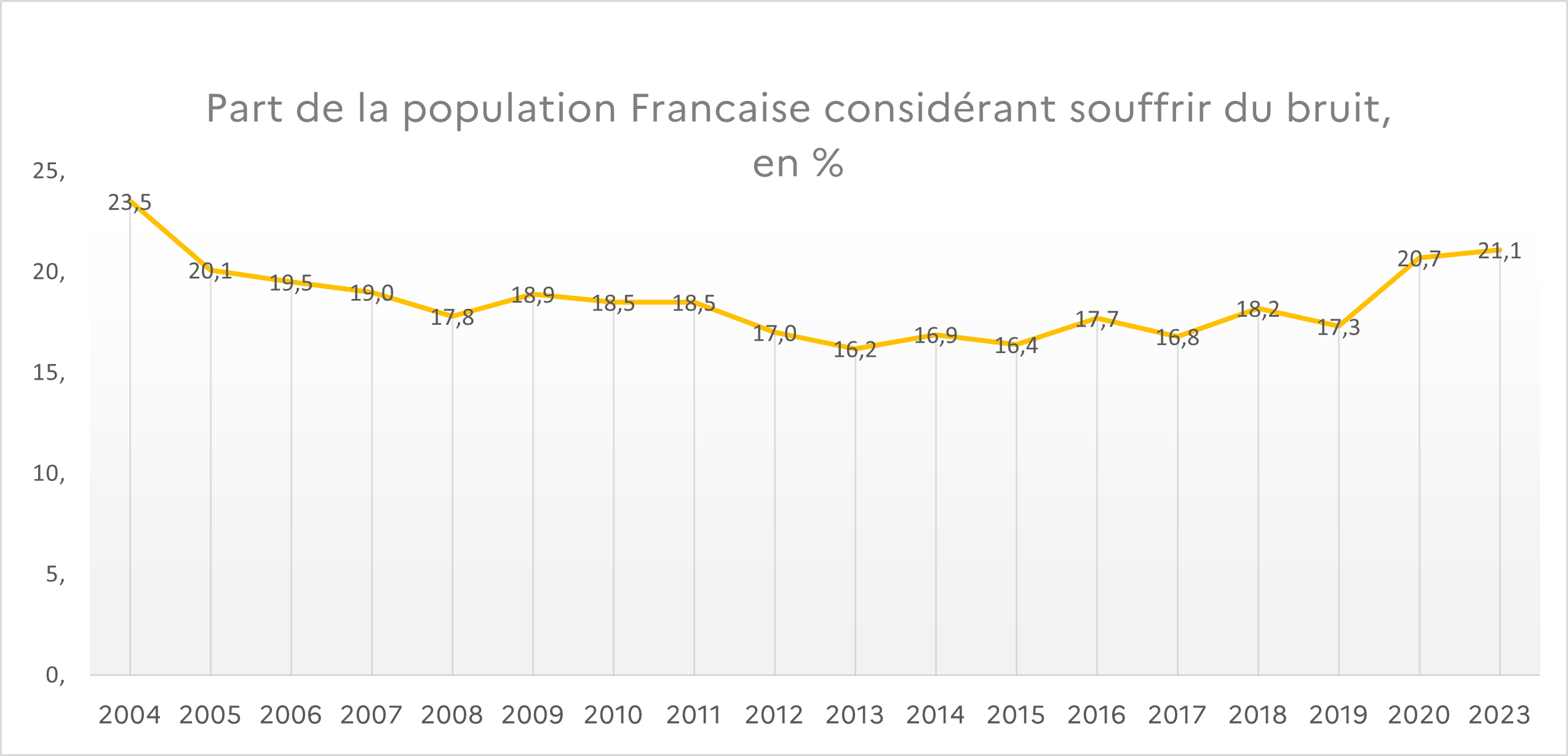
- Noise, a form of pollutionDefinition and characteristics• Noise is a sound emission that propagates through vibration in the air. It is characterized by its frequency (measured in hertz), its level (measured in decibels), and its duration. • Depending on its duration, intensity, origin, and individual perceptions, noise can be considered a form of pollution.Noise perception by French peopleAccording to a survey conducted by EUROSTAT, more than one in five French people reported suffering from noise in 2023. This sense of disturbance from noise pollution decreased significantly between 2004 and 2019 before increasing again since 2020.Health effectsNoise pollution causes significant health effects, ranging from hearing loss to the development of cardiovascular diseases. The World Health Organization considers noise pollution as the second leading cause of mortality, behind air pollution, among environmental risk factors in Europe (source).
- Impacts of noise pollutionTypes of effects• Beyond auditory effects such as communication disruption or hearing impairment, noise pollution can cause effects ranging from sleep disorders to cardiovascular system disturbance. • Generally observed effects: • auditory effects (hearing loss, deafness, etc.), resulting from prolonged exposure to high noise levels typically in workplace or recreational settings • objective non-auditory effects (sleep disruption, endocrine system disruption, cardiovascular system disruption, immune system effects, etc.) • subjective non-auditory effects, resulting from individual perception (disturbance, effects on attitudes and social behavior).Long-term health impacts• Non-auditory health impacts can occur in the short or medium to long term after regular exposure to sometimes low sound levels. It is difficult to establish a direct link between noise exposure and the onset of disorders. However, links have been established between exposure to transport noise and the onset of certain symptoms or disorders (sleep disruption, cardiovascular diseases, learning disorders) (See the chapter on pollution in the 2024 environmental status report, pages 54 and 55). • According to the European Environment Agency, noise would cause more than 660,000 cases of premature mortality per year in Europe.Social costIn France, a study commissioned by ADEME (Ecological Transition Agency) estimates the social cost of noise pollution at 147 billion euros per year in 2021, taking into account in particular the cost of associated disorders and illnesses, loss of productivity, and decline in real estate prices.Headphone safety tips• Wearing headphones or earphones: best practices • Adjust volume only in a quiet place • Do not set volume above half the device's maximum and do not increase it to mask ambient noise • Limit listening duration • Do not fall asleep with headphones on
- Factors of exposure to noise pollutionTransportation• Sources of exposure to noise pollution are diverse and have varying impacts on humans. • Different modes of transportation (road traffic, trains, airplanes, etc.) generate the main noise nuisance for French people according to a 2020 survey cited by the Ministry of Ecological Transition. • Road noise comes from both car engines and rolling, meaning the contact between moving tires and the road. This rolling noise increases rapidly with speed. For rail transport, the condition of the rails plays an important role. Noise pollution from aviation occurs mainly during takeoff and landing. It also depends on the aircraft (commercial airliner, military plane, helicopter, etc.). • The development of road and rail traffic, as well as the construction of housing near transport infrastructure, has subjected a large number of people to severe noise pollution. • To address this, the 2009 "Environmental Grenelle" laws require noise prevention at the source and noise reduction for the most critical situations. The 2002 European noise directive also requires the development of a noise prevention action plan for major construction projects, with impact studies and protection measures to be employed. • What solutions to reduce road noise? Several solutions exist to reduce road noise at the source. For example: reducing traffic (carpooling, detours, improving public transportation), speed limits, installing acoustic radars, or switching to electric vehicles. It is also possible to attenuate noise propagation by placing a barrier between the noise source and buildings. This barrier can take the form of noise barriers, tertiary buildings such as shops, or vegetation.Acoustic insulation• Exposure to noise nuisance also depends on the acoustic insulation of buildings. Current regulations impose maximum noise levels for the construction of new housing with more than 10 units. After work, it is necessary to evaluate the overall acoustic insulation of the housing from noise coming from outside and inside the building. Interior noise comes for example from boiler rooms, elevators, or ventilation systems. • For existing housing, it is possible to improve acoustic insulation by changing floor coverings, windows, or wall insulation. Financial assistance is available for housing near certain airports.Neighbors, construction, and work activities• The law regulates any activity that may cause noise nuisance. Neighbor noises such as music, construction, or animals can be penalized if they are repeated, intense, or persistent. At night, they are classified as noise disturbance. • Economic activities (nightclubs, bars, industries, construction sites, etc.) must provide decibel measurements compliant with regulatory thresholds. In case of violation and absent amicable resolution, the companies or individuals responsible for the noise must pay damages to the victims. • For certain neighbor noises, it is possible to establish a violation without measuring decibels, such as behavioral noises (conversations, parties, repairs, animal sounds) and use of household appliances (household appliances, hi-fi systems, ventilation, etc.). • The National Noise Council created a guide for establishing a violation for these activities.
- Urban populations particularly exposedCited nuisance factorsA survey conducted among the French population in 2014, led by the ministry in charge of the environment, showed that the first nuisance factors cited by French people are traffic and neighbors.Noise mapsSince the 2002 European noise directive, the preparation of noise maps is required from transport infrastructure managers (air, road, rail) and certain metropolitan areas with more than 100,000 inhabitants.Exposed populationsIn France, 30 metropolitan areas have prepared these maps to identify areas where populations are most exposed to noise. During the day, 13 million people (70% of the population covered by these maps) are exposed to road noise levels above 55 decibels. At night, road noise above 50 decibels affects 7.8 million people (See the chapter on pollution in the 2024 environmental status report, pages 54 and 55).
- Difficult reduction of noise hotspotsNoise hotspot definitionA noise hotspot (PNB) is a "sensitive" building (residential, health care, or educational facility) exposed to noise levels exceeding regulatory limit values.Census of hotspot buildings• ADEME identified 246,000 hotspot buildings in mainland France distributed across 480 neighborhoods. • See the noise hotspot map in mainland France:Priority fundingThe fourth national environmental health plan provides funding for acoustic insulation of these priority hotspot buildings.
- Funding and monitoring to combat noise pollution exposureEnvironmental Grenelle noise plan• In 2009, the Environmental Grenelle enabled the creation of the noise plan led by ADEME, with three objectives: • funding for reducing noise nuisance caused by the national road and rail network • a mechanism to combat noise nuisance from air transport • development of a network of noise observatories in major metropolitan areas.Fourth national environmental health planMore recently, the fourth national environmental health plan provides several actions to combat noise, such as acoustic renovation of social housing near roads, railways, and airports. Quiet spaces are created within municipalities and acoustic radars allow for automatic detection of overly noisy motorized vehicles.Quiet LabelIn parallel, the plan created the Quiet Label aimed at valuing and promoting actions or projects designed to improve or preserve the acoustic environment. Companies, local authorities, and organizations can obtain this label by creating a quiet space or a calm moment allowing individuals to enjoy sound tranquility.Noise combat spendingIn 2022, 3 billion euros were allocated to combating noise pollution, approximately 0.1% of France's gross national product. Main spending concerns the acoustic renovation of windows in buildings as well as replacement of vehicle silencers and treatment of roads and hotspots.
Further reading
- Guide de constat d’infraction sans mesurage des bruits de voisinageecologie.gouv.fr
- Points noirs de bruit dans les 480 quartiers prioritaires du NPNRU – ADEMEdata.ademe.fr
- Se protéger des sons forts : qu’est-ce que l’écoute sans risque ?who.int
Questions et réponses sur le site de l’Organisation Mondiale de la Santé (OMS).
- Zero pollution monitoring and outlook 2025eea.europa.eu
Rapport de l’Agence européenne pour l’environnement (AEE) et de la Commission européenne.
- Agence nationale de sécurité sanitaire de l’alimentation, de l’environnement et du travail (ANSES)anses.fr
Établissement public contribuant à assurer la sécurité sanitaire humaine dans les domaines de l'environnement, du travail et de l'alimentation, et également à assurer la protection de la santé et du bien-être des animaux,la protection de la santé des végétaux, l'évaluation des propriétés nutritionnelles et fonctionnelles des aliments.
- Santé publique France (SPF)santepubliquefrance.fr
Santé publique France a pour mission de protéger la santé des populations. En tant qu'agence scientifique et d’expertise du champ sanitaire, elle a en charge l'observation épidémiologique et la surveillance de l'état de santé des populations ; la veille sur les risques sanitaires menaçant les populations ; la promotion de la santé et la réduction des risques pour la santé ; le développement de la prévention et de l'éducation pour la santé ; la préparation et la réponse aux menaces, alertes et crises sanitaires ; le lancement de l'alerte sanitaire.