Les ondes électromagnétiques
Les ondes électromagnétiques sont présentes naturellement dans l’environnement, comme la lumière visible nous permettant de voir les couleurs ou les champs magnétiques terrestres faisant dévier l’aiguille des boussoles. Aujourd’hui, de nombreux appareils ont besoin d’ondes électromagnétiques pour fonctionner : télévisions, radios, fours micro-ondes, téléphones mobiles, antennes-relais, etc. Si aucun effet à long terme n’a été établi, les effets de ces ondes électromagnétiques sur la santé font aujourd’hui encore débat.
Electromagnetic waves are naturally present in the environment, such as visible light allowing us to see colors or Earth's magnetic fields deflecting compass needles. Today, many devices need electromagnetic waves to function: televisions, radios, microwaves, mobile phones, relay antennas, etc. While no long-term effects have been established, the effects of these electromagnetic waves on health are still debated today.
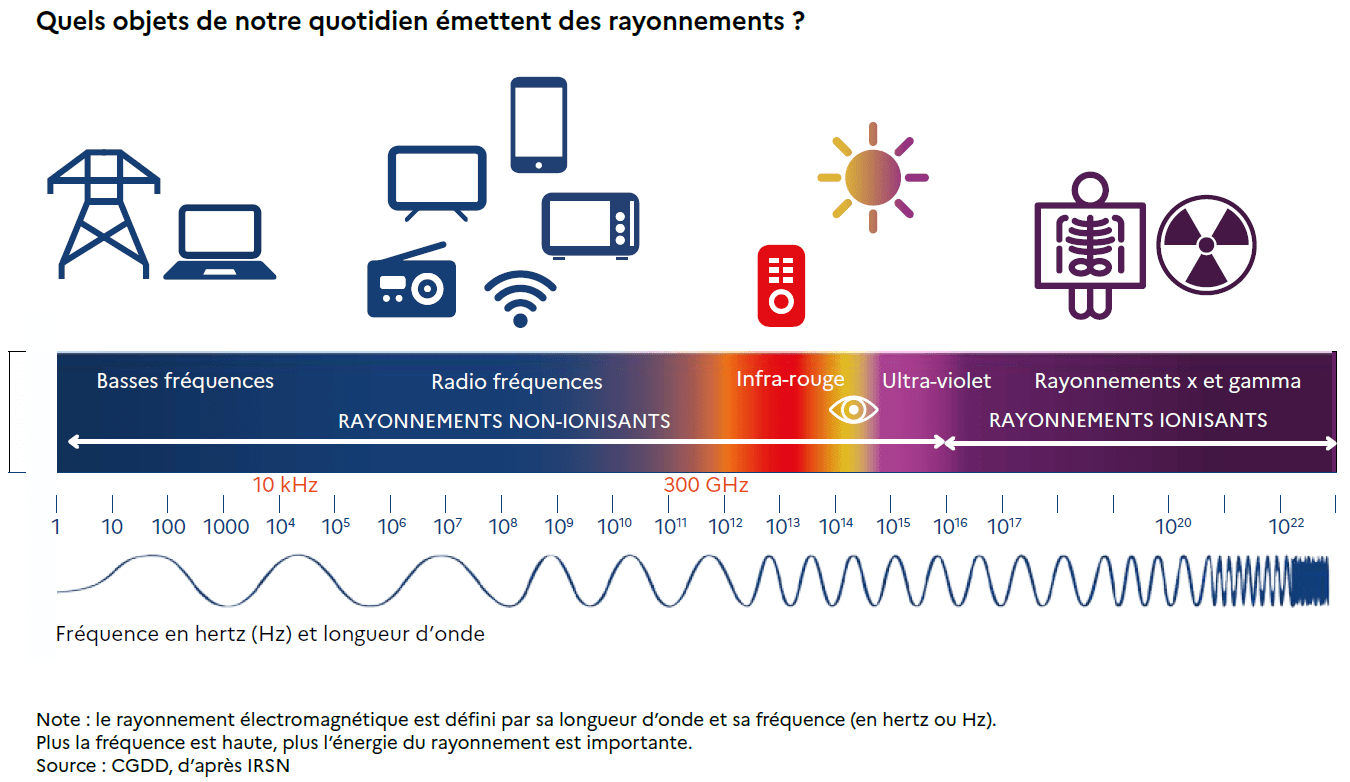
- In a nutshellWhat is a wave• A pebble thrown into water creates a disturbance. By absorbing part of the pebble's energy, the water propagates it around (source). • These waves at the water's surface are the simplest and most direct way to see waves. But there are many other forms of waves that follow the same principle while being invisible to the naked eye. • The electromagnetic wave falls into this category of waves invisible to the naked eye. It travels at a speed close to that of light, or 300,000 km per second. It can therefore travel around the Earth 7 times in one second. • There are types of electromagnetic waves of natural origin such as visible light that allows us to see colors. Waves created by humans serve, for example, to power smartphones, radios, or for X-rays of the human body. • These different electromagnetic waves differ by their frequency, that is, their number of oscillations (or waves) per second. Frequency is measured in Hertz (Hz), one oscillation per second corresponds to one Hertz.Types of waves• Static and low frequency waves, generated by high-voltage power lines and household appliances • Radio waves, used for communication means such as smartphones, Wi-Fi, television, satellites, and microwaves • Infrared rays, which detect the heat of objects and the environment • Visible light, with all the colors of the rainbow • Ultraviolet or UV rays, which come mainly from the Sun or artificial tanning devices • X-rays, which allow radiography of the human body • Gamma rays, notably used in medicine for cancer treatmentSpectrum frequencies• Within the electromagnetic spectrum, frequencies vary greatly depending on the type of wave. The frequency of a static or low frequency wave is between 0 and 10 kHz, or 10,000 oscillations per second. Gamma rays can reach 10¹⁹ Hz, or 10 billion billion oscillations per second. • Radio waves encompass frequencies between 10 kHz and 300 GHz. The lowest frequencies of 10 kHz are used by submarines to communicate with land. The highest at 300 GHz concern satellites, Internet, smartphones, and microwaves. Most common uses involve frequencies between 100 kHz and 6 GHz. • Low frequencies cover greater distances but high frequencies will have more capacity.AM and FM radio• AM and FM radios: what are the differences? • To broadcast a radio show, the voice of the announcer is transformed into an electrical signal by the microphone. This electrical signal oscillates at the same rate as the voice, they have the same frequency. However, the frequency of the voice is far too low for the signal to be transmitted as an electromagnetic wave. It is therefore necessary to create an electrical signal at very high frequency that is transmitted to the antenna. For this, 2 methods are possible: • For AM radio, the amplitude of the electrical signal is changed, that is, the height of the oscillations of the electrical signal according to the voice signal. • For FM radio, the frequency is changed. Frequency modulation is much more reliable; there will be less static than with amplitude modulation.
- Effects on the human bodyElectromagnetic fields• According to ANSES (National Food Safety, Environmental and Occupational Health Agency), humans are exposed to different electromagnetic fields created by human activities. • An electromagnetic field is the combination of an electric field and a magnetic field. All electrical appliances in operation generate an electromagnetic field to which we are exposed daily. Electromagnetic fields are differentiated into two types: • extremely low frequency fields, emitted by power lines and domestic use; • radiofrequencies, coming from radio, television, radar antennas, mobile telephony, or microwavesExposure to static and low frequency waves• The population is exposed to multiple sources of electromagnetic fields at low frequencies. This can be in the outdoor environment via power lines, transformers, transportation means, or in the indoor environment via household appliances. • It is inside homes that the highest levels of electromagnetic field are found: they are produced by household appliances, but exposure to these appliances is generally very brief and localized. • The highest electromagnetic field values in outdoor environments are measured particularly under very high-voltage power lines and in immediate proximity to transformer stations or electrical substations. Certain industrial activities can also generate high exposures to low-frequency electromagnetic fields. • ANSES has found no link between exposure to low-frequency electromagnetic fields in everyday environment and health effects (source). • The Grenelle environmental laws created a public information system on electromagnetic fields emitted by high-voltage power lines. Regulations require that exposure measurements be carried out in urbanized zones of municipalities crossed by high-voltage lines. • In 2010, several studies conducted by ANSES showed a possible link between childhood leukemia and exposure to low-frequency magnetic fields at levels above 0.2 microtesla (µT) or 0.4 µT. • Approximately 40,000 children under 15 years of age are exposed at their home to a magnetic field greater than 0.4 µT, and approximately 8,000 children attend school in a facility exposed to a magnetic field greater than 0.4 µT. • Since 2010, ANSES has recommended not installing new facilities for sensitive individuals (hospitals, schools…) in immediate proximity to very high-voltage power lines.Exposure to radiofrequencies• Certain radio waves, used for example by radio and television as a transmission medium, have been present in our environment for a long time. However, the development of new technologies such as Bluetooth, Wi-Fi, new generations of mobile telephony, connected objects, or electric vehicles, increases our exposure. • To the best of current knowledge, there is no established link between exposure to waves emitted by phones and health effects. The recent appearance of certain types of waves makes it difficult to study their long-term effects on humans. • A study conducted by the National Cancer Institute in 2011 (PDF, 1,689 KB) mentions a possible increase in brain tumor risk, in the long term, for heavy mobile phone users, which is why the International Agency for Research on Cancer classified radiofrequencies as "possibly carcinogenic". • The National Frequency Agency conducted measurements of public exposure to radio waves over a 10-year period from 2014 to 2023 (PDF, 2.4 MB). For the 30,000 measurements made in France, the measured levels of exposure to waves proved to be all significantly lower than the regulatory limit values. • Acute exposure of high intensity can also cause short-term heating of biological tissues (skin, as well as internal tissues of the body), this is called the thermal effect. The exposure limit values currently in force in France nonetheless guarantee that such levels of radio waves are never reached in public spaces and under normal conditions of use of transmitter devices. • Exposure to electromagnetic fields depends both on the frequency (linked to wavelength), the distance from the radiation source, as well as the type of medium used. • For a mobile telephone base station (relay antenna), the entire body is exposed, unlike the mobile phone, where only part of the body is affected. Exposure limit values for the public to waves emitted by equipment used in telecommunications networks or by radioelectric installations were defined by European recommendation of July 12, 1999 and decree no. 2002-775 of May 3, 2002. • In Europe, in the name of the precautionary principle, some local authorities or states (Belgium, Italy, Luxembourg, etc.) have adopted specific limit values in living spaces, more restrictive than the European recommendation. • France ensures monitoring of atypical points based in particular on an attention value of 6 volts per meter (V/m) for homes and places accessible to the public. The city of Paris adopted, in 2017, a new mobile phone charter reducing the maximum authorized level of exposure to mobile telephony frequency waves to 5 V/m in enclosed living areas. This threshold is calculated as 900 MHz equivalent. • Part of the energy carried by electromagnetic waves that interact with the human body is reflected outward, the other is absorbed by the body. To quantify this effect, the reference measurement is that of SAR (specific absorption rate), for all waves between 100 kHz and 6 GHz. SAR is expressed in Watts per kilogram (W/kg). • According to European laws, mobile phones must not exceed a SAR of 2 W/kg. Manufacturers must indicate this value on the product label. To limit exposure to waves, it is recommended to prioritize the purchase of mobile phones displaying the lowest SAR values.Exposure to X and Gamma raysGamma or X rays used in radiographs of the human body are ionizing. They have proven effects on health, which vary according to the type and dose received, from skin burns to cancer.
- Increasing exposure due to radiofrequency developmentGeneral exposure• According to the 2024 report from ANFR (National Radioelectric Frequencies Agency) (PDF, 2.5 MB), the average exposure of French people to electromagnetic waves is increasing. • Over an eleven-year period, ANFR conducted more than 32,000 measurements in France of electric field intensity, expressed in V/m. Between 2014 and 2024, the average of the overall exposure level observed increased, rising from 0.68 V/m to 1.2 V/m. • According to this same study, the average recorded in cities is almost three times higher than in the countryside. Similarly, exposure is on average 50% higher outdoors compared to indoors. • Nevertheless, the measured levels proved to be all significantly lower than the limit values set by law, which vary between 28 V/m and 87 V/m depending on frequencies.5G development• 4 generations of mobile telecommunications have succeeded one another, each bringing technological innovations. In the 1990s, 2G technology enabled calls and SMS on mobile phones. In the 2000s, 3G technology served to introduce Internet but limited to photo sending (MMS). • In the 2010s, the development of 4G enabled wider use of the Internet (videos, applications). From 2020, France authorized the development of 5G at mobile network sites. Between 2020 and 2025, the 4 mobile network operators (Orange, Free, Bouygues, and SFR) equipped more than 49,000 sites in France with 5G technology. • According to ANFR, 5G technology has data rates 10 times higher than 4G, opening the way for wider uses: autonomous vehicles, remote piloting, telesurgery, industrial automation… • An increase in traffic is thus expected, and therefore an increase in population exposure to radiofrequencies. • According to a study conducted by ANFR over the period 2020-2023 (PDF, 1,898 KB), a 13% increase in exposure to waves was observed at sites that deployed 5G. The recorded values remain however on average 30 times lower than the limit values set by the State. • In summary, French exposure to radioelectric waves is increasing, in parallel with traffic increases and 5G development. Exposure values remain well below regulatory limit values.
- Measuring children's exposure to electromagnetic wavesEffects in children• Expert work conducted by ANSES based on current data from international scientific literature does not allow conclusions on the existence or absence of effects of radiofrequencies in children on behavior, auditory functions, development, male and female reproductive systems, immune system and systemic toxicity, nor of carcinogenic or teratogenic effects. • On the other hand, ANSES concludes that there is a possible effect of exposure to radiofrequencies on children's well-being and their cognitive functions (memory, executive functions, attention). The observed effects on well-being could however be more linked to the use of mobile phones rather than the radiofrequencies they emit.Use of new technologiesEspecially since children's exposure to new wireless technologies is sharply increasing with the increase in the use of radioelectric devices (tablets, connected toys, etc.).Measurements in schools• As part of the national system for measuring exposure to electromagnetic waves, radiofrequency exposure measurements were carried out in a representative sample of 298 schools. • The median level of radiofrequency electric field inside schools in France is 0.16 V/m and 0.27 V/m outdoors. These measurements remain below the attention value of 6 V/m and regulatory limit values ranging from 48 V/m to 61 V/m for mobile telephony. Statistical analyses show that outdoor levels are significantly higher than indoor levels.
- French divided between concern and suspicion about mobile antenna risksRisk perceptionThe Institute for Radiological Protection and Nuclear Safety publishes an annual survey on French risk perception. The issue of mobile telephone network antennas continues to raise concerns among the French but this is tending to decrease. In 2024, 40% of French people declare they accept living next to a telephone network antenna, compared to 28% in 2020.Suspicion and trustIn 2017, more than half of French people showed skepticism regarding the information provided to them about the dangers of waves emitted by these antennas. This high level of suspicion has been generally stable since 2009. On the other hand, the population is somewhat less distrustful than in the past: between 2011 and 2017, the share of respondents declaring they do not trust French authorities to protect them from this type of risk thus decreased by 12 points, falling from 52% to 40%.
Further reading
- État de l’environnement en Francenotre-environnement.gouv.fr
Le Rapport sur l’état de l’environnement en France, REE 2024, répond à un objectif : apporter des clés de lecture sur les grands enjeux de la transition écologique.
- L’ANFR, Agence nationale des fréquencesanfr.fr
En France, la gestion du spectre est partagée entre neuf ministères et autorités appelés affectataires qui disposent de droits sur certaines bandes de fréquences, exclusives ou partagées. L’Agence œuvre à leur service commun. Elle propose la planification et la répartition du spectre, organise les procédures appropriées pour une bonne cohabitation des utilisateurs, contrôle l’utilisation des fréquences et le respect des règles. Le travail de l’ANFR (hors services administratifs) est structuré selon quatre processus de réalisation : Gestion des bandes de fréquences et prospective Assignation des fréquences et gestion des sites Gestion des fréquences pour le compte des affectataires Contrôle L’ANFR s’investit également dans le programme GALILEO, le futur GPS européen, qui devrait être lancé en 2020. L’Agence, lors de la Conférence Mondiale 2000, a contribué à obtenir l’attribution de nouvelles bandes de fréquences au service de radionavigation par satellite (SNRS). L’Agence a également mené diverses études et des mesures sur l’environnement radioélectrique.
- Foire aux questions de l’Organisation mondiale de la santé sur les ondes et la santéwho.int
Foire aux questions de l'Organisation mondiale de la santé sur les effets des ondes électromagnétiques sur la santé humaine.
- Zero pollution monitoring and outlook 2025eea.europa.eu
Rapport de l’Agence européenne pour l’environnement (AEE) et de la Commission européenne.
- Que sont les ondes radiofréquences ? | Portail interministériel d’information sur les radiofréquencesradiofrequences.gouv.fr
Portail interministériel d’information sur les radiofréquences
- Agence nationale de sécurité sanitaire de l’alimentation, de l’environnement et du travail (ANSES)anses.fr
Établissement public contribuant à assurer la sécurité sanitaire humaine dans les domaines de l'environnement, du travail et de l'alimentation, et également à assurer la protection de la santé et du bien-être des animaux,la protection de la santé des végétaux, l'évaluation des propriétés nutritionnelles et fonctionnelles des aliments.
- Santé publique France (SPF)santepubliquefrance.fr
Santé publique France a pour mission de protéger la santé des populations. En tant qu'agence scientifique et d’expertise du champ sanitaire, elle a en charge l'observation épidémiologique et la surveillance de l'état de santé des populations ; la veille sur les risques sanitaires menaçant les populations ; la promotion de la santé et la réduction des risques pour la santé ; le développement de la prévention et de l'éducation pour la santé ; la préparation et la réponse aux menaces, alertes et crises sanitaires ; le lancement de l'alerte sanitaire.