
La pollution des sols : origines et conséquences
Les sols sont au centre de grands enjeux environnementaux, comme la qualité de l’eau, la préservation de la biodiversité, la sécurité de l’alimentation ou la lutte contre le changement climatique. Pourtant, à cause des activités humaines, les sols subissent des dégradations multiples. Ils sont pollués par de nombreuses substances. Souvent toxiques pour l’homme, la faune et la flore, elles proviennent à la fois de l’industrie, des ménages, des transports, et de l’agriculture.
Soils are central to major environmental challenges, such as water quality, biodiversity preservation, food security, and climate change mitigation. Yet due to human activities, soils suffer multiple degradations. They are polluted by numerous substances. Often toxic to humans, fauna, and flora, they come from industry, households, transport, and agriculture.
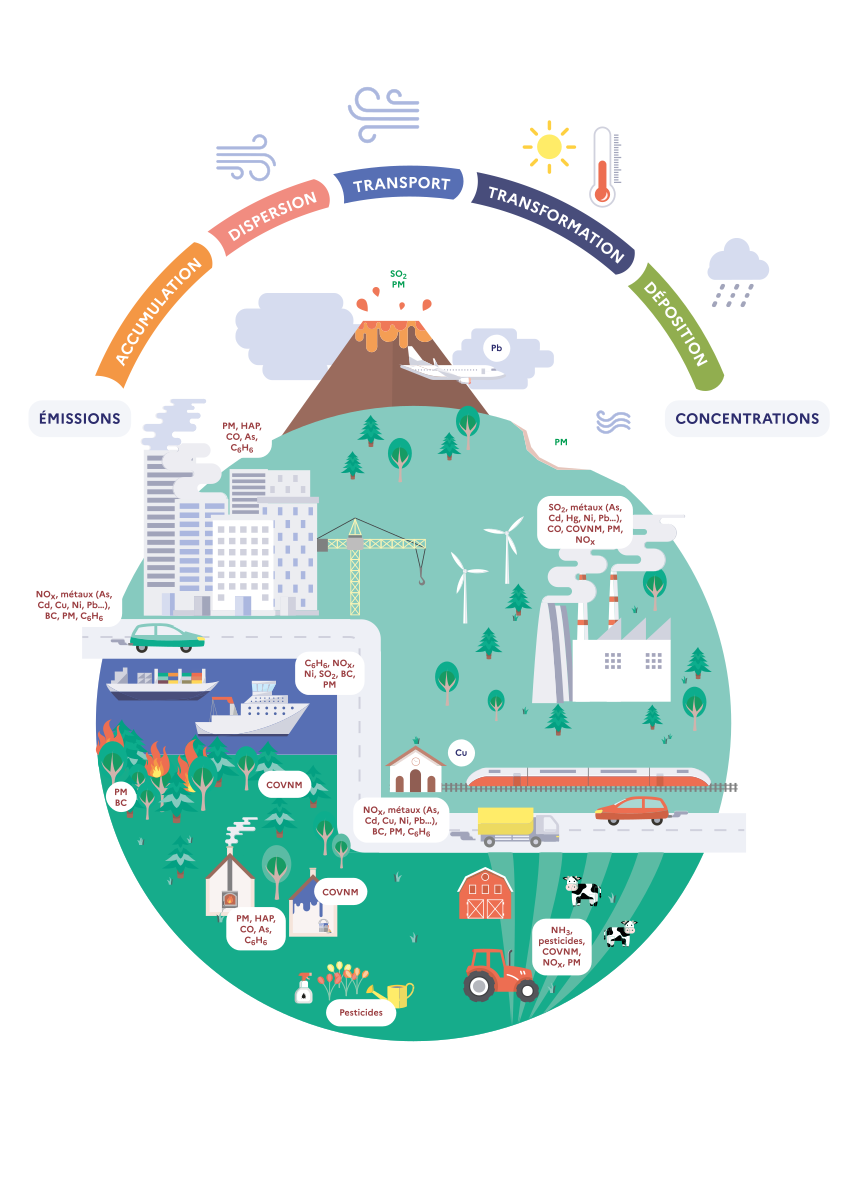
- Why are soils polluted?Diffuse pollution• Soils can be polluted in a "diffuse" manner, meaning through regular exposure to relatively low doses of pollutants that accumulate over the long term. These pollutants can remain present in soils for decades after the activities causing them have ended. • This is notably the case for substances from transport. Although lead-free fuels definitively replaced those containing lead in the early 2000s, past vehicle traffic remains the cause of over 90% of diffuse lead pollution today. • Agriculture is also a major source of diffuse soil pollution. Soil in areas of intensive farming or livestock raising contains, for example, high levels of lindane (a product used as an insecticide or antiparasitic agent) in mainland France, despite being banned since 1998 in agriculture. In the Caribbean, chlordecone (insecticide) remains massively present in the soil of banana plantations and ecosystems even though this product has not been used since 1993.Localized pollutionSoil pollution can also be localized and concentrated on a specific site, generally linked to nearby industrial activity. These localized pollutions result from air emissions, handling or transport accidents, or poor containment of toxic products. They initially affect only a few dozen hectares at most, but can spread through pollutant dispersal (via air or water).Pollution across ecosystems• Soil pollution has cascading effects on all natural ecosystems. Soil plays a central role in these systems: it harbors invisible but essential life, filters water, nourishes plants, and regulates biological cycles. When polluted by pesticides, heavy metals, or industrial waste, this balance is disrupted. • Soil biodiversity decreases, weakening vegetation and food chains. Pollutants then seep into groundwater and rivers, contaminating water and aquatic ecosystems. Weakened soil retains water and nutrients less effectively. This promotes erosion and runoff, carrying pollutants to other natural areas. • This entire chain of disruptions also affects forests, wetlands, crops, and even seas. Over time, due notably to the disruption of microbial life and vegetation decline, polluted soils release more greenhouse gases, worsening climate change. Soil pollution never remains local: it weakens entire ecosystems and reduces their capacity to regenerate.
- What are the impacts on human health?Exposure pathways• Since natural environments (soil, water, air) are interconnected, exposure possibilities are multiple, whether through ingestion or inhalation (source). The most common are: • Ingestion of soil by young children, particularly exposed due to their behavior when playing on the ground, where they may directly ingest soil deposited on hands or objects they put in their mouths. • Consumption of food crops grown on polluted land. • Consumption of water, which may contain products transferred from soil to groundwater. • Breathing dust emitted by polluted soils. • Direct breathing of pollutants that may enter the air from soil.Health risks• Populations most exposed to soil pollution effects are those living on or near polluted sites. Many chemical substances found in polluted soils are known for their harmful health effects, including serious diseases (source). • Certain metals and metalloids can for example cause cancers, reproductive disorders, or kidney, bone damage, cardiovascular, respiratory and gastrointestinal pathologies with prolonged ingestion exposure. Many cases of lead poisoning have also been reported in industrial areas heavily polluted by industrial activities (foundries, battery factories). • Hydrocarbons can cause lung disease if inhaled. They can also cause skin drying or chapping after repeated contact. • > French people concerned about pollution > According to the 2024 barometer from the Institut de radioprotection et de sûreté nucléaire (IRSN), 63% of French people consider risks to be high or very high. This level of concern does not match that toward air pollution (69%) or pesticides (66%) but remains significant and, like other diffuse pollutions, remains relatively stable over time. 68% of French people feel poorly informed about these diffuse pollutions, and even 72% specifically about soil pollution.
- What are soil pollutants?Metals• Metals (cadmium, lead, etc.) and metalloids (boron, arsenic, etc.) are naturally present in soils. However, industrial emissions, household waste, transport, and agriculture contribute to diffuse soil pollution by metals. Toxic at varying doses for humans, fauna and flora, they can contaminate ecosystems through food chains (livestock) and water resources. • Due to the strong link between lead and soil organic matter, this metal is poorly available for plants and migrates very little in depth. High surface concentrations can thus be attributed to human activities (transport, industry, mining, urban sludge, phytosanitary treatments), while at depth they result more from rock degradation. • Like lead, copper is poorly mobile in soils except in very acidic or poorly drained environments. It is also an essential trace element for life (in very small quantities). Various human activities can cause copper pollution: agriculture (vineyard and orchard treatments, pig manure spreading), industry (metallurgy), and waste reuse (wastewater treatment sludge, household waste compost).Polycyclic aromatic hydrocarbonsPolycyclic aromatic hydrocarbons are persistent organic pollutants, produced mainly by combustion of organic matter (forest fires, fossil fuel combustion). Toxic to human health and the environment, they are generally poorly biodegradable. Beyond their ability to transport over long distances, they accumulate in living tissues due to their high fat solubility. Finally, they easily bind to organic matter, suspended matter, or river sediments.Pesticides• Prolonged use of certain pesticides has caused diffuse pollution affecting large parts of the country. This is the case with lindane, used for over 50 years, considered toxic to humans and dangerous for the environment. Poorly mobile in soils, lindane can evaporate and be transported in air depending on soil nature and moisture levels, as well as application method. Soil type, climate, and lindane burial depth affect the time needed for its degradation in soil (up to over 40 years). • In French Caribbean territories, chronic agricultural soil pollution and contamination of water and ecosystems by chlordecone results from its use until 1993 to combat a pest insect, the banana weevil. Chlordecone molecules are classified as persistent organic pollutants and recognized as endocrine disruptors and potential carcinogens. The Caribbean population is exposed through ingestion of contaminated water or food.Plastic waste• Due to the multiple uses of plastics in our daily lives, global plastic production has been multiplied by 266 since 1950 to reach 400.3 million tonnes in 2022. These uses generate large quantities of waste representing a treatment challenge. According to the OECD, of 353 million tonnes of plastic waste produced globally in 2019, only 9% were recycled. • The other challenge lies in the size of this waste: under the effect of ultraviolet rays, heat, bacterial activity, and mechanical agitation, it fragments into microplastics (size under 5 millimetres) and disperses across all environments, particularly soils. 76% of 33 sites studied in France in 2020, mainly in large-scale farming, contained plastic fragments (mainly polyethylene and polypropylene). To better understand the origin and nature of microplastics in soils, Ademe (Agence de la transition écologique) studied 21 different organic materials used as fertilizers (green waste, compost, agricultural effluent, etc.). Of 167 samples analyzed, 166 contained microplastics. • Plastic pollution threatens ecosystems and health. Hundreds of animal species are affected by ingestion of debris and chemical additives that enter the food chain. In humans, several studies observe microplastics in lungs, blood, or feces. The link between microplastic exposure and health is still poorly understood.Perfluorinated pollutants• With non-stick, heat-resistant, and water-repellent properties, poly- and perfluoroalkyl substances (PFAS) are present in many products: kitchen utensils, food packaging, textiles, fire-fighting foams, etc. Others, like trifluoroacetic acid (TFA), are sometimes used in pesticide and pharmaceutical manufacturing or result from environmental degradation of molecules in the same family. • This is the case with the herbicide flufenacet, used notably on cereal or potato crops, which generates TFA as a metabolite (degradation by-product). Once in the environment, PFAS are poorly degradable and nicknamed "forever pollutants," contaminating surface or groundwater, air, soils, and sediments. • PFAS have been integrated into the European human biomonitoring program to better understand our exposure and contamination levels and understand their health effects: cancers, fertility and fetal development disruptions, increased cholesterol and obesity risk, weakened immune system, the most critical effect on human health.RadioactivitySoil radioactivity can be of natural origin (related to rock present in the subsoil) or artificial when pollution occurs, linked for example to nuclear power plant accidents (Chernobyl).
- Polluted sites and their managementExtent and sourcesIn 2025, 11,234 polluted or potentially polluted sites and soils are registered due to France's industrial past, half located in former mining regions (source). These pollutions result either from uncontrolled pollutant releases or from accidents or poor containment.Pollutant distributionPollutions are often multiple on the same site. The two most frequently identified pollutant categories in soils or aquifers are metals and metalloids (less than one quarter of all soil pollutions) and hydrocarbons (less than one third). The three hydrocarbon families (mineral, chlorinated, PAH) represent slightly less than 60% of multiple soil pollutions. Cyanides, BTEX (sum of benzene, toluene, ethylbenzene and xylene), and other pollutants (ammonium, chlorides, pesticides, non-halogenated solvents, sulfates, radioactive substances) represent respectively less than 10% of soil pollutions.Groundwater contaminationGroundwater pollution commonly results from soil pollution at these sites. The distribution of pollutant families identified in aquifers closely resembles that of soils, with hydrocarbon shares (27%) or metals and metalloids (18%) being slightly lower.
Further reading
- La contamination des sols par les métauxnotre-environnement.gouv.fr
La présence de métaux dans les sols est naturelle, mais aussi le fait de pollutions liées aux activités humaines. Toxiques, ils font l’objet d’un suivi environnemental et sanitaire.
- La pollution des sols par les hydrocarbures aromatiques polycycliques (HAP)notre-environnement.gouv.fr
Les hydrocarbures aromatiques polycycliques (HAP) sont principalement issus de la combustion des matières organiques. Ils sont un indicateur de pollution des sols.
- La pollution des sols par les pesticidesnotre-environnement.gouv.fr
Les pesticides employés en agriculture s’accumulent dans les sols et polluent l’ensemble des milieux, avec des conséquences sur la biodiversité et la santé humaine.
- Déchets et microplastiques : comprendre et agir face à une pollution mondialenotre-environnement.gouv.fr
Présents dans l’air, les sols, les eaux ou les organismes vivants, les déchets plastiques s’accumulent dans les milieux naturels.
- Les polluants perfluorés (PFAS) : une menace croissante pour l’environnementnotre-environnement.gouv.fr
Les PFAS, polluants éternels, contaminent eau, air et sols. Dans quels produits se cachent‑ils, quels dangers pour la santé et quelles actions pour réduire leur usage.
- Les sites et les sols pollués en Francenotre-environnement.gouv.fr
De nombreux sols sont pollués en France en raison d’activités industrielles. Face aux risques pour l’environnement et la santé humaine, les sites concernés sont suivis et gérés.
- Zero pollution monitoring and outlook 2025eea.europa.eu
Rapport de l’Agence européenne pour l’environnement (AEE) et de la Commission européenne.
- Le sol : formation, menaces, fonctions écosystémiques…fao.org
Séries d’infographies réalisées par la FAO dans le cadre de l’année internationale des sols en 2015.
- 4 pour 1000 : la séquestration du carbone dans les solsnotre-environnement.gouv.fr
Infographie illustrant la séquestration du carbone dans les sols pour la sécurité alimentaire et le climat.
- Vers une gestion durable des terres et des solseea.europa.eu
Infographie illustrant les pressions exercées sur les sols et les actions permettant une utilisation des sols plus durable.
- État des lieux des sols en Europenotre-environnement.gouv.fr
Infographie présentant l’état des lieux des sols en Europe.
- Sol, terres et changement climatiquenotre-environnement.gouv.fr
Infographie illustrant les conséquences du changement climatique sur le sol.
- Cycle des matières organiques du soleea.europa.eu
Infographie illustrant le cycle de l’azote, du phosphore et du phosphate dans le sol.
- Le sol est les objectifs de développement durable (ODD) des Nations Uniseea.europa.eu
Infographie illustrant les liens entre les sols et certains des objectifs de développement durable (ODD) des Nations Unies.
- Groupement d’intérêt scientifique sur les sols (GIS Sol)gissol.fr
Structure ayant pour mission de constituer et gérer un système d’information sur les sols de France et répondre aux demandes des pouvoirs publics et de la société au niveau local et national.
- Association française pour l’étude des sols (AFES)afes.fr
L’AFES est une société savante consacrée au sol. Elle est la branche française de l’Union internationale de la sciences du Sol (UISS).
- Infographies et vidéos de synthèse sur les solsnotre-environnement.gouv.fr
Infographies et vidéos de synthèse utiles sur les sols.