
Parallel Worlds Probably Exist. Here’s Why
12 chapters
- Classical vs Quantum MechanicsClassical FrameworkIn classical mechanics, knowing the position and velocity of a particle allows you to use Newton's second law to calculate its future behavior.Quantum FrameworkIn quantum mechanics, if you know the wave function of a particle, you can use the Schrodinger equation to calculate what the particle will do in the future, with the wave spreading out over time.The ProblemThe wave function evolves smoothly and continuously according to the Schrodinger equation, but when measured, the particle is found at a single point in space, creating a fundamental inconsistency.The Measurement ParadoxHow do we reconcile the spread-out wave function evolving smoothly with the point-like particle detection observed in experiments?
- The Born Rule and Wave Function CollapseHistorical ContextThe founders of quantum theory considered measurement more real than the wave function because measurement was something actually observed, matching our experience of matter as particles.Born's InterpretationMax Born proposed that the squared amplitude of the wave function at a point gives the probability of finding the particle there, introducing probability as a fundamental aspect of quantum mechanics.Philosophical Impact• The universe is no longer deterministic with the Born rule • Einstein and other scientists were uncomfortable with this probabilistic interpretation • Despite philosophical concerns, the Born rule remains successful at predicting experimental outcomesTwo-Rule FrameworkWhen not observing, the wave function evolves according to the Schrodinger equation; when measuring, it collapses suddenly and the probability of outcomes is given by the squared amplitude.
- Schrodinger's Cat Thought ExperimentSetupA cat is placed in a box with a radioactive atom, a detector, and poisonous cyanide gas. If the atom decays, the detector releases poison and the cat dies; if it doesn't decay, the cat lives.Quantum SuperpositionAccording to quantum mechanics, the atom exists in a superposition of both decayed and not decayed, which entangles with the detector and cat, putting the entire system in a superposition.The ParadoxThe wave function describes the cat as simultaneously both alive and dead until the box is opened, when measurement causes the wave function to collapse into one definite state.Schrodinger's CritiqueSchrodinger created this thought experiment to demonstrate that quantum mechanics as formulated was wrong, not to show how weird quantum mechanics is.
- Examining SuperpositionDefinitionSuperposition is the idea that quantum objects can exist in two different states at the same time, which seems like a crazy idea but is supported by indirect evidence.Double Slit Experiment• When individual electrons are fired through two slits at a screen, they produce an interference pattern • This is not just the sum of electrons going through one slit and the other separately • A single electron must somehow go through both slits simultaneouslyWave NatureElectrons are represented by wave functions, which are spread out in space and can cancel at some points and reinforce at others to produce the interference pattern.ConclusionSuperposition is on solid ground as concrete evidence that wave functions enable individual electrons to pass through both slits at the same time.
- Understanding EntanglementBasic ExampleTwo electrons fired toward each other with equal and opposite velocities will scatter, but measuring the momentum of one electron instantly reveals the momentum of the other, which must be equal and opposite.The MysteryBefore measurement, each electron's momentum was in a superposition of states; measuring one instantaneously collapses the wave function of the other, even if they were light-years apart.True NatureEntangled electrons do not have separate wave functions; they are described by a single wave function. Measuring one affects the state of the other because the single wave function has collapsed.Universal ImplicationRigorously speaking, there is only one wave function in the universe describing everything, and particles are entangled once they interact with something else.
- The Measurement ProblemThe InconsistencyQuantum mechanics has two different sets of rules: one for how systems evolve when not observed, and another for when measurements are made, which seems fundamentally odd.Alternative ViewMeasurement is simply the interaction of one quantum system with another quantum system, and we know how to handle that using the Schrodinger equation alone.The ImplicationIf we discard all measurement rules and only use the Schrodinger equation to evolve wave functions, we can still describe what happens in systems like Schrodinger's cat.Logical ConsistencyThere need not be separate rules for measurement if measurement is just interaction between quantum systems governed by the same mathematical laws.
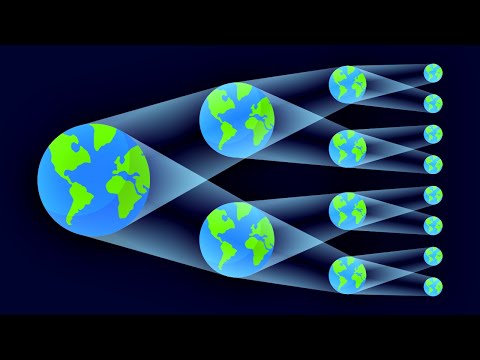
- Many-Worlds InterpretationThe SolutionWhen we open Schrodinger's box, we don't observe the wave function collapse; instead, we become entangled with the state of everything inside the box, experiencing both outcomes in separate worlds.Branch Creation• The observer splits into two identical copies, one entangled with each outcome of the experiment • Both copies continue to exist in separate worlds that will never interact • Each copy experiences a definite outcome but is unaware of the other's experienceEnvironmental DecoherenceWhen a quantum object in superposition becomes entangled with the environment, the wave function branches into separate realities, splitting the universe into different copies.Cleaner MathematicsMany-worlds eliminates the need for wave function collapse and provides a cleaner formalism where only wave functions evolved under the Schrodinger equation exist.
- Many-Worlds FormulationThe TheoryThe many-worlds interpretation was formulated by Hugh Everett and states that the branching of the wave function happens all the time, possibly at an infinite rate, creating infinite subtly different worlds.Mathematical BasisAll the worlds are naturally part of the mathematics of quantum mechanics; to get rid of them requires something like wave function collapse, but discarding collapse leaves cleaner math.Reality Description• The wave function is the complete picture of reality • Measurement is just a tiny fraction of reality that we become entangled with • Our experience of reality is the same as if the wave function collapsed • The universe is deterministic; every outcome happens 100% of the timeKey InsightWe only experience our tiny sliver of the multiverse, so probability emerges from the fact that we cannot perceive all branches of reality.
- Interview with Sean Carroll - Energy and BranchingEnergy ConservationThe total energy of the whole wave function is completely conserved in many-worlds, but the energy perceived by people in each branch is different because the universe subdivides rather than duplicates.Branching Frequency• The universe branches whenever a quantum system in superposition becomes entangled with its environment • Radioactive decays in the body occur 5000 times per second, each causing branching • Branching happens many times per second across the universe • Whether it happens infinitely often depends on unknowns about quantum gravity and cosmologyCommon MisconceptionMany-worlds does not mean everything that could possibly happen happens; it means the wave function obeys the Schrodinger equation, which predicts many things but not everything is possible.LimitationsThe Schrodinger equation forbids certain outcomes, like an electron converting into a proton, which would violate conservation laws, giving these events zero probability.
- Interview with Sean Carroll - Worlds and PossibilitiesPossible OutcomesWhile unlikely, there are worlds in which ordinary events happen, like a version of you becoming president, though with very low amplitude probability.Branching NatureWhen branching happens, those branches create separate people who came from you but are no longer you and are no longer identical to each other.Comparison to Classical Cosmology• Just as the universe could be infinitely large beyond what we can observe • There could be infinite copies of people exactly like us in different regions of space • These copies vary due to different atom arrangements, not due to quantum mechanics • This is less weird than the quantum idea of multiple worldsHuman Perception BiasHuman cognition has a bias toward thinking probabilities are only 0%, 50%, or 100%, making very low probabilities feel more significant than they mathematically are.
- Interview with Sean Carroll - Branching DetailsBranching SpeedWhether branching happens instantly throughout space or spreads at the speed of light is up to interpretation; both descriptions make identical predictions about what observers will see.Mathematical EquivalenceOne description shows branching happening instantly; another shows it spreading at light speed, but both lead to exactly the same predictions about observable outcomes.Human ConvenienceThe concept of dividing the wave function into different branches or worlds is a human convenience, not something built into the fabric of reality itself.AnalogyJust as describing air temperature and pressure is convenient instead of tracking every air molecule's position and velocity, describing branches is convenient but not fundamental to reality.
- Norton 360 SponsorshipCybersecurity Features• Antivirus and anti-spyware protection • Dark web monitoring powered by LifeLock • Virtual private network (VPN) for encrypted data tunnels • Multi-layered protection against evolving cyber threatsVPN BenefitsA VPN creates encrypted connections that prevent cyber criminals from hacking into Wi-Fi and intercepting data, particularly useful when using public Wi-Fi at hotels, airports, or coffee shops.OfferNorton 360 is offering up to 60% off using promo code veritasium or by clicking the link in the description.RecommendationThe presenter personally tested Norton 360 deluxe and recommends it for its comprehensive protection and peace of mind.