
Microwaving Grapes Makes Plasma
4 chapters
- The Original Grape Plasma DiscoveryBackgroundEight years ago, the channel creator made a video demonstrating that cutting a grape almost completely in half and microwaving it produces plasma, though the explanation was incomplete at the time.Scientific CollaborationDr. Stephen Bosi, a fellow physicist, is brought in to provide proper explanation of the phenomenon that had previously been poorly understood.Recent ResearchThree scientists have now published a peer-reviewed explanation in the Proceedings of the National Academy of Sciences using high-speed cameras, thermal cameras, and electromagnetic modeling.Broader ApplicationsThe explanation extends beyond just grapes and can be replicated using hydrogel water beads, which are tiny polymer beads that expand about 100 times in volume when soaked in water.
- Microwave Physics FundamentalsMicrowave SpecificationsHousehold microwaves operate at a frequency of approximately 2.45 gigahertz, producing a wavelength of about 12 centimeters in air.Refractive Index Effect• The refractive index of grape material in the microwave regime is almost 10, compared to approximately 1.33 at visible wavelengths • This causes microwaves to travel about 10 times slower through grapes than through air • The effective wavelength inside a grape becomes about 1.2 centimeters, roughly matching the grape's sizeWave TrappingWhen an object's diameter roughly matches the wavelength of radiation within it, the microwaves become trapped inside through a process similar to total internal reflection, bouncing at the object's borders.Resonant ModesThe trapped microwaves form standing wave patterns called resonant modes, with maximum electromagnetic field concentrated at the grape's center, causing heating from the inside out rather than outside in.
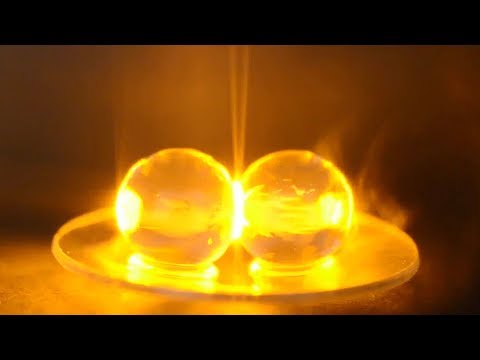
- Field Concentration and Plasma FormationTwo-Grape Interaction• When two grapes are placed close together or touching, electromagnetic fields from each grape interact with each other • The strongest electromagnetic field occurs at the contact point between the two grapes • This is why many videos use a watch glass to keep grapes together during microwavingPlasma GenerationThe extremely strong electromagnetic fields at the intersection ionize the air, creating sparks as electrons and ions are energized, leading to visible plasma formation.Plasma Characteristics• The plasma pulses at 120 hertz, which is twice the 60 hertz frequency of mains power • This pulsing reflects the oscillating amplitude of the microwaves in each cycle • Spectroscopic analysis shows strong potassium and sodium emission lines from ionized atoms in the grapeSize and AbsorptionWater in the grape absorbs microwaves, which broadens the resonance peaks and allows the effect to work across a range of grape sizes rather than requiring a precise size match.
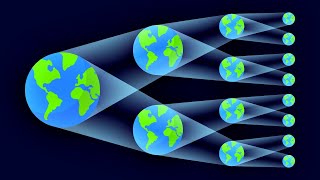
- Real-World Applications and Future ImplicationsLithography ChallengeCurrent microchip fabrication is limited by lithography techniques that struggle to create increasingly smaller features needed for continued technological advancement.Electromagnetic FocusingTwo spheres of the appropriate size and refractive index can focus electromagnetic energy from radiation with a 12 centimeter wavelength down to a tiny spot of about 1 millimeter at their contact point.Potential InnovationIf this focusing phenomenon could be adapted for use with light instead of microwaves, it could provide significant improvements over current lithography techniques, potentially enabling features as small as 2 nanometers.Moore's Law ContinuationThis approach could enable placing more features on a single chip with higher resolution, helping continue Moore's Law by allowing manufacturers to pack more components into smaller spaces.