
The Surprising Secret of Synchronization
10 chapters
- Introduction to Spontaneous OrderThe ParadoxThe second law of thermodynamics indicates everything tends toward disorder, yet spontaneous order appears throughout nature despite this tendency.Observable Examples• Synchronized metronomes • Perfectly timed orbits of moons • Simultaneous flashes of fireflies • Regular beating of the heartCentral QuestionWhat puts these systems in order in spite of nature's tendency for disorder?Real-World ImpactUnderstanding synchronization is essential to comprehending why natural systems can exhibit remarkable order and coordination.
- The Millennium Bridge DisasterOpening ProblemThe Millennium Bridge in London began wobbling when crowds filled it on opening day, despite being designed for heavy pedestrian traffic.Historical Context• Armies have known for nearly 200 years to break step when crossing bridges • In 1831, 74 men from the 60th Rifle Corps marching in sync caused the Broughton suspension bridge to collapse, injuring 20The PuzzleRandom members of the public were walking in step with each other on the Millennium Bridge without coordination, which should not have been possible.Closure and MysteryThe bridge was closed for two years after costing 18 million pounds, but the underlying cause remained unexplained at this point.
- Huygens' Pendulum Clock DiscoveryOriginal PurposeIn 1656, Christian Huygens invented the first working pendulum clock to help sailors determine their longitude by keeping accurate time while at sea.The ChallengeClocks of that era were inaccurate by about 15 minutes per day, while Huygens' pendulum clocks achieved accuracy to 10-15 seconds per day.Accidental DiscoveryWhile ill in February 1665, Huygens observed that two clocks hung from the same wooden beam would spontaneously synchronize their pendulums within 30 minutes, even after being deliberately disturbed.Key Finding• Air currents were not the cause of synchronization • When clocks were separated, synchrony disappeared • The wood beam transferred mechanical vibrations between the clocks, creating coupling between the two oscillators
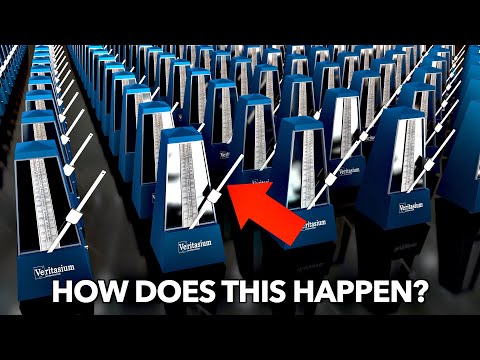
- Metronome Synchronization PhysicsThe DemonstrationMultiple metronomes with different natural frequencies placed on a light, wobbly platform will spontaneously synchronize their beats when started out of sync.How It Works• When large masses accelerate, they push the platform in the opposite direction, keeping the center of mass stable • Out-of-sync metronomes receive kicks from the platform motion that speed them up until they align with the majorityPhase RepresentationAn oscillator's position in its cycle can be represented as a point on a circle, with higher frequency causing faster circular motion.Mathematical ModelThe Kuramoto model describes how oscillators synchronize: each oscillator's rate depends on its natural frequency plus a coupling term related to its distance from other oscillators.
- Synchronization Across NatureFirefly SynchronizationFireflies in Southeast Asia synchronize their flashes despite each having its own natural frequency, with hundreds or thousands flashing simultaneously through strong coupling.Phase Transition MechanismSynchronization does not occur gradually as coupling increases; instead, it appears suddenly like water freezing at a critical temperature, a phenomenon called crystallization in time.Phase Transition ExampleAn audience in Budapest applauding spontaneously transitions from individual clapping to synchronized rhythm without external instruction, demonstrating the phase transition visually.Universal ApplicabilitySynchronization occurs at every scale from subatomic to cosmic, using gravitational, electrical, chemical, and mechanical interactions to coordinate coupled systems.
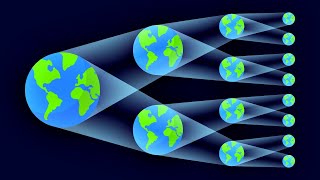
- Tidal Locking and Orbital ResonanceMoon SynchronizationEarth's moon is tidally locked, rotating exactly once per orbit around Earth, which is why we only see one side of it.How Tidal Locking Works• The planet's gravitational pull is stronger on the closer side, distorting the moon into an egg shape • As the moon orbits, bulges swing out of alignment with the planet • Gravitational forces constantly pull bulges back into alignment, slowing or accelerating rotation until lockedScale of the Phenomenon34 moons in our solar system are tidally locked to their planets, making this a common synchronization effect.Complex ResonanceJupiter's three innermost moons (Io, Europa, Ganymede) are tidally locked and also in a 1:2:4 orbital resonance, where for every Ganymede orbit, Europa completes 2 and Io completes 4.
- Chemical Oscillations and WavesThe BZ ReactionIn the 1950s, Russian chemists Boris Belousov and Anatol Zhabotinsky discovered an oscillating chemical reaction that behaves like a chemical pendulum, repeatedly changing colors between blue and orange.Thermodynamic AllowanceWhile thermodynamics states closed systems increase entropy over time, nothing prevents oscillatory damping to equilibrium, allowing the BZ reaction to function continuously.Observable Patterns• In stirred reactions, quadrillions of molecules act synchronously like a chemical clock • In unstirred petri dishes, spiral waves or target patterns emerge, with expanding circles of color propagating through the liquidImplicationsThe same spiral wave patterns seen in the BZ reaction appear in heart electrical activity, providing insight into cardiac arrhythmias.
- Cardiac Arrhythmias and DefibrillationThe ConnectionSpiral waves of electrical excitation in the heart resemble spiral waves in the BZ chemical reaction, suggesting common synchronization principles.Mentor's WorkResearcher Art Winfrey used chemical reaction waves to understand cardiac arrhythmias and develop insights for better defibrillator design.The DangerVentricular fibrillation is the most deadly arrhythmia, causing sudden death within minutes due to loss of blood pumping from desynchronization.The BalanceToo little synchronization causes heart failure, while too much synchronization can also cause problems, demonstrating the need for optimal coordination.
- The Millennium Bridge ExplanationDesign UniquenessThe Millennium Bridge featured unique ribbon-like construction with supporting cables running alongside like guitar strings.The Hidden FrequencyWhile civil engineers knew to avoid a vertical resonant frequency of 2 Hz matching walking pace, they missed that sideways resonance at 1 Hz also matters, matching the frequency of single footsteps.Trigger Mechanism• Individual sideways forces from footsteps are only 1/10th of downward forces and normally negligible • When sideways resonance aligns with foot frequency, people can start moving the bridge • At 166 people, acceleration grew dramatically, causing visible wobblingThe Feedback LoopThe moving bridge caused people to instinctively spread their legs and synchronize their walking with the bridge's motion, which pumped more energy into it, creating a positive feedback loop.
- Complex Systems and ReductionismScientific ApproachReductionism, breaking problems into smaller parts for analysis, has been phenomenally successful across all scientific branches.The New FrontierThe great challenge in modern science is understanding complex systems where the whole appears greater than the sum of its parts.Examples of Complexity• The immune system remains poorly understood despite knowing individual components • Consciousness and the economy resist reductionist explanationCore QuestionHow can we determine the properties of a whole system given knowledge of its individual component properties?