The Snowflake Myth
8 chapters
- Creating Snowflakes in the LaboratoryThe ExpertDr. Ken Libbrecht is a renowned snowflake researcher who served as a consultant for the movie Frozen and had his snowflake photographs featured on US Post Office stamps.The ProcessKen uses high-voltage equipment to create snowflakes in controlled laboratory conditions, with needle tips around 100 nanometers in diameter.Artistry InvolvedKen calls himself a designer snowflake creator, manually controlling growth conditions by adjusting temperature and humidity to produce snowflakes with specific characteristics.Quality AdvantageLaboratory-grown snowflakes have sharper and crisper facets compared to natural snowflakes, which begin to evaporate as they fall through the atmosphere.
- The Historical Record of Snowflake PhotographyDiscoveryWilson A. Bentley took the first close-up photograph of a snowflake in the wild in 1885 and originated the idea that no two snowflakes are alike.CollectionOver his lifetime, Bentley photographed more than 5,000 snowflakes, with selections published in his book Snow Crystals, which remains in print today.Selection BiasBentley only selected snowflakes in pristine condition with uncommon beauty and symmetry, meaning most natural snowflakes look quite different from his famous photographs.Reality vs. MythFinding beautiful snowflakes is extremely difficult; they are one in a million among the thousands that fall on any surface.
- Mysteries and Diversity of Snowflake StructureKey Questions• Why do all snowflakes have six-fold radial symmetry? • How do opposite arms mirror each other so perfectly? • Why are snowflakes flat, measuring millimeters in diameter but only micrometers thick? • How does one side of the snowflake know what the other side is doing?Variety of FormsSnowflakes take many different forms beyond the classic plate shape, including hollow columns, needles, cups, bullets, and capped columns.ClassificationKen Libbrecht identified 35 different types of snowflakes; historical classifications range from 41 to 108 types, with no universal standard definition.Formation BasisAll these different forms appear spontaneously from water vapor freezing into ice, with no DNA or blueprint controlling the process.
- The Science of Snowflake FormationFormation Process• Water evaporates into water vapor in the atmosphere • Rising vapor cools and becomes super saturated, with more water molecules than equilibrium • Molecules condense onto dust particles to form tiny droplets • One droplet eventually freezes, forming a hexagonal crystal seedMolecular StructureWater molecules form hydrogen bonds between the slightly negative oxygen and slightly positive hydrogen atoms, creating a hexagonal molecular lattice that determines crystal shape.Crystal GrowthWater vapor molecules preferentially stick to rough surfaces with dangling molecular bonds and bounce off smooth, flat facet surfaces, causing rough areas to fill in and creating faceted shapes.Snowflake DevelopmentAround 100,000 droplets are required to make a single snowflake, and the process usually takes 30 to 45 minutes.
- The Nakaya Diagram and Snowflake TypesThe DiscoveryIn the 1930s, Ukichiro Nakaya systematically studied snowflakes at the University of Hokkaido in Japan and discovered that temperature and super saturation level determine snowflake type.The Pattern• Around -2°C: plates form • At -5°C: columns and needles form • At -15°C: plates again • Below -20°C: columns and platesReading HistoryEach snowflake reveals its growth history through its shape; you can determine the temperature and humidity conditions the crystal experienced by examining its structure.Weather ApplicationTypical weather patterns like cold fronts produce capped columns because as air rises and cools, it first forms columns then plates, resulting in plates with columns on the ends.
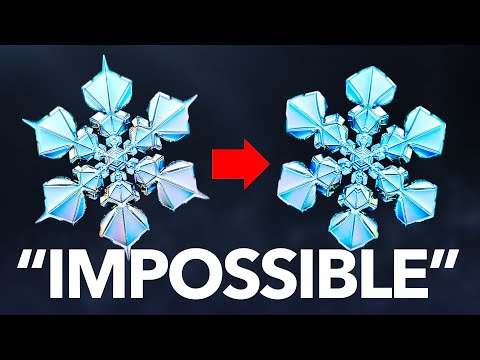
- Symmetry and Uniqueness ExplainedSymmetry SourceThe perfect symmetry between opposite arms of a snowflake is not because one side knows what the other is doing, but because both sides grow in identical conditions.Synchronized ResponseWhen a crystal changes position and temperature shifts, all six branches experience the same temperature change simultaneously and respond identically.Uniqueness OriginEach different snowflake follows a unique path through the atmosphere, experiencing a different set of temperature and humidity conditions, which is why no two snowflakes are alike.Lab ControlIn controlled laboratory conditions, Ken has created nearly identical twin snowflakes by growing them side by side under the same conditions, proving the theory.
- The Nucleation Barrier MysteryThe ProblemThe Nakaya Diagram explains most snowflake behavior, but it does not explain why we get columns at -5°C and then plates again at -15°C, a mystery unsolved since the 1930s.Ken's HypothesisNucleation barriers are lower for large flat facets, but narrow facets have different barriers with dips at specific temperatures: narrow basal facets dip around -4°C and narrow prism facets dip at -15°C.Edge EffectsOn narrow facet edges, water molecules stick to rough surfaces and diffuse to minimize surface energy, exceeding the critical density needed to overcome the nucleation barrier.Experimental ValidationKen's laboratory experiments investigating these effects agree nicely with the hypothesis, suggesting the molecular physics of ice may finally explain the diverse forms of snowflakes.
- Motivation and the Pursuit of KnowledgeScientific DriveKen has spent much of his career in astronomy and astrophysics, fields where researchers are never asked to justify their work by practical applications.Personal MotivationKen's real reason for studying snowflakes is simple: looking at a snowflake reveals that we don't understand how it works, and as a scientist, he wanted to be the one to figure it out.Core PhilosophyScientific curiosity driven by genuine puzzlement about natural phenomena is reason enough to pursue research.Understanding AchievementAfter 85 years, Ken's research may finally explain why snowflakes grow into such a diverse collection of columnar and plate-like forms through molecular physics.