
How to Understand What Black Holes Look Like
4 capitulos
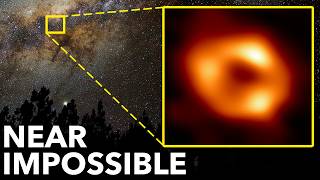
- The First Black Hole Image and Event HorizonsThe Historic ImageThe Event Horizon Telescope will release the first-ever image of a black hole on April 10th, 2019, which will resemble a fuzzy coffee mug stain.Event Horizon Basics• The event horizon is the location from which not even light can escape • The radius of the event horizon is called the Schwarzschild radius • Once you cross the event horizon, there is no coming back, not even for lightScientific SignificanceThis image will help determine whether the general theory of relativity accurately predicts what happens in the strong gravity regime around black holes.Why We Can See ItAlthough a black hole alone would absorb all electromagnetic radiation, Sagittarius A* (the black hole in the center of the Milky Way) has an accretion disk of matter around it, making it observable.
- The Accretion Disk and Orbital MechanicsMatter in Motion• The accretion disk contains dust and gas swirling chaotically around the black hole • Matter reaches temperatures of millions of degrees • Matter moves at a significant fraction of the speed of lightOrbital LimitsFor a non-spinning black hole, the innermost stable circular orbit is at three Schwarzschild radii; matter cannot orbit closer without spiraling into the singularity.Photon Sphere• Light, having no mass, can orbit closer than matter at 1.5 Schwarzschild radii • The photon sphere is actually a sphere of possible photon orbits in any orientation • From the photon sphere, you could theoretically see the back of your headStability IssuesThe photon sphere is an unstable orbit; photons either spiral into the singularity or spiral outward toward infinity.
- Spacetime Warping and the Black Hole ShadowLight BendingThe black hole warps spacetime around it, changing the paths of light rays so they don't travel in straight lines through space, though they do travel in straight lines through curved spacetime.Shadow Formation• Light rays crossing the event horizon are lost forever • Light rays coming in above the event horizon also get bent and cross it • Only light rays coming in 2.6 Schwarzschild radii away will graze the photon sphere and escape to reach observersShadow SizeThe resulting shadow is 2.6 times bigger than the event horizon itself, with the event horizon mapped onto the center of the shadow.Multiple ImagesLight can wrap around the back of the black hole, creating infinite images of the event horizon as rings approaching the edge of the shadow, though we primarily see the outermost ring from light grazing the photon sphere.
- Observing Black Holes at Different AnglesPerpendicular ViewWhen viewing perpendicular to the accretion disk, we see the black hole shadow with its characteristic ring structure.Edge-On Perspective• Even when viewing the black hole edge-on, we can see the shadow due to spacetime warping • Light from the top of the accretion disk bends over and reaches our telescopes • Light from the bottom bends underneath the black hole toward usAdvanced Effects• Light from the top of the accretion disk can wrap around the back and create a thin ring underneath the shadow • Light from the bottom can go underneath and around the back, creating a ring of light above • These effects create a spectacular appearance when viewed from close to the black holeBrightness Asymmetry• Matter moving toward us appears much brighter than matter moving away (relativistic beaming) • This Doppler beaming effect creates a bright spot on one side of the accretion disk in the image