How did they actually take this picture? (Very Long Baseline Interferometry)
4 capitulos
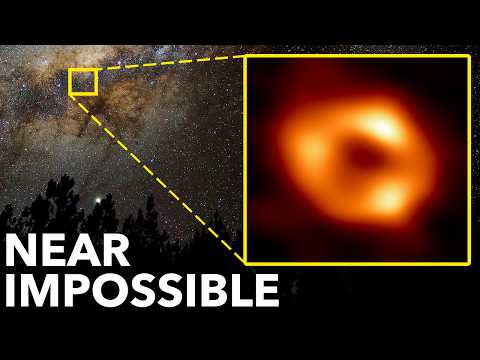
- The Challenge of Imaging Sagittarius A*Discovery & ContextThis is the second picture of a black hole ever taken, showing the supermassive black hole at the center of the Milky Way galaxy known as Sagittarius A*. The image captures hot plasma swirling around the black hole, which itself doesn't emit light.Key Challenges• Sagittarius A* is 2,000 times closer than M87* but 1,000 times smaller, appearing only slightly larger in the sky • Dust and gas between Earth and the galactic center block visible light observation • The black hole is unusually quiet and dark compared to M87, consuming little matter • Changes in appearance occur on the order of minutes, making observations difficultSize PerspectiveThe black hole appears the size of a donut on the moon when viewed from Earth. To understand this scale: divide the whole sky into 180 degrees, one degree into 60 arcminutes, one arcminute into 60 arcseconds, then divide an arcsecond by 100 three times over.Observation MethodObservations were made using radio waves with a wavelength of 1.3 millimeters, rather than visible light, because this allows penetration through the dust and gas surrounding the black hole.
- Radio Telescope FundamentalsHow Telescopes WorkRadio telescopes look like huge satellite dishes. When pointed at a radio source, all radio waves travel the same distance, bounce off the dish, and arrive at the same time in phase, producing a bright spot through constructive interference.Resolution Concept• Angular resolution is how narrowly a telescope can identify the source of radio waves • It is proportional to wavelength and inversely proportional to telescope diameter • Moving the telescope slightly past the source causes destructive interference and signal intensity drops to zero • The steeper this drop-off, the sharper the image producedResolution ImprovementTwo ways to achieve better resolution: observe higher frequency radio waves so slight telescope movement represents a greater fraction of wavelength, or increase telescope diameter to increase path length differences between radio waves on opposite sides.The Resolution ProblemFor any individual radio telescope on Earth, the angular resolution is too large to see the ring structure of a black hole. The telescope would still receive waves from both sides simultaneously as it passes over the black hole, unable to distinguish if there's a ring or just a blob.
- Very Long Baseline Interferometry TechniqueEarth-Sized SolutionTo see a black hole's ring requires a telescope the size of Earth, which is impossible. However, you don't need a complete dish—just pieces of it: individual radio telescopes separated by distances up to Earth's diameter.How VLBI Works• All telescopes observe Sagittarius A* simultaneously • Each telescope records the signal at its location with precision down to the femtosecond • Petabytes of data are generated from this process • Signals cannot be combined in real-time; instead hard drives were physically transported to centralized locationsSignal CombinationWhen two distant telescopes receive the same wave at the same time, the source must be located directly between them. However, radio waves could be multiple wavelengths closer to one telescope and still arrive in phase, creating ambiguity.Image FormationEach pair of telescopes produces interference patterns: close telescopes create wide fringes, distant ones create narrow fringes. By combining patterns from pairs at all different orientations and distances, an image of the black hole emerges from the interference patterns it created.
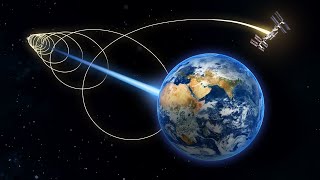
- Understanding the Black Hole ImageThe Shadow ExplainedThe black shadow in the image is 2.6 times larger than the event horizon itself. Light rays at 2.6 Schwarzschild radii away just graze the photon sphere at closest approach, then escape to infinity, creating the shadow's edge.What We Actually See• The event horizon maps to the center of the shadow • Light rays bend around the back of the event horizon and map to a ring on the shadow's edge • From one viewpoint, we see the entire event horizon mapped onto the shadow • Infinite images of the event horizon exist as you approach the shadow's edge due to additional light loopsSpacetime Warping EffectsThe black hole warps spacetime, changing light ray paths so they don't travel in straight lines. Light rays coming from any angle except far enough away will curve into the event horizon, fundamentally changing what's visible.Viewing Angle ImpactWhen viewing perpendicular to the accretion disk, you see a clean shadow. At other angles or edge-on views, light from the accretion disk bends over the top and underneath the black hole, creating the spectacular ring-like appearance seen in images. Relativistic beaming makes one side of the disk appear much brighter than the other.