Nappes phréatiques et eaux souterraines : où en est-on face à la pollution et la sécheresse ?
Un tiers de l’eau douce se cache sous nos pieds : ce sont les eaux souterraines, dont les nappes phréatiques font partie. Ces réserves en eau communiquent avec celles qui se trouvent en surface (lacs, rivières, zones humides…). Elles participent ainsi au cycle de l’eau. Comme les eaux de surface, elles sont fragilisées par la pollution, le réchauffement climatique et une utilisation trop importante par les activités humaines.
One-third of fresh water lies beneath our feet: these are groundwater resources, including phreatic tables. These water reserves communicate with those found on the surface (lakes, rivers, wetlands, etc.). They thus participate in the water cycle. Like surface water, they are threatened by pollution, climate warming and overuse by human activities.
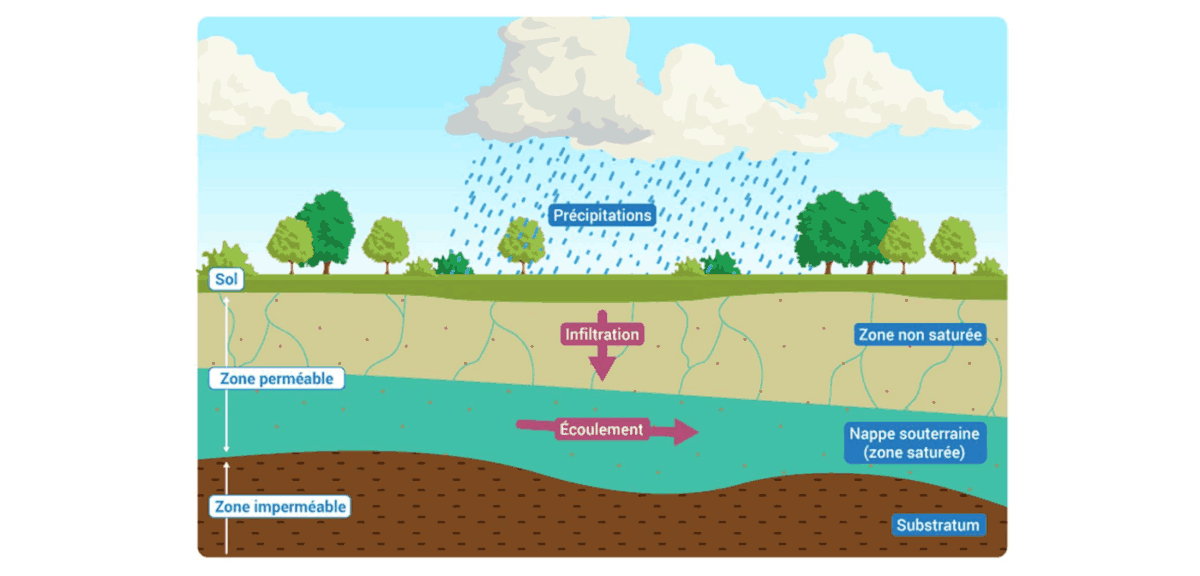
- How does water accumulate in soil?Groundwater formation• Water that infiltrates into the soil is stored in rock layers called "aquifers". This is where underground water tables form. Phreatic tables are those found near the surface. Other types of tables can be located deeper, several hundred meters below ground.Seasonal variation and recharge• The level of water tables varies throughout the year. Recharge (the period when the water table refills) occurs mainly from early autumn to early spring: • precipitation is generally more abundant; • temperatures are cooler, which limits evaporation; • plants need less water: water can therefore infiltrate without being captured by roots.Further resourcesFor more information, visit the EauFrance and BRGM websites.
- Why are groundwater resources under threat?Increasing use, decreasing availability• Groundwater, like surface water, is extracted and used for many human activities: drinking water supply, agriculture (irrigation of certain crops, livestock watering), industry (washing, cooling, food processing, etc.). • Climate change also severely disrupts the water cycle: evapotranspiration (water evaporation from soil and plant transpiration) has increased by 0.18% per year since 1959 in mainland France. This phenomenon dries out soils and reduces water resources. Result: water resources decreased by 14% between 2002 and 2023 (compared to 1990-2001). • In 2023, despite average evapotranspiration, water resources were 18% below normal. Usage restrictions were therefore implemented on 34% of the territory for surface water and 7% for groundwater. Between 2012 and 2023, the frequency of restrictions in France showed that water needs are now too high compared to its availability. • Source for all data on this page: France 2025 Environmental Assessment, SDES.Frequent pollution, often from pesticides• Like surface water, groundwater can be polluted by industrial, agricultural or domestic activities. In 2022, only 68% of groundwater was in good chemical condition, meaning with a concentration of pollutants (heavy metals, pesticides, hydrocarbons, etc.) below regulatory levels. This figure is unsatisfactory, but it has improved compared to 2010, when 59% of groundwater was in good chemical condition. • Pesticides in particular are the source of these pollutions, in mainland France as in the overseas territories. The northern half of France is most exposed to groundwater pollution by pesticides, particularly in the Seine-Normandy, Rhine-Meuse and Artois-Picardy basins. The Loire-Brittany basin is also affected, especially in its eastern part, with areas of large-scale crops (Beauce, Berry). • During 2021-2023, the main pollutions were caused by substances banned for several years, or by their metabolites (products resulting from their degradation in the environment). These substances sometimes persist in soils and natural environments for decades after their use ends. This is notably the case: • chlordecone, banned in 1993; • atrazine, banned in 2003; • chloridazone, banned in 2020; • mancozeb and bentazone, banned in 2021 and 2022. • About half of groundwater tables have a total pesticide concentration exceeding the quality threshold of 0.5 μg/l. • Monitoring of groundwater also covers other micropollutants such as solvents, PAHs (polycyclic aromatic hydrocarbons), PFAS (per- and polyfluoroalkyl substances), drug residues, metals, etc. Analyses conducted from 2021 to 2023 also reveal their presence in groundwater. • Groundwater is also polluted by nitrates. After increasing significantly until 2013, their concentration has remained stable since. The national average is around 29 milligrams of nitrates per liter (mg/l). This is above but fairly close to the reference value of 25 mg/l. • The level of nitrate contamination of water tables varies greatly depending on the region. The northern half of France is thus most exposed to this pollution (as with surface water). This pollution is mainly linked to intensive agriculture. • Nitrate concentration in groundwater closest to the surface (2021-2023)Drinking water intakes forced to close• In 2025, France had 37,788 active water intakes intended for drinking water production. 36,207 of them draw water from groundwater. Each year, this heritage shrinks: between 1980 and 2025, nearly 14,640 intakes have been closed. • Among the causes of these closures: • 31.9% were linked to water quality deterioration (of which 41.6% due to excessive nitrate and/or pesticide concentration); • 8.6% were linked to production flow rates that were too low; • 5.3% were linked to the inability to ensure resource protection. • Since the mid-2010s, the share of these closures due to excessive pollution or degraded quality is closer to 20%. • Today, network rationalization, aging infrastructure, and flow-related issues are the main reasons for closing water intakes. • Closed drinking water intakes and main reasons for abandonment (1980-2025)
Further reading
- Les eaux souterraines (Eau France)eaufrance.fr
EauFrance est le service public d’information sur l’eau. Cette page explique le fonctionnement des nappes d’eau souterraine et présente de nombreuses ressources pour connaître leur état.
- Dossier thématique eau souterraine, sécheresse et inondations (BRGM)brgm.fr
Le BRGM (bureau de recherches géologiques et minières) est l’établissement public français expert du sol et du sous-sol. Cette page répond à de nombreuses questions au sujet de l’eau souterraine, du suivi des nappes phréatiques et des données à ce sujet.