Les feux de forêts
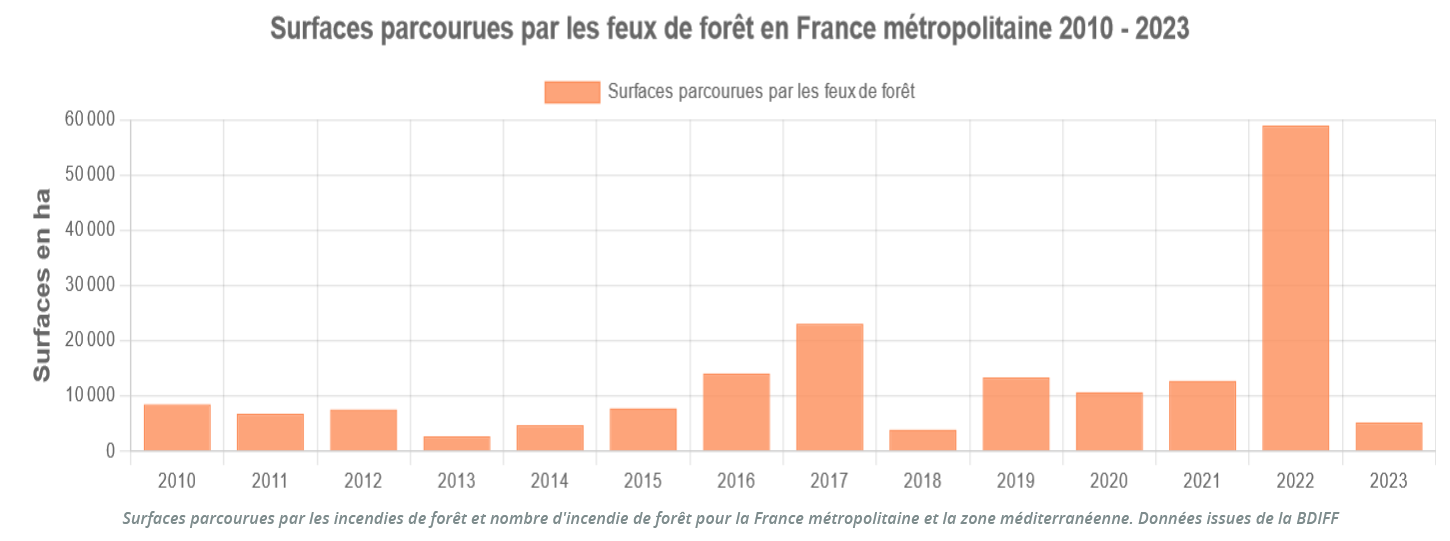
Les sécheresses et les canicules liées au changement climatique augmentent les risques de feux de forêts. Si le sud de la France est historiquement plus vulnérable aux incendies, ce risque s’étend désormais à d’autres régions. En 2022, une commune sur cinq en France a été déclarée exposée aux feux de forêts par les préfets, et 90 départements ont été touchés par un incendie de végétation significatif.
Droughts and heat waves linked to climate change are increasing forest fire risks. While southern France has historically been more vulnerable to fires, this risk is now spreading to other regions. In 2022, one in five municipalities in France was declared exposed to forest fires by regional prefects, and 90 departments were affected by significant vegetation fires.
4 chapters
- What are the causes of forest fires?Human-caused fires• 9 out of 10 fires are caused by humans. They result from everyday carelessness, economic activities, or deliberate acts of sabotage. Many fires stem from negligence: discarding cigarette butts, burning vegetation or waste, leaving barbecues or campfires improperly extinguished, setting off fireworks, or spreading fireplace ashes, for example. Work that generates sparks, construction sites, and agricultural or forestry activities can also start fires. Some fires are triggered accidentally by electrical networks, railways, or vehicle fires. The majority of fires start within 50 meters of homes (source: Géorisques, expert file on forest fires).Spread conditionsFires become more intense and spread faster in heat, dry air, and wind, especially when soil and vegetation are dry. When these conditions align, even a weak heat source, such as a cigarette butt, can produce flames.Natural causes1 in 10 forest fires is caused naturally, triggered by lightning (source: Géorisques, Forest or vegetation fire).
- What are the consequences of forest fires?Impacts on population• Forest fires pose a significant danger to the public and firefighters, as they can cause deaths or injuries. Additionally, air pollution from smoke and soil and water pollution from ash have negative effects on human health and the environment. • Fires can have economic and social consequences such as loss of agricultural production and timber, decline in tourism activity, or loss of homes and workplaces. • In 2022, 6,870 municipalities were declared exposed to forest fire risk by regional prefects: this represents approximately one in five municipalities. 5 regions account for 90% of municipalities declared exposed to forest fires: Occitania, Auvergne-Rhône-Alpes, New Aquitaine, Provence-Alpes Côtes d'Azur, and Corsica (source: Géorisques, expert file on forest fires). Climate conditions and vegetation type make southern France regions more vulnerable to forest fires. However, due to climate change, the risk is gradually extending across mainland France. • France experienced a particularly high number of forest fires in 2022. That year, 90 departments in total were affected by significant fires. Some, such as Jura or Finistère, were previously little exposed to this risk. The 2022 fires are a concrete example of climate change consequences: drought and heat waves affecting mainland France greatly contributed to the increase in forest fires (source: Géorisques, Forest or vegetation fire).Environmental impactsForest fires destroy areas rich in biodiversity. Trees and vegetation are burned and few wild animals manage to escape. Fires also cause greenhouse gas emissions: trees store carbon dioxide (CO2) which is released into the atmosphere when they burn.
- Forest fires: effects of climate changeRisk expansionHigh temperatures, droughts, and decreased summer rainfall: the effects of climate change increase forest fire risk. According to a Senate information report, by 2050, nearly 50% of mainland moors and forests could face high exposure to forest fires. In 2010, only one-third were exposed. With climate change, new regions are being affected by forest fires. The risk is spreading notably in northwestern France, in the Loire Valley, Centre-Val de Loire, Brittany, and Île-de-France.Extended fire seasonFurthermore, the annual period exposed to forest fires is likely to lengthen with climate disruption (source: Géorisques, expert file on forest fires). According to Météo France, in a France warming by +4°C by 2100, fire risk would spread across the entire country, with severe aggravation in the Mediterranean region. The fire season could last 1 to 2 additional months in some regions.
- Prevention of forest firesNational strategy and planning• Following the 2022 forest fires, France adopted in 2023 the national strategy for defending forests and non-wooded areas against fires. This strategy aims to limit the intensification and expansion of fire risk and reduce negative consequences for people, the environment, animals, and the economy. To achieve this, actions are being implemented to improve knowledge of this risk and solutions, and to raise awareness of good practices to prevent fires. • Certain arrangements are useful for preventing and fighting fires, such as cleared strips in forests. Creating a break in vegetation slows the advance of flames. There must also be access roads in forests reserved for firefighter vehicles, and water sources, such as water tanks. • Access to forest areas can be limited or prohibited to the public during high-risk periods. Finally, legal obligations to clear vegetation around one's home are also effective in preventing fire starts and slowing their spread (see the box below).Forest weather serviceSince 2023, Météo-France broadcasts daily from June to September a forest weather forecast. This map informs you of the fire danger level in your department: green (low danger), yellow (moderate danger), orange (high danger), and red (very high danger). The danger level is measured based on weather forecasts of conditions favorable to fire start and spread: air humidity and temperature, wind, rain, and vegetation drought conditions.Clearing obligationsTo protect your home from forest fires, clearing vegetation is essential. This helps prevent fires from starting, slows their progression, and facilitates firefighter intervention. In some departments, if your home is located less than 200 meters from a forest or woods, clearing is a legal obligation. To find out if you are affected, consult cartes.gouv.fr or contact your town hall. Clearing involves, for example, mowing grass, cutting low tree branches, trimming hedges, removing brush, and sometimes cutting down trees or branches too close to your home. It is also important to dispose of garden waste by taking it to a recycling center or composting it. The goal is to reduce the amount of material that can burn and could fuel a fire.
Further reading
- La météo des forêtsmeteofrance.com
- Débroussailler: comment protéger votre habitation des feux de forêt et de végétation?ecologie.gouv.fr
- Débroussailler pour protéger sa maison des incendies: ce qu’il faut savoirnotre-environnement.gouv.fr