Les tremblements de terre et les éruptions volcaniques
En France métropolitaine et dans les outre-mer, plusieurs régions sont exposées au risque de séismes, en particulier les Antilles. Les tremblements de terre de 2004 en Guadeloupe et de 2007 en Martinique ont eu de graves conséquences sur la population. En 2019, le séisme du Teil en Ardèche a entraîné des dégâts sur de nombreux bâtiments. Entre 1982 et 2022, 668 communes ont été reconnues au moins une fois en état de catastrophe naturelle pour des tremblements de terre (source : SDES, Chiffres clés des risques naturels 2023). La France compte aussi quatre volcans actifs dans les outre-mer.
In mainland France and overseas territories, several regions are exposed to earthquake risk, particularly the Caribbean. The 2004 earthquakes in Guadeloupe and 2007 earthquakes in Martinique had serious consequences for the population. In 2019, the Ardèche Teil earthquake caused damage to many buildings. Between 1982 and 2022, 668 municipalities were officially recognized at least once as being in a state of natural disaster due to earthquakes (source: SDES, Chiffres clés des risques naturels 2023). France also has four active volcanoes in its overseas territories.
2 chapters
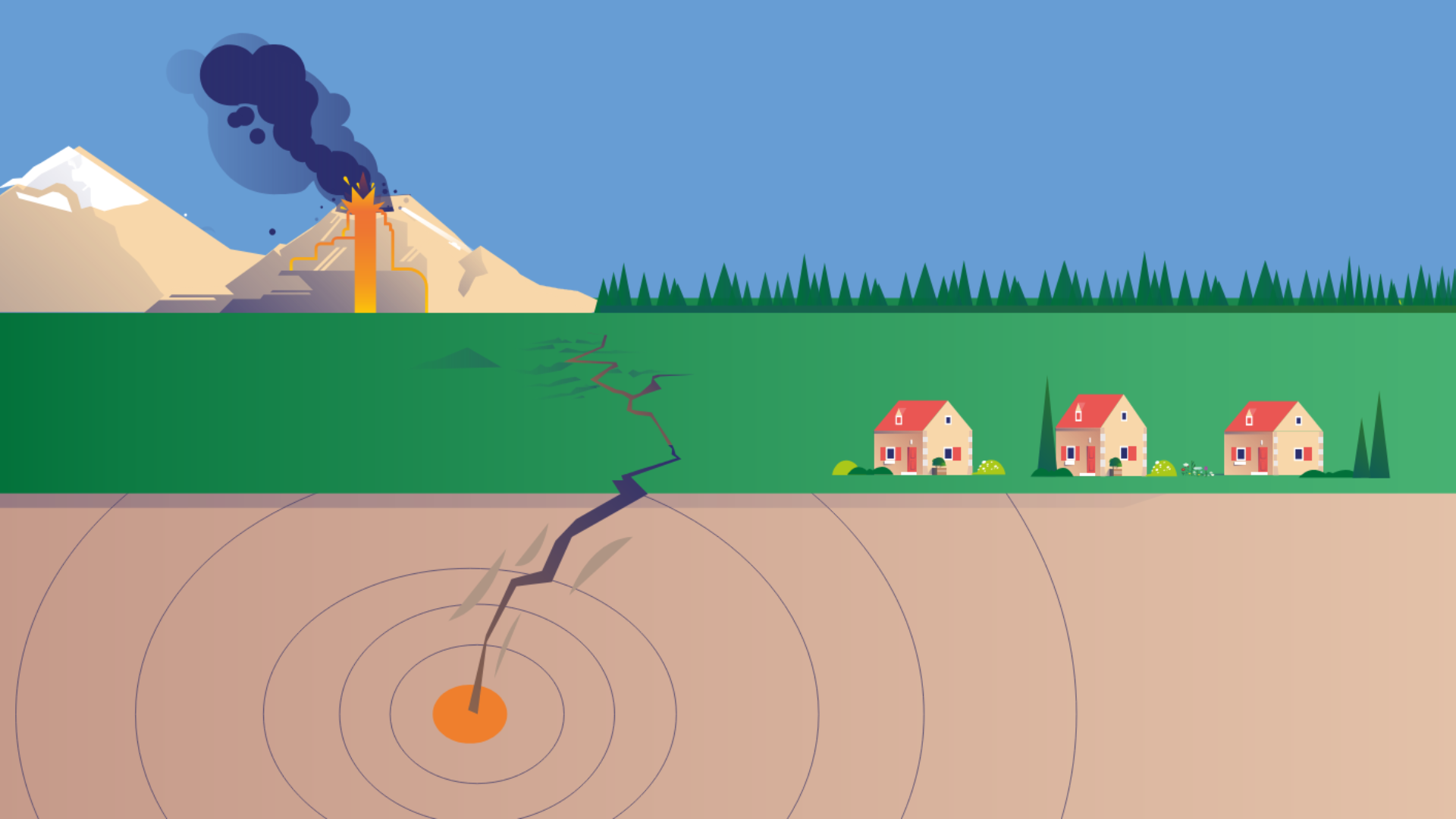
- Earthquakes: an unpredictable and destructive riskGeneral context• Earth's crust is divided into several tectonic plates: these are rock blocks beneath the ground that can move due to heat stored at the Earth's center. Tectonic plates can move closer together, overlap, move apart, or slide against each other. As they move, they cause the earth to shake and trigger earthquakes. They can also create volcanoes at the boundary between two plates.Damage and hazards• Earthquakes can cause major damage to buildings and endanger people's lives. They can also trigger landslides, tsunamis, or break water, energy, and communication networks. If they destroy pipes or hazardous substance storage sites, earthquakes can cause significant water and environmental pollution. • Today, it is impossible to know with certainty when an earthquake will occur. This makes them particularly dangerous because it is nearly impossible to evacuate buildings in time.Population protection• To protect populations from earthquake risk, there are building codes for earthquake-resistant structures, which are buildings more resistant to ground vibrations. Additionally, the public must be educated on safety measures: for example, it is recommended to secure furniture to walls as a precaution. During shaking, people should take shelter away from windows, near a wall, under a table, or move away from buildings (source: Géorisques, Que faire en cas de séisme?). • > How do we define the severity of an earthquake? > There are two ways to measure the violence of an earthquake: magnitude and intensity. Magnitude corresponds to the amount of energy released as seismic waves. The Richter scale is the most well-known for measuring it: for example, a magnitude 4 earthquake is clearly felt by the population but causes little damage, whereas a magnitude 6 or 7 earthquake is destructive. > The intensity scale of an earthquake measures how people experience it and the extent of damage. It depends on the magnitude, but also on the depth of the focus (the starting point of the earthquake underground), the nature of the soil, and the distance of populations from the epicenter. The epicenter is located on Earth's surface, directly above the focus, and is generally where the shaking is most violent. > The earthquake intensity scale ranges from 1 to 12, from imperceptible shaking to widespread building collapse (source: Géorisques, séisme).What are earthquake risks in France?• In France, the highest earthquake risk is in the Caribbean: in Guadeloupe, Martinique, Saint Martin, and Saint Barthélemy. Indeed, the Caribbean is located at the boundary between the North American, South American, and Caribbean tectonic plates. Between 2014 and 2019, nearly 4,600 earthquakes occurred in Guadeloupe and Martinique. 99% of them were below magnitude 3. • In mainland France, earthquake risk is moderate. Compared to Mediterranean countries such as Turkey, Greece, or Italy, France is rarely affected by high-magnitude earthquakes. Nearly all earthquakes that occurred between 1962 and 2020 in mainland France were below magnitude 3. The mainland regions most exposed are the Pyrenees, the Alps, Provence, and Alsace (source: SDES, Chiffres clés des risques naturels 2023).
- Volcanic eruptionsFour active volcanoes• Magma is molten rock, extremely hot, located inside the Earth. Volcanic eruptions occur when this magma rises toward the surface. • There are two types of volcanic eruptions. "Effusive" eruptions release magma as fluid lava that flows down the volcano. "Explosive" eruptions release solid materials at high temperature, along with large quantities of gas. • Eruptions are sometimes accompanied by pyroclastic flows: these are avalanches of hot gas, ash, and rock fragments. There can also be ash falls and volcanic "bombs," gas emissions, mudslides, and ground movements. • Volcanic eruptions can last from a few hours to several dozen years, or even centuries. This means they can lead to long periods of crisis and have lasting consequences for the population and environment (Source: Géorisques, éruption volcanique). • Active volcanoes in overseas territories are permanently monitored by volcanological and seismological observatories. These observatories can anticipate volcanic eruptions by studying, for example, earthquakes, volcano movements, and temperature changes. • If an eruption is likely, the Orsec Volcano plan (Organization of Civil Security Response) is applied. It provides for the evacuation and safety of the population according to different alert levels (Source: SDES, Chiffres clés des risques naturels 2023).Piton de la Fournaise, RéunionBetween 1979 and 2021, Piton de la Fournaise on Réunion erupted 83 times. The average duration of an eruption is about 19 days and 96% of lava flows are emitted in an uninhabited area. Eruptions can, however, pose a risk to visitors attracted to the volcano.Montagne Pelée, MartiniqueMontagne Pelée is an active volcano located in northern Martinique. It has been under yellow alert since 2020, meaning its monitoring by scientists has been strengthened.La Soufrière, GuadeloupeLa Soufrière is an active volcano in Guadeloupe's national park. Should it erupt, nine municipalities would need to be evacuated.Fani Maoré, underwater volcanoAn underwater volcano recently appeared fifty kilometers off the Island of Mayotte. In 2018, many earthquakes were felt by island residents. It was while investigating the cause of these tremors that scientists discovered Fani Maoré in 2019 (Source: SDES, Chiffres clés des risques naturels 2023).
Further reading
- Les risques naturels en France : état des connaissances en 2025statistiques.developpement-durable.gouv.fr
SDES, le 12/02/2026
- Géorisques, le portail pour s’informer sur les risques naturels et technologiquesgeorisques.gouv.fr