Les mouvements de terrain en France : types de risques et prévention
Glissements de terrain, effondrements de cavités souterraines, éboulements : les risques de mouvements de terrain concernent 41 % des communes françaises, soit 4 sur 10. Ils peuvent avoir des conséquences importantes sur les bâtiments et parfois mettre en danger les personnes. 54 % des maisons individuelles, soit plus de la moitié, sont aussi exposées au retrait-gonflement des argiles, ce qui provoque des fissures aux murs, car les sols argileux gonflent avec la pluie et se rétractent en période de sécheresse (Source : SDES, Les risques naturels en France – État des connaissances en 2025 ).
Landslides, subsidence of underground cavities, rockfalls: ground movement risks affect 41% of French municipalities, or 4 out of 10. They can have significant consequences on buildings and sometimes endanger people. 54% of individual homes, or more than half, are also exposed to clay shrinkage-swelling, which causes cracks in walls, because clay-rich soils swell with rain and shrink during dry periods (Source: SDES, Natural Hazards in France – State of Knowledge in 2025).
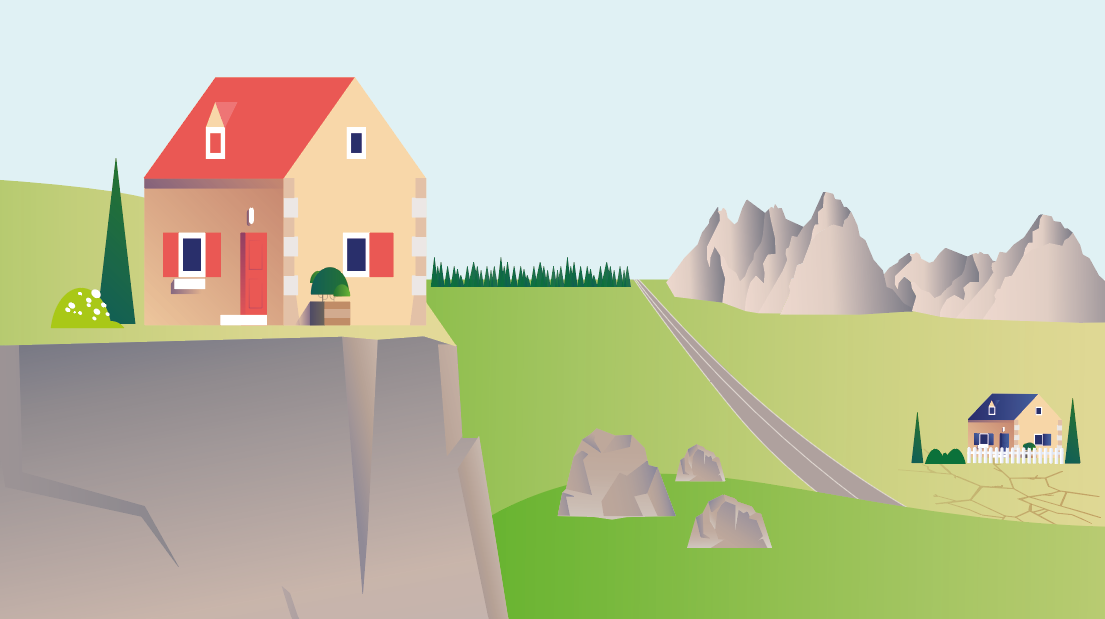
- LandslidesDefinition and speedLandslides are generally slow: they are masses of earth that descend gradually down a slope. The ground can move at different speeds: from a few millimeters per year to a few meters per day.CausesLandslides can be triggered by heavy rainfall, snowmelt, erosion of a watercourse, collapse of underground cavities, or earthquakes. They can also occur due to human activities, such as development work (Source: Géorisques, expert report on ground movements).Sensitivity in mainland France• Sensitivity to landslides in mainland France • Approximately 20% of mainland France has a high or very high sensitivity to landslides. Mountain areas, such as the Alps, Corsica, the Massif Central, the Pyrenees, and the Vosges, are the most exposed to this risk.Overseas territoriesThe Caribbean and Réunion are also exposed to landslides, which can transform into mudslides due to abundant tropical rainfall and clay-rich terrain on steep slopes (Source: SDES, Key Figures on Natural Hazards 2023).
- Rockfalls and rockslides in mountainsDefinitionRockfalls occur when large chunks of rock suddenly fall from a cliff or mountain. These are therefore rapid and sudden ground movements.Infrastructure damageThey can cause damage, particularly to roads and railways. Rock blocks can fall on cars, damage the road surface, destroy signs or safety barriers along roads. On the rail network, rockfalls can damage trains, rails, or electrical cables. This can disrupt traffic for a few minutes or several months, depending on the severity of the damage (Source: Key Figures on Natural Hazards 2023).CausesRockfalls can be triggered by heavy rainfall, the alternation between freezing and thawing, vegetation growth, or earthquakes, for example (Source: Géorisques, expert report on ground movements).
- Subsidence of underground cavitiesOrigin of cavitiesFrance has approximately 173,800 underground cavities, which is 5 times more than the total number of municipalities in France. They are sometimes of natural origin: water can carve holes in rock. But approximately 54% of underground cavities are of human origin. For example: shelters or galleries dug for military purposes, cellars, or underground quarries. Quarries are cavities that were dug to extract building materials such as stone, sand, or minerals. They are very numerous in the Île-de-France region and in the Centre-Val de Loire region.Associated risksSeveral risks are associated with underground cavities: subsidence, where the ground above the cavity gradually descends, localized collapse of part of the cavity, or general collapse of the entire cavity. This can be dangerous for buildings above a cavity and make the ground unsuitable for construction: work is then necessary to strengthen the soil.Geographic distribution• The departments of Eure and Seine-Maritime in Normandy contain nearly 25% of known underground cavities in France. This is explained by the presence of former quarries, and especially former marl pits. Marl pits are cavities dug to extract marl or chalk, used to make agricultural soils more fertile. • There are also former quarries in more than half of the municipalities in Paris and the inner suburbs (Hauts-de-Seine, Seine-Saint-Denis, and Val-de-Marne) (Source: SDES, Key Figures on Natural Hazards 2023). • Number of underground cavities per 10 km² by department
- Clay shrinkage-swelling: a risk for homesDefinition and exposureClay-rich soils swell with rain and shrink during dry periods: this is what is called clay shrinkage-swelling. It is a slow ground movement that weakens the structure of houses and can cause cracks. 54% of individual homes in France are exposed to this risk (Source: SDES, Natural Hazards in France – State of Knowledge in 2025).Preventing ground movement risks• Is your municipality affected by the risk of ground movements? Search for your address on the Géorisques website to learn more about the risks around you. • Natural hazard prevention plans (PPNR) are established by local authorities to protect property and people. These plans define, in particular, construction rules for areas exposed to a risk. Over 2,000 municipalities in France are covered by a prevention plan for clay shrinkage-swelling. 1,900 municipalities are covered by a prevention plan for other ground movement risks (Source: SDES, Natural Hazards in France – State of Knowledge in 2025).
Further reading
- Retrait-gonflement des sols argileux : plus de 4 millions de maisons potentiellement très exposéesnotre-environnement.gouv.fr
Les maisons se fissurent à cause des épisodes de pluie et de sécheresse. Avec le changement climatique, le risque de retrait-gonflement des argiles augmente en France.
- Géorisques, mieux connaître les risques sur le territoiregeorisques.gouv.fr
- Les risques naturels majeurs en Francenotre-environnement.gouv.fr
La France est exposée à des risques naturels variés et de plus en plus fréquents, pouvant avoir des conséquences matérielles et humaines importantes.
- Fissures et sécheresse : 12 millions de maisons exposées au retrait-gonflement des argilesnotre-environnement.gouv.fr
Les maisons se fissurent à cause des épisodes de pluie et de sécheresse. Avec le changement climatique, le risque de retrait-gonflement des argiles augmente en France.
- Géorisques - Mieux connaître les risques sur le territoiregeorisques.gouv.fr
Le site Géorisques, édité par le ministère du Développement durable et conçu par le Bureau de Recherches Géologiques et Minières (BRGM), rassemble les informations géographiques sur les risques naturels et technologiques dans un portail national.