
Augmentation des aérosols dans l’atmosphère
Les aérosols désignent des particules fines en suspension dans l’air, solides (poussières) ou liquides (embruns), de nature organique (suie) ou minérale (roche érodée). La grande majorité d’entre elles sont d’origine naturelle (éruptions volcaniques, tempêtes de sable, etc.) mais elles peuvent également résulter des activités humaines (aérosols primaires) ou de transformations physico-chimiques dans l’atmosphère (aérosols secondaires). Les aérosols sont susceptibles d’agréger de multiples substances d’origine différente. Leur composition, au droit d’un territoire donné, dépend en partie des activités qui s’y déroulent.
Aerosols are fine particles suspended in the air, solid (dust) or liquid (sea spray), of organic (soot) or mineral (eroded rock) nature. The vast majority originate from natural sources (volcanic eruptions, sandstorms, etc.) but can also result from human activities (primary aerosols) or from physicochemical transformations in the atmosphere (secondary aerosols). Aerosols can aggregate multiple substances of different origins. Their composition in any given territory depends in part on the activities taking place there.
2 chapters
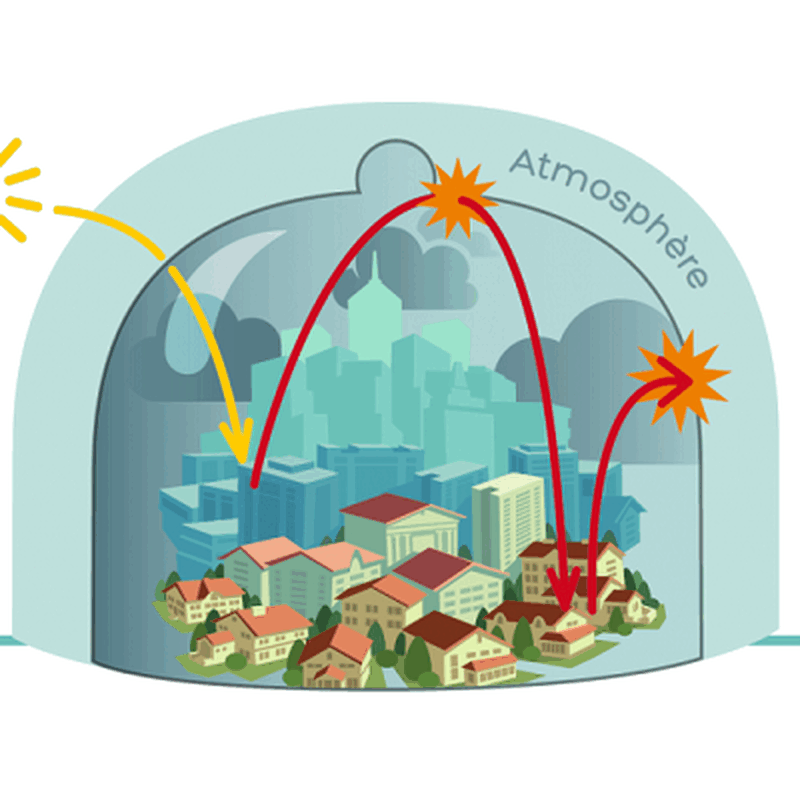
- Global issuesHealth effects• Due to their small size, aerosols can penetrate the respiratory system and cause harmful health effects in both the short and long term. Larger particles (diameter greater than 5 µm) are retained in the nasopharyngeal region, while the finest particles (less than 1 µm) can reach the bronchiolar and alveolar regions, where they may persist in these tissues for extended periods. • The most vulnerable populations to aerosols are fetuses, newborns, children, the elderly, and anyone with cardiovascular or respiratory disease, diabetes, or obesity.Climate influence• Since the pre-industrial era, human activities have doubled the global atmospheric concentration of most aerosols (Rockström et al., 2009). Furthermore, as shown by the Intergovernmental Panel on Climate Change (IPCC) in its successive reports, aerosols have a strong influence on the climate system by disrupting Earth's radiative balance. Indeed, increased aerosol concentration in the atmosphere leads to higher atmospheric opacity and can reduce solar radiation reaching Earth's surface by 10% to 15%. The impact of aerosols on cloud formation and lifecycle is a notable example. • The effects of aerosols on radiative balance are also linked to the physicochemical composition of the particles present: thus, those composed of black carbon and organic carbon (from cooking and heating using biofuels and diesel transport) tend to cause warming, unlike those made of sulfates and nitrates (from fossil fuel combustion). The latest IPCC report (2018) indicates that the contribution of 'warming' aerosols is becoming dominant due to increased emissions of soot carbon particles.Planetary boundary• Due to their potentially harmful effects on climate and health, increased atmospheric aerosols constitute one of nine critical global processes (Rockström et al., 2009). The planetary boundary is understood in terms of global particle concentration in the atmosphere on a regional basis. However, the complexity of aerosols and spatio-temporal variability of particles, sources, and impacts has prevented defining a global threshold. • During the revision of the conceptual model (Steffen et al., 2015), the boundary is refocused on aerosol optical depth [2] (or 'atmospheric opacity rate due to aerosols'). The South Asian monsoon is used as a case study. The optical depth of anthropogenic aerosols (warming and scattering) over the Indian subcontinent is 0.25; the regional threshold provides that the optical depth of warming aerosols should be less than 10% of the total optical depth of aerosols (warming and scattering). • In 2015, the aerosol optical depth measured in Southeast Asia is 0.30. Indeed, aerosols can have a major impact on Asian monsoon circulation: they act as an additional heat source at altitude and can cause precipitation to shift earlier in May–June in the Himalayan region.
- Situation in FranceFine particle composition• Since 2008, the Central Air Quality Monitoring Laboratory has managed a chemical characterization program for particles at the national scale, the CARA program. This program aims in particular to understand as quickly as possible the origin of particle pollution episodes that occur each year in France. • About fifteen measurement sites, distributed across the entire national territory, can carry out filter sampling and chemical analyses in real-time and continuously. This operational system, unique in Europe, allows for the collection of valuable information for better air quality management during pollution episodes and for developing and evaluating action plans.Human emissions sources• In France, four main activity sectors account for PM10 particle emissions (fine particles with diameter less than 10 µm): the residential and tertiary sector (mainly from wood combustion), industry, agricultural activities (spreading, effluent storage, re-suspension during plowing, burning), and transport. Their emissions decreased in total by 41% over the 2000–2017 period due to improvements in all activity sectors (enhanced dust collection techniques in industry, improved performance of wood heating systems, etc.). • The distribution of PM2.5 emission sources is different: emissions from residential and tertiary sectors (wood combustion primarily) are predominant. These are followed by industry and transport. PM2.5 emissions decreased by 48% over the 2000–2017 period. This decline is due to improvements achieved in all activity sectors, such as improved biomass combustion technologies.Population exposure• In Europe, outdoor air pollution from fine particles causes over 400,000 premature deaths annually, with nearly 40,000 in France (European Environment Agency, 2018). Since October 2013, ambient air particles have been classified as carcinogenic to humans (Group 1) by the International Agency for Research on Cancer based on sufficient evidence of an association between exposure and increased lung cancer risk. • France regularly faces national-scale pollution episodes. Over the 2013–2016 period, these episodes are mainly due to particles smaller than 10 µm in diameter (PM10). In early winter, episodes are marked by a large amount of organic matter linked to combustion phenomena such as wood heating or burning garden waste. In spring, observed episodes are distinguished by the influence of emissions from agricultural activities (fertilizer spreading) that combine and interact with pollutants from industry and transport. • Natural phenomena, such as volcanic eruptions or transport of terrestrial dust from Africa, can also lead to particle pollution episodes.