Des événements climatiques extrêmes de plus en plus fréquents
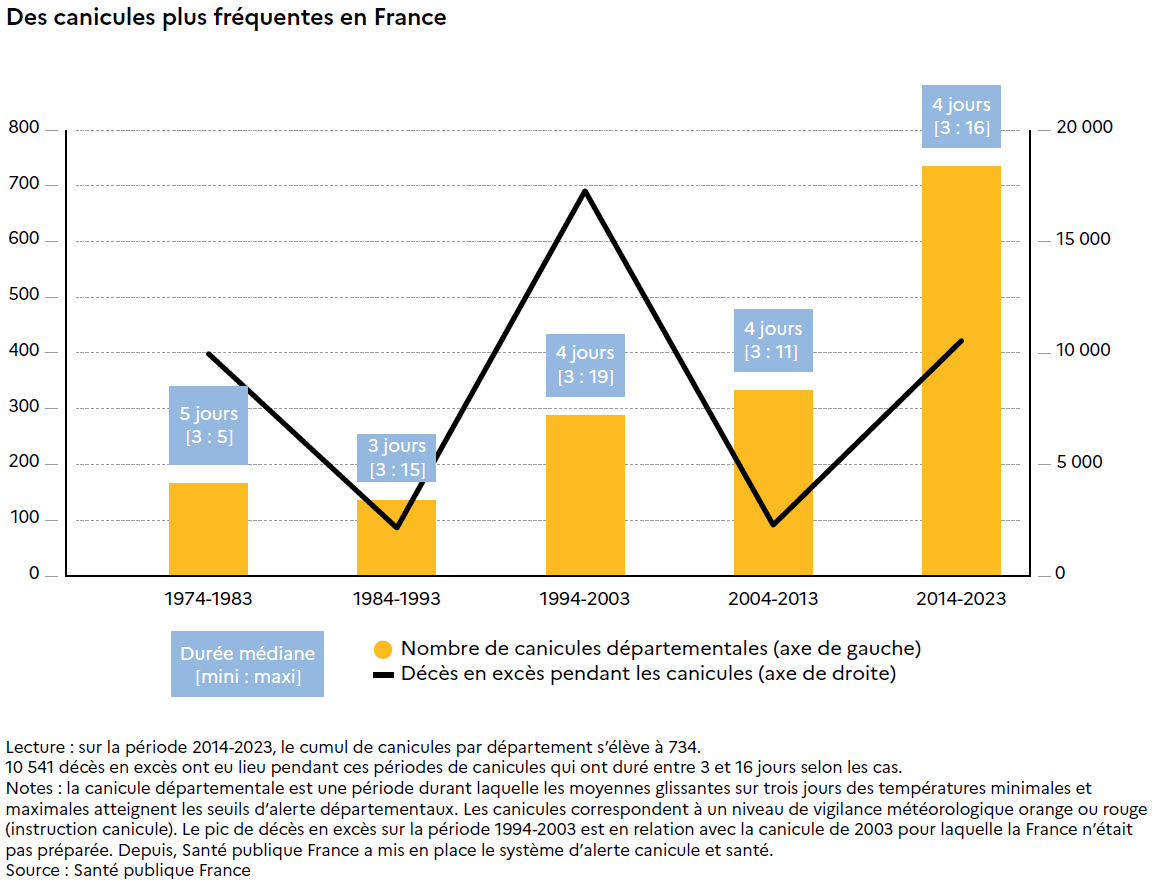
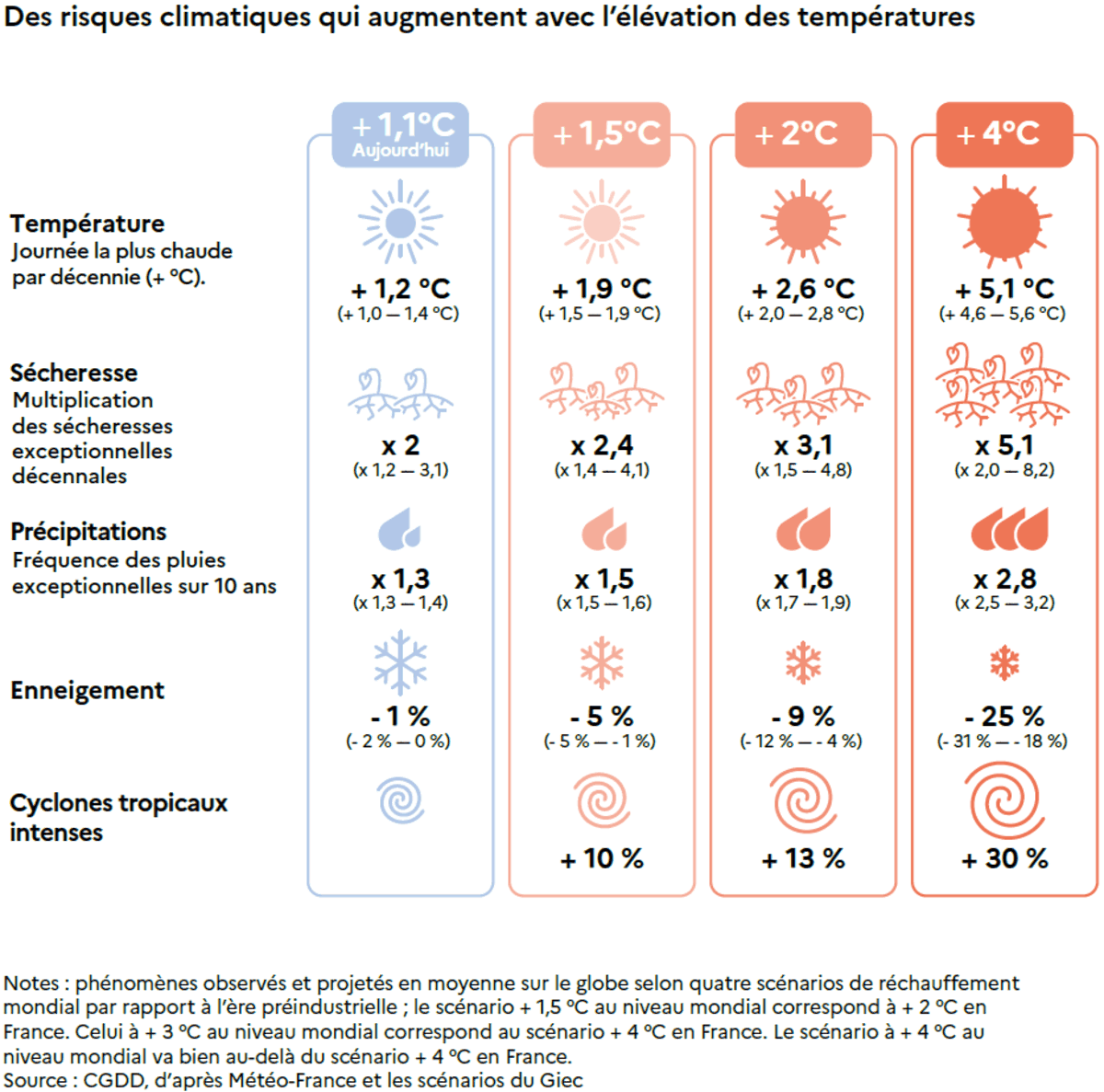
Inondation et submersion par les vagues, mouvement de terrain, avalanche, feu de forêt, cyclone, tempête, séisme, éruption volcanique : parmi les huit principaux types d’événements naturels dangereux, les six premiers dépendent des conditions climatiques. À mesure que le climat se réchauffe, ces événements climatiques sont de plus en plus intenses ou de plus en plus fréquents. Le niveau des mers et des océans est lui aussi en augmentation rapide, même si cette vitesse diffère en fonction des régions du globe.
Flooding and wave inundation, ground movement, avalanche, wildfire, cyclone, storm, earthquake, volcanic eruption: among eight main types of dangerous natural events, the first six depend on climate conditions. As the climate warms, these climate events are becoming increasingly intense or frequent. Sea and ocean levels are also rising rapidly, though the rate varies by region globally.
- Extreme weather events in FranceClimate risks exposure• France is exposed to numerous climate risks: floods, storms, hail, drought, wildfires, etc. In 2019, nearly 18.5 million French residents lived in territories potentially affected by river overflow or storm surge flooding. Approximately 10 million individual homes were exposed to "clay shrinkage-swelling" risk linked to drought. Nearly 7,000 municipalities were classified as "wildfire" risk areas. In 2022, over 70,000 hectares burned, equivalent to 7 times the area of Paris. • Since the natural disaster compensation scheme was established in 1982, approximately fifteen catastrophic floods have occurred in France, for example following Storm Xynthia in 2010 or in the Pas-de-Calais department in late 2023-early 2024. Over the same period, about twenty extreme atmospheric phenomena, storms, and hurricanes have also affected France.Rising disaster payouts• Among the 26 EU member states, France, the EU's largest country, records the most natural disasters (source). Thus, each year, nearly 6,000 municipalities are officially recognized as experiencing natural disasters. Between 1982 and 2022, insurance companies paid out 50 billion euros in compensation, primarily due to drought from 2017 onward. Between 1990 and 2020, nearly 30 billion euros in compensation were paid under Storm-Hail-Snow coverage included in multi-risk home insurance policies.
- Rising sea and ocean levelsGlobal variation by region• Sea and ocean levels are rising due to global warming. Since 1900, the average ocean level has risen approximately 21 centimeters. Between 1993 and 2022, average ocean rise is estimated at approximately 11 centimeters, or 3.3 millimeters per year, representing more than half the rise accumulated since 1900. Between one-third and one-half of sea level rise is due to thermal expansion caused by ocean water temperature increase. The remainder is attributed to melting of Antarctic and Greenland glaciers, continental glaciers, and changes in the water cycle. • While the global trend shows rising average ocean levels, there is significant regional variation ranging from minus 10 to plus 10 millimeters per year. This is explained by ocean temperature rise, major ocean currents, and differences in salt concentration.France today and tomorrow• France's coastlines face three natural hazards: marine inundation risk (1.5 million inhabitants), tsunami risk, and coastal erosion. Therefore, protective structures must be planned or land use must change, but this has a cost. These changes can be difficult for populations to accept or to properly adapt locally. • Coastal erosion—the retreat of the boundary between sea and land—results partly from rising water levels and affects nearly one-quarter of French coastlines. Adding the 1,500 kilometers of structures replacing the original coastline, one-third of France's coastline is threatened. Human settlements in low-lying coastal areas are directly threatened. Thus by 2100, approximately 450,000 buildings would be threatened with a 1-meter rise in average sea levels. Nearly 50,000 homes would be threatened by coastal erosion alone. • Due to ocean thermal inertia—the fact that stored heat persists long—a 2-meter sea level rise appears inevitable in the future. According to recent studies, this threshold would be surpassed at the earliest in a century and at the latest in two millennia depending on future global emissions levels and their effects on polar ice sheets. • > An adaptation model in the lower Saâne valley > At Quiberville-sur-Mer in Seine-Maritime, the municipal seaside campground, threatened by erosion and rising waters, was relocated 700 meters from shore. Work conducted between 2022 and 2023 cost 8.6 million euros, with two-thirds financed by European funds and one-third by the region, department, and municipality. > Overseas, the village of Miquelon will also be relocated to ensure the future of its 600 inhabitants.
Further reading
- Chiffres clés des risques naturels - Édition 2023statistiques.developpement-durable.gouv.fr
Datalab - Service des données et études statistiques - Janvier 2024.
- Géorisques - Mieux connaître les risques sur le territoiregeorisques.gouv.fr
Le site Géorisques, édité par le ministère du Développement durable et conçu par le Bureau de Recherches Géologiques et Minières (BRGM), rassemble les informations géographiques sur les risques naturels et technologiques dans un portail national.
- Portail interministériel de prévention des risques majeursgouvernement.fr
Le portail interministériel de prévention des risques majeurs a pour objectif d'apporter les connaissances nécessaires et les comportements à adopter en situation de crise.
- Vigicrues - Suivre l’évolution des crues en directvigicrues.gouv.fr
Service d'information sur le risque de crues des principaux cours d'eau en France.
- Le projet EXTREMOSCOPEcse.ipsl.fr
Ce projet d’interprétation et d’attribution des événements météorologiques et climatiques extrêmes a permis de développer des outils pour déterminer l’influence du changement climatique.