La matière organique et le carbone dans les sols
Les sols agissent sur les flux de gaz à effet de serre en régulant notamment le cycle du carbone par l’intermédiaire de leurs micro-organismes. Les sols constituent également la base de la production agricole et forestière en fournissant les minéraux, la matière organique et l’eau indispensables à la croissance des plantes. Les sols de France métropolitaine renferment ainsi environ 3,75 gigatonnes de carbone organique.
Soils act on greenhouse gas fluxes by regulating the carbon cycle through their microorganisms. Soils also form the basis of agricultural and forestry production by providing the minerals, organic matter and water essential for plant growth. Soils in metropolitan France contain approximately 3.75 gigatonnes of organic carbon.
- Organic carbon stocks in the superficial layer of metropolitan soilsGlobal stock estimateThe quantity of organic carbon stored in the superficial soil layer is estimated at 700 gigatonnes (Gt) globally. In metropolitan France it is evaluated at 3.75 Gt (plus or minus 1.27 Gt), representing an average stock of 74 t/ha.Land use variationThis stock depends essentially on soil type and land use: lowest stocks in vineyards (34 t/ha) and notably in Languedoc-Roussillon and very intensive cultivation, moderate levels in large cultivated plains (around 60 t/ha), high levels (between 80 and 90 t/ha) under pastures, forests and natural grasslands or pastures. However, mountain soils (Alps, Ardennes, Jura, Massif Central, Pyrenees, Vosges) contain the highest carbon stocks (over 130 t/ha), due to climatic conditions unfavorable to microorganism activity. Indeed, soil organic carbon results primarily from the transformation of plant debris into organic matter and nutrients (nitrogen, phosphorus, potassium). Composed of 58% organic carbon on average, organic matter binds to the soil's mineral matter in its most evolved forms. This property enables them to play a buffering role with respect to water, air, subsoil, flora and fauna: contaminant trapping, greenhouse gas regulation and improvement of soil fertility, stability, water reserve and biodiversity.Stock mappingThe spatial distribution of soil carbon stocks in metropolitan France (excluding Corsica) has been the subject of recent work (INRA, GIS Sol) confirming previous results. Integrated into the global carbon stock map, this mapping is part of a global exercise led by the Global Soil Partnership hosted by the United Nations Organization for Food and Agriculture (FAO) and according to specifications established by the FAO.
- Organic carbon stocks in Martinique soilsTropical soil stocksOrganic carbon stocks are high in overseas soils, despite faster carbon mineralization in tropical environments, driven by climate particularly favorable to abundant plant productivity. In Martinique, these stocks are evaluated at 6.3 Mt in the first 30 cm of soil, or 62 t C/ha.Origin and land useSoils from volcanic materials in the north of the island explain the high stocks, while they are moderate under banana plantations and low under sugar cane or very intensive vegetable crops.
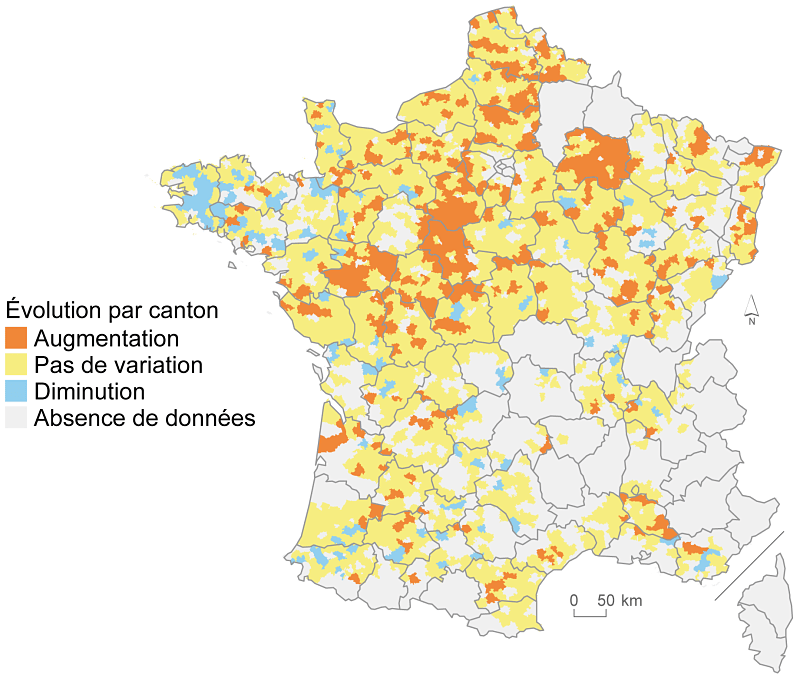
- Changes in organic carbon content in soilsEvolution 1990-2014In metropolitan France, soil organic carbon content tends to increase over the period 1990-2014. The proportion of cantons affected increases from 11% to 16%. It remains nearly stable for more than three-quarters, despite a smaller proportion (55%) between 1995-1999 and 2000-2004. Finally, the proportion of cantons where soil organic carbon content decreases drops by half to reach 6% between 2005-2009 and 2010-2014.Regional disparities 2000-2009Between 2000-2004 and 2005-2009, soil organic carbon content decreases in 4% of cantons in metropolitan France, notably in Lower Normandy, Morbihan, Pays de la Loire and Rhône-Alpes. Conversely, soil organic carbon content increases in 8.5% of cantons.Trends 2000-2014• The previously observed trends are confirmed. Soil organic carbon content decreases in 3.5% of cantons in metropolitan France between 2000-2004 and 2010-2014, essentially in Brittany, while it increases in 10.5% of cantons. The reasons are likely multiple: overall ecosystem evolution, changes in agricultural practices favorable to carbon storage in soils (organic waste inputs from urban areas, simplified cultivation techniques, etc.).Soil's role in carbon cycleIndeed, certain changes in land use or agricultural practices promote carbon storage in soils, such as the conversion of cultivated land to pastures or forests. Conversely, the cultivation of pastures or forests leads to a decrease in carbon stock. Soil acts as a carbon sink or source, mainly in the form of carbon dioxide (CO2). The Kyoto Protocol, which aims to reduce CO2 emissions, includes the possibility of counting carbon stored in soils as a negative emission.
Further reading
- Geosolnotre-environnement.gouv.fr
Geosol est l’outil de visualisation des statistiques issues des données de la BDAT stockées dans le système d’information décisionnel.
- Carte nationale des stocks de carbone des sols intégrée dans la carte mondiale de la FAOnotre-environnement.gouv.fr
La carte de la France métropolitaine (hors Corse) des stocks de carbone dans les sols a été préparée par l’INRA dans le cadre d’un exercice mondial piloté par le Partenariat Mondial sur les Sols hébergé par l’Organisation des Nations-Unies pour l’alimentation et l’agriculture, la FAO.
- Food and Agriculture Organization : Dégradation des solsnotre-environnement.gouv.fr
La dégradation des sols est définie comme un changement dans l'état de santé du sol qui entraîne une diminution de la capacité de l'écosystème à fournir des biens et services pour ses bénéficiaires. Les sols dégradés sont dans un état de santé tel qu'ils ne fournissent pas les biens et services habituels du sol dans son écosystème.
- Fonctions environnementales et GEStion du patrimoine SOL (Gessol)notre-environnement.gouv.fr
En réponse à la pression croissante exercée par l’homme sur les sols, le ministère en charge de l'écologie initie en 1998 le programme de recherche GESSOL "Fonctions environnementales et GEStion du patrimoine SOL"