L’occupation et l’artificialisation des sols en France
Les sols contribuent au maintien de la vie sur Terre. Ils sont essentiels au bon fonctionnement des écosystèmes. Ils offrent un habitat naturel à la faune et à la flore, fournissent des matières premières et des ressources énergétiques, minérales et agricoles indispensables à l’humanité. Ils stockent des quantités importantes de carbone et participent à réguler le climat. Les sols constituent le support principal des infrastructures et des activités humaines : bâtiments, transports. Ainsi, l’artificialisation des sols contribuent à notre confort et à notre qualité de vie, mais dégrade en même temps la biodiversité. Le terme « d’artificialisation » des sols résume la transformation de milieux naturels, ou de terres agricoles et forestières, en terres destinées à l’occupation humaine. Pour répondre aux problèmes causés par l’occupation et l’artificialisation des sols, l’État dispose d’un système d’observation pour mieux connaître l’état et l’usage des sols.
Soils contribute to maintaining life on Earth. They are essential for the proper functioning of ecosystems. They provide natural habitat for fauna and flora, supply raw materials and energy resources, minerals and agricultural resources vital to humanity. They store significant amounts of carbon and help regulate the climate. Soils form the primary basis for human infrastructure and activities: buildings, transport. Thus, soil artificialisation contributes to our comfort and quality of life, but simultaneously degrades biodiversity. The term "artificialisation" of soils summarizes the transformation of natural environments, or agricultural and forest lands, into land destined for human use. To address problems caused by soil use and artificialisation, the State has an observation system to better understand the state and use of soils.
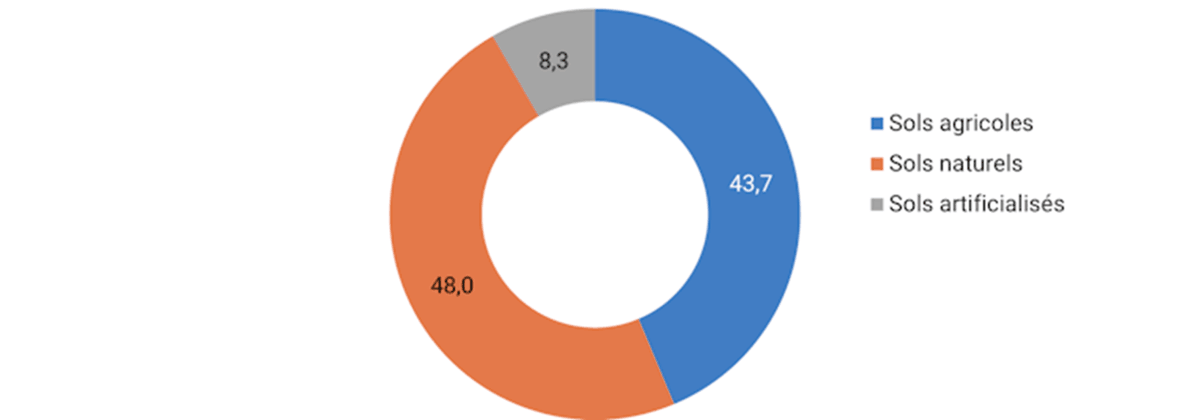
- How are soils used in France?Soil use distributionThe distribution of soil use in 2022 in % shows that natural soils now represent less than half of France's soils, and artificialised soils are approaching 10% of all soils.
- How are soil use and artificialisation evolving in France?Artificialised area change• Since 1992, artificialised land has increased from 6.9% of the country's total area to 8.3% in 2023, representing an average annual consumption of 60,000 additional hectares of artificialised space—equivalent to the Territoire de Belfort department each year. • According to studies conducted on metropolitan territories, between 2019 and 2022, 20,000 to 25,000 hectares were artificialised annually. In comparison, between 1982 and 2010, 53,900 hectares were artificialised per year.Territorial distributionArtificialisation is unevenly distributed across the territory. Metropolises and coastal zones are most affected, while mountainous regions are better preserved. There has been a slowdown in the annual rate of artificialisation compared to 2010, which marked a turning point in this decline.Zero net artificialisation• The zero net artificialisation goal—meaning no overall increase in already artificialised soils in France—was decided by the Climate and Resilience Act adopted by Parliament in 2021. Planning and urban development documents, such as those in town halls, must now include objectives to limit land consumption. • The 2050 goal is not a complete halt to artificialisation of new areas, but rather that any artificialisation must be accompanied by an equal restoration of natural spaces from already artificialised areas.
- Soil artificialisationCauses of artificialisation• Artificialisation is caused by increasing economic activities and population growth. It directly causes the loss of agricultural land or natural habitats for animals. • Between 2009 and 2022, approximately 25,000 hectares—equivalent to the entire Val-de-Marne department—were artificialised on average each year. These agricultural, forest, or natural lands were consumed to create housing or infrastructure.Environmental functions lost• Even if some consumed land has not become impermeable, it can no longer serve its environmental role: • food production; • carbon storage, from meadow soils, natural environments, and forests; • soil water-filtering capacity; • groundwater recharge and natural water storage.Impacts on biodiversityUrban areas and their associated transport infrastructure directly destroy habitats for many animal and plant species. Like garden fences, they also obstruct the free movement of certain animal species, preventing them from breeding and feeding properly. Finally, artificialisation of highly productive and resilient agricultural soils is irreversible.
- Artificialised soils become impermeableRunoff and flooding• Artificialisation reduces or prevents water infiltration and therefore promotes flooding or inundation. • Making soil impermeable increases water runoff along slopes at the expense of infiltration. This also causes soil erosion, mudflows, and increases flooding risk. Concentrated runoff intensifies the transfer of sediments laden with soil contaminants to watercourses (nitrogen or phosphorus fertilizers, hydrocarbons, heavy metals, pesticides).Carbon release and biodiversitySoil artificialisation can also cause rapid and significant carbon release, which contributes to climate change when soil is not quickly covered (vegetation, surfacing). Finally, it creates barriers in natural habitats, ecosystems, and landscapes, affecting biodiversity.
- Soil artificialisation in public opinionConstruction regulation perceptionPublic opinion on combating soil artificialisation through development has been measured, and appears to be an issue that must be considered, even if it means building fewer buildings.
