Fissures et sécheresse : 12 millions de maisons exposées au retrait-gonflement des argiles
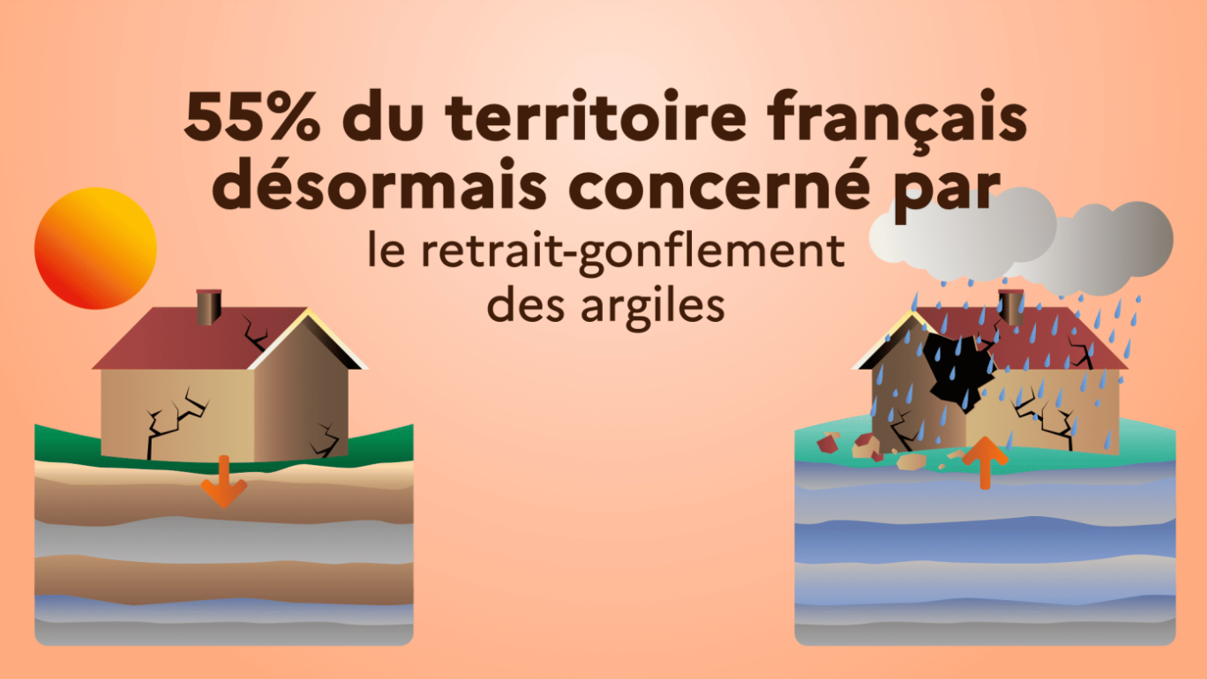
Des maisons fissurées, des bâtiments et des routes endommagés : l’alternance entre la pluie et la sécheresse provoque des mouvements de terrain sur les sols argileux. C’est le retrait-gonflement des argiles, qui se répand en France à cause des évènements climatiques de plus en plus fréquents et intenses. 55 % de la surface de la France métropolitaine y est exposée en 2025. C’est deux fois plus que dans les années 2010. La majorité des dommages concerne les maisons individuelles : 61 % d’entre elles sont aujourd’hui touchées par ce risque (Source : Centre de ressources pour l’adaptation au changement climatique ).
Cracked houses, damaged buildings and roads: the alternation between rain and drought causes ground movements in clayey soils. This is clay shrinkage and swelling, which is spreading across France due to increasingly frequent and intense climate events. 55% of mainland France's surface is exposed to it in 2025. This is twice as much as in the 2010s. Most damage affects individual houses: 61% of them are now affected by this risk (Source: Climate Change Adaptation Resource Center).
- What is clay shrinkage and swelling?Definition and mechanism• Like sponges, clayey soils swell with rain and shrink during dry periods. This is called clay shrinkage and swelling. • These ground movements are slow but cause significant damage to buildings, especially individual houses. Individual houses often have shallow foundations, meaning they are built on a base that does not penetrate very deeply into the ground. Shrinkage and swelling can crack walls, weaken the structure of houses, or warp window and door frames.Affected buildings• 12 million houses are exposed to clay shrinkage and swelling, representing 61% of individual houses. • Apartment buildings are less exposed because they are built on deeper foundations. However, clay shrinkage and swelling can also damage roads, bicycle paths, or underground pipes, for example.Aggravating factorsCertain developments can worsen the damage: for example, trees too close to houses, because their roots dry out the soil even more. Similarly, poor drainage of rainwater or a pipe leak can increase moisture under houses (Source: Géorisques, expert report on clay shrinkage and swelling).Map of clay shrinkage and swelling risk zones in 2026Many regions in mainland France are exposed to clay shrinkage and swelling: much of central France, the Île-de-France, and the Nouvelle-Aquitaine, Occitanie, and Provence-Alpes-Côte d'Azur regions. Some departments in northern and eastern France are also affected, especially since 2016 (Source: SDES, Key figures on natural risks 2023).
- How to prevent damage from clay shrinkage and swelling?Land sale and construction: what does the Elan law say?• To prevent houses from cracking, construction must be adapted to the risk of clay shrinkage and swelling. • To do this, there are solutions called "vertical" which aim to strengthen the structure and foundation of houses. For example: adding micropiles, which are iron stakes that go down to a depth of 10 meters, injecting resin into the ground to solidify it, or stapling cracks to prevent them from widening. Repair work can be very costly. • Solutions called "horizontal" are preventive: they aim to limit movements of clayey soils under houses. For example, moving trees and vegetation away from houses or installing root barriers underground to protect them. It is also possible to waterproof the perimeter of houses to limit swelling of clay due to rain. Similarly, water leaks from pipes or gutters nearby must be avoided (Source: Climate Change Adaptation Resource Center). • > Clay Prevention Fund > Since 2025, the government is testing a clay shrinkage and swelling prevention fund in 11 particularly exposed departments. This is financial and technical assistance for households living in a house exposed to clay shrinkage and swelling, before significant damage appears. The objective: conduct a vulnerability assessment and carry out work if necessary. A simulator allows you to determine if you are eligible for this Clay Prevention Fund. • The Elan law requires a soil study before selling land that can be built on in an area exposed to clay shrinkage and swelling. The person buying the land must know the nature of the soil and associated risks. The Elan law also requires certain construction techniques when land is exposed to clay shrinkage and swelling. Houses built after 2020 are more resistant to these ground movements because they follow these construction techniques. • The map of areas exposed to clay shrinkage and swelling and covered by the Elan law was updated in 2026 (Géorisques - View the interactive map of clay shrinkage and swelling exposure).
- Cracked houses: what compensation is available?Cost of repairsDamage caused by clay shrinkage and swelling can be very costly. On average, work on an individual house costs 16,500 euros, but the price varies greatly depending on the situation (Source: Géorisques, expert report on clay shrinkage and swelling).Natural disaster guarantee conditions• When episodes of heavy rain and drought are particularly intense, the natural disaster guarantee allows for compensation for damage, under certain conditions: • your home must be covered by a home insurance contract; • you must report the damage to your town hall, which must ask the prefect to recognize the state of natural disaster through an order published in the Official Journal. This order is necessary for insurers to apply the natural disaster guarantee; • the damage must be a direct consequence of clay shrinkage and swelling, and must have appeared during the same period as the natural disaster status defined by the order. Insurers ask an expert to verify that the cause of the damage is indeed clay shrinkage and swelling (Learn more about expertise in case of clay shrinkage and swelling, Central Reinsurance Board).Cost to insurersBetween 1982 and 2024, drought is the second most expensive natural risk, after floods. However, as droughts become more frequent and intense, damage from clay shrinkage and swelling is increasing. Over the past ten years, clay shrinkage and swelling has become the most expensive natural risk for insurers: 53% of costs reimbursed by the natural disaster guarantee were due to drought (Source: CCR, Natural disasters in France – Report 1982-2025).
Further reading
- Géorisques - Cherchez votre commune pour savoir si vous êtes exposé au risque de retrait gonflement des argilesgeorisques.gouv.fr
- Les mouvements de terrain en France : types de risques et préventionnotre-environnement.gouv.fr
Il existe plusieurs risques de mouvements de terrain en France : glissement de terrain, effondrement de cavité souterraine, éboulement et retrait gonflement des argiles.
- Géorisques, le portail pour s’informer sur les risques naturels et technologiquesgeorisques.gouv.fr
- Retrait-gonflement des argiles : à quoi s’attendre et comment s’adapter ?adaptation-changement-climatique.gouv.fr
Centre de ressources pour l'adaptation au changement climatique - Ministères transition écologique aménagement du territoire transports ville et logement