Le logement et ses conséquences sur l’environnement
Le logement a des effets sur l’environnement lors de sa construction, pendant son utilisation, et à cause de l’espace qu’il occupe. Il faut des ressources pour construire un logement, de l’énergie pour le faire fonctionner, et il modifie les sols pour longtemps. Les matériaux utilisés, leurs émissions de gaz à effet de serre ou la place que prennent les logements dans les villes et les campagnes, sont des questions de plus en plus importantes alors que le nombre de logements augmente en France.
Housing has environmental effects during its construction, throughout its use, and because of the space it occupies. Resources are needed to build housing, energy to operate it, and it transforms the soil for a long time. The materials used, their greenhouse gas emissions, and the space housing takes up in cities and rural areas are increasingly important questions as the number of homes grows in France.
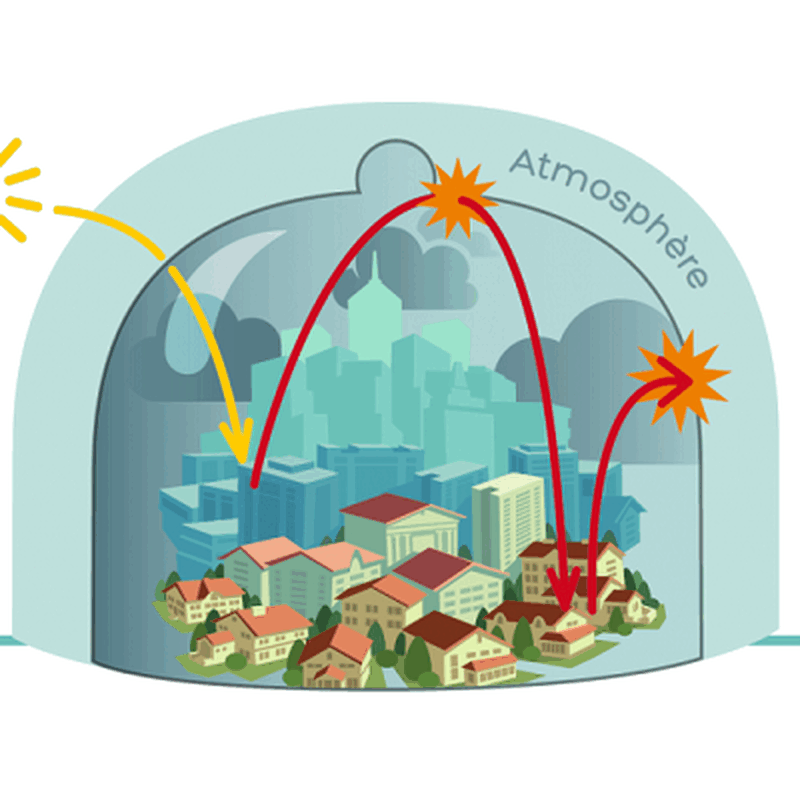
- Why does housing have environmental consequences?Key figuresIn July 2023, France had 38 million housing units, 327,000 more than a year earlier (+ 0.87%). This steady growth is explained by the increase in the number of households and the decline in their average size (source: SDES).Life cycle stagesHousing affects the environment at every stage: from construction to demolition, including occupation and renovation.Land use and resources• Land artificialisation: housing construction contributes to transforming agricultural or natural areas into built zones. • Resource consumption: building housing consumes materials such as sand, gravel, cement, wood, metals, and more. These resources are extracted, transported, and processed, which requires energy and water. Housing fixtures (furniture, appliances, decoration, etc.) also consume materials and create waste.EmissionsGreenhouse gas and pollutant emissions: housing emits greenhouse gases at multiple stages. During construction, materials like concrete are highly emitting. During occupation, heating and equipment use consume energy. Depending on the energy sources used—gas, oil, electricity—more or less greenhouse gas is produced.
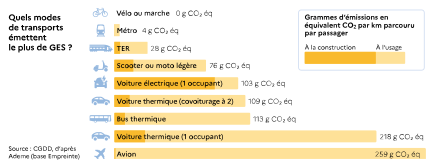
- Housing consumes natural and agricultural landLand consumedApproximately 25,000 hectares of natural, agricultural, or forest surfaces were consumed on average each year between 2009 and 2022. This represents more than 35,000 football fields or two and a half times the area of Paris per year. Of these consumed surfaces, 63% were used for housing (source: INSEE).Rural distribution65.5% of land consumption between 2014 and 2020 occurred in rural municipalities, even though they only welcomed 20.8% of new residents and 28.8% of new households during that period (source: Cerema).Sprawl consequencesIn addition to contributing to land artificialisation, this dispersed habitat increases daily household commutes, which generate atmospheric pollutants and greenhouse gas emissions.
- Resource impacts from housing constructionBuilding materialsBuilding housing requires large quantities of materials. These are mainly non-metallic minerals—resources extracted from the ground such as sand, gravel, stones, or limestone. These materials, also called aggregates, are used to make concrete, mortars, bricks, and tiles.Extraction in FranceIn 2022, France extracted 392 million tonnes of non-metallic minerals, most of which were used in building and public works (source: SDES). This quantity represents nearly 64% of resources extracted from French soil (excluding water). It is the leading category of materials consumed, ahead of biomass (wood, agricultural products) and fossil fuels (coal, oil, gas).Environmental effectsThese materials are mostly sourced from quarries located in France. Their extraction, processing, and transport have significant environmental impacts: landscape changes, destruction of natural habitats, water consumption, greenhouse gas emissions, noise nuisance, and increased road traffic.Limited recyclingAlthough efforts are being made to recycle materials from construction sites, the recycling share remains limited. In 2020, approximately 29.6 million tonnes of aggregates came from recycling, representing about 9.8% of quarry production (source: Union nationale des producteurs de granulats).
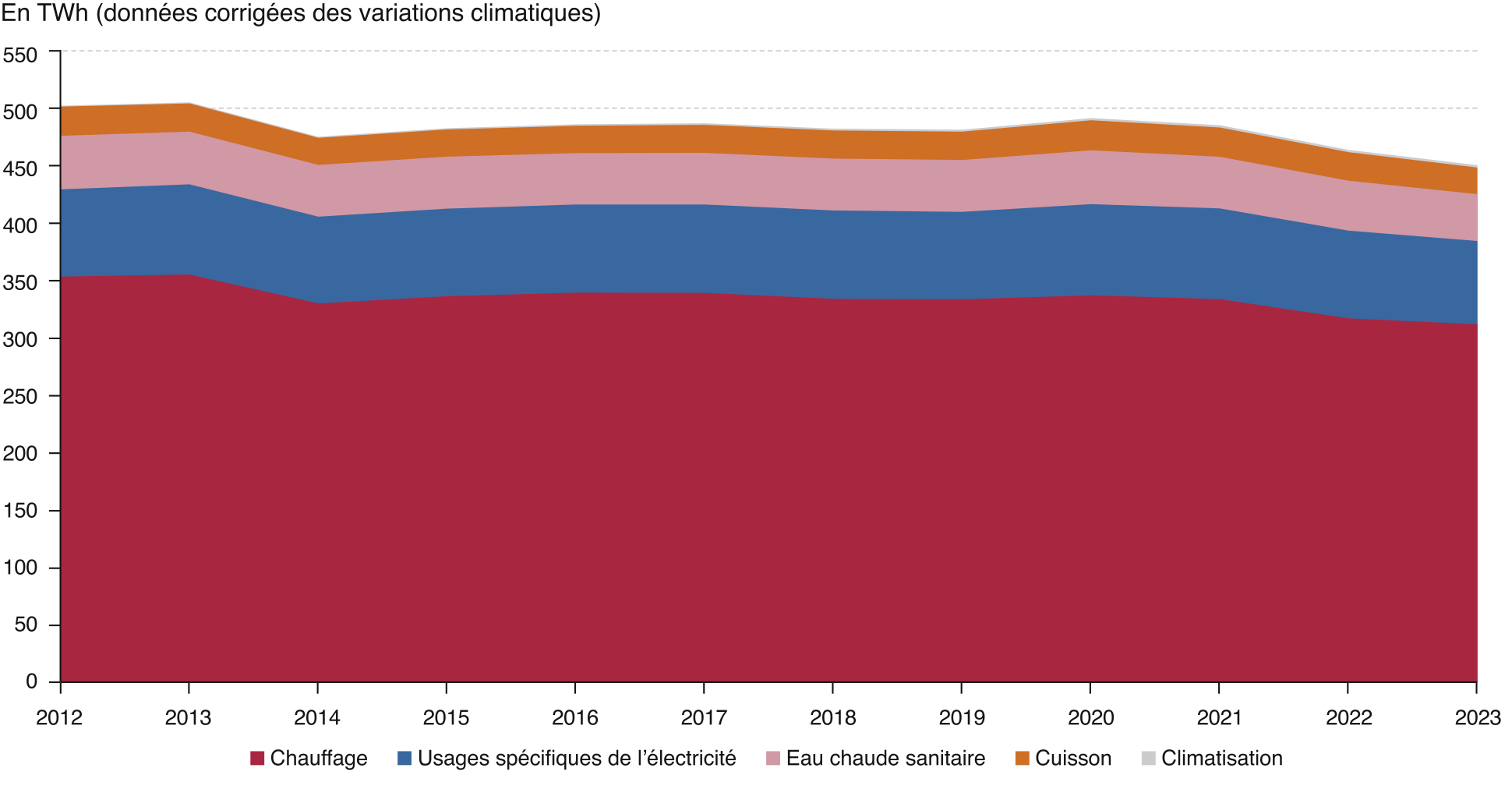
- Housing energy consumptionEnergy usesLiving in a housing unit requires energy consumption, mainly for heating, but also for domestic hot water production, cooking, lighting, and use of electrical appliances. Air conditioning energy consumption is still quite low, at about 1% of total household consumption according to calculation methods used. However, it is increasing due to climate change and the pursuit of summer comfort.National share• Residential housing represents: • approximately 16% of national greenhouse gas emissions (source: SDES / 2023 figures); • and 30% of final energy consumed in France (source: SDES / 2023 figures).Consumption trends• Between 2012 and 2022, average energy consumption per square meter in main residences declined by 1.8% per year, falling from 190 to 161 kilowatt-hours per square meter. This is the lowest level recorded since 1997 (source: SDES). • This trend reflects the improved performance of new housing, the increase in energy renovation projects, as well as reduced heated areas and changes in behavior. • Heating is the leading energy consumption category, representing more than two-thirds of household consumption.How energy is used in French homes (2023)How energy is used in French homes (2023)
- Housing energy renovationRenovation workThis includes building insulation, replacement of heating systems, and installation of more efficient ventilation. These improvements reduce energy consumption, improve home comfort with more stable temperatures and lower humidity, and help control expenses.Low-energy targetFrance has set the goal of achieving a "low-energy" housing stock by 2050. This means that by then, all occupied housing must consume minimal energy for heating and hot water. Buildings classified as "low-energy" must consume no more than 80 kilowatt-hours of primary energy per square meter.Spending and support• To progress toward this goal, renovation work is essential and is increasing: in 2023, spending on housing maintenance and improvements rose 6.6% compared to the previous year (after +12.1% in 2022), with much of the increase driven by prices that remain very dynamic (+5.8%, after +9.8%) (source: SDES). • This growth is supported by several public programs, including: • MaPrimeRénov', which funded over 500,000 renovations in 2023 (source: SDES); • energy efficiency certificates; • Anah assistance for low-income households; • and reduced VAT for certain work.Energy inefficient homes• Despite these efforts, a significant portion of housing remains poorly performing. Most are still in classes D, E, F, or G of the Energy Performance Certificate (EPC). Homes that consume the most energy, called "energy-inefficient" (classes F or G), accounted for 13.9% of main residences, or approximately 4.2 million homes, in 2024. Only 7.2% were rated A or B (source: SDES). • Distribution of homes by energy class
Further reading
- Repenser la construction de logements pour limiter les conséquences sur l’environnementnotre-environnement.gouv.fr
Découvrez comment repenser nos modes d’habitat pour préserver la biodiversité et les solutions qui permettent de concilier besoins en logement et protection de l’environnement.
- Tableau de suivi de la rénovation énergétique dans le secteurstatistiques.developpement-durable.gouv.fr
Article Web, Service des données et études statistiques (SDES).
- Bilan énergétique de la France en 2023statistiques.developpement-durable.gouv.fr
Service des données et études statistiques (SDES) - Janvier 2025.
- Rapport du compte du logement 2023statistiques.developpement-durable.gouv.fr
Service des données et études statistiques (SDES) - Octobre 2024.
- Analyse de la consommation d’espacesartificialisation.developpement-durable.gouv.fr
Cerema (Centre d'études et d'expertise sur les risques, l'environnement, la mobilité et l'aménagement) - Mai 2024.