Les effets de l’alimentation sur l’environnement
De la culture des aliments jusqu’à l’assiette, l’alimentation utilise des ressources, produit des déchets et émet des gaz à effet de serre. Découvrez les principaux chiffres pour comprendre ces conséquences en France et comment les réduire.
From growing food to the plate, food uses resources, produces waste, and emits greenhouse gases. Discover the main figures to understand these consequences in France and how to reduce them.
- What do the French eat?Meat and food consumption• In 2023, each inhabitant consumed an average of 87 kg of meat in "carcass equivalent," meaning the total weight of slaughtered animals, including parts not consumed (source: FranceAgriMer). This consumption is down from a peak of 94 kg observed in the late 1990s. Poultry accounted for 31% of this consumption in 2023. • Dairy products also hold an important place in the diet. Cereals, fruits, and vegetables are among the most consumed foods, but with significant variety depending on seasons, regions, and eating habits. • Habits are changing: consumption of ultra-processed products and quick meals (snacking) is increasing (source: Anses).Eating practices• At the same time, eating practices are changing: • flexitarianism means voluntarily reducing meat consumption without eliminating it entirely; • pescatarianism excludes meat but includes fish and shellfish; • vegetarianism excludes meat and fish; • veganism excludes all animal products, including eggs, dairy, and honey. • In 2020, 24% of French people identified as flexitarians, 1.1% as pescatarians, 0.8% as vegetarians, and 0.3% as vegans (source: FranceAgriMer).Access inequalityAccess to balanced, quality food may depend on income, for example. People with low incomes consume, on average, fewer fruits, vegetables, or fresh products, and more foods high in sugar or fat (source: France Stratégie).
- What is food's share in the French environmental footprint?Food's carbon footprint shareIn 2018, food accounted for 22% of the French carbon footprint, or 2.1 tonnes of CO2 equivalent per person per year (source: Insee).Production versus transport• The largest share of this footprint (61%) comes from food production, particularly animal products. Beef or lamb are among the most greenhouse gas-intensive foods. • Contrary to popular belief, transporting food accounts for only a small part of this footprint: between 6% and 14% depending on the product, versus more than half for agricultural production itself. This means eating locally helps reduce your footprint somewhat, but the type of food consumed (for example, meat versus vegetables) has a much greater impact on climate.Imported productsWe also observe that 46% of emissions related to our food come from imported products. This particularly concerns raw materials like soy, used to feed livestock, or products like palm oil and certain exotic fruits. These products can have a significant environmental impact due to deforestation associated with their cultivation in producing countries, or because they must travel long distances before being consumed in France (source: High Council for Climate).
- From production to consumption: where are the environmental consequences?Food journey stages• Each stage of food's journey, from production to consumption, has environmental consequences: • agricultural production: most greenhouse gases from a food item are emitted during production. This includes crops, fertilizer and farm machinery use, and livestock, which accounts for more than half of agricultural emissions; • processing: requires energy to operate machines, heat, cool, or preserve food, and produces waste such as food waste or packaging; • distribution: transporting food, sometimes over long distances, and refrigeration needs increase greenhouse gas emissions; • consumption: cooking food and storing it in refrigerators or freezers consume energy and contribute to the environmental footprint of food; • waste: some still-edible food is discarded. This can happen at different stages: during production, at sale, in restaurants, or at home. Often, this waste could have been avoided.
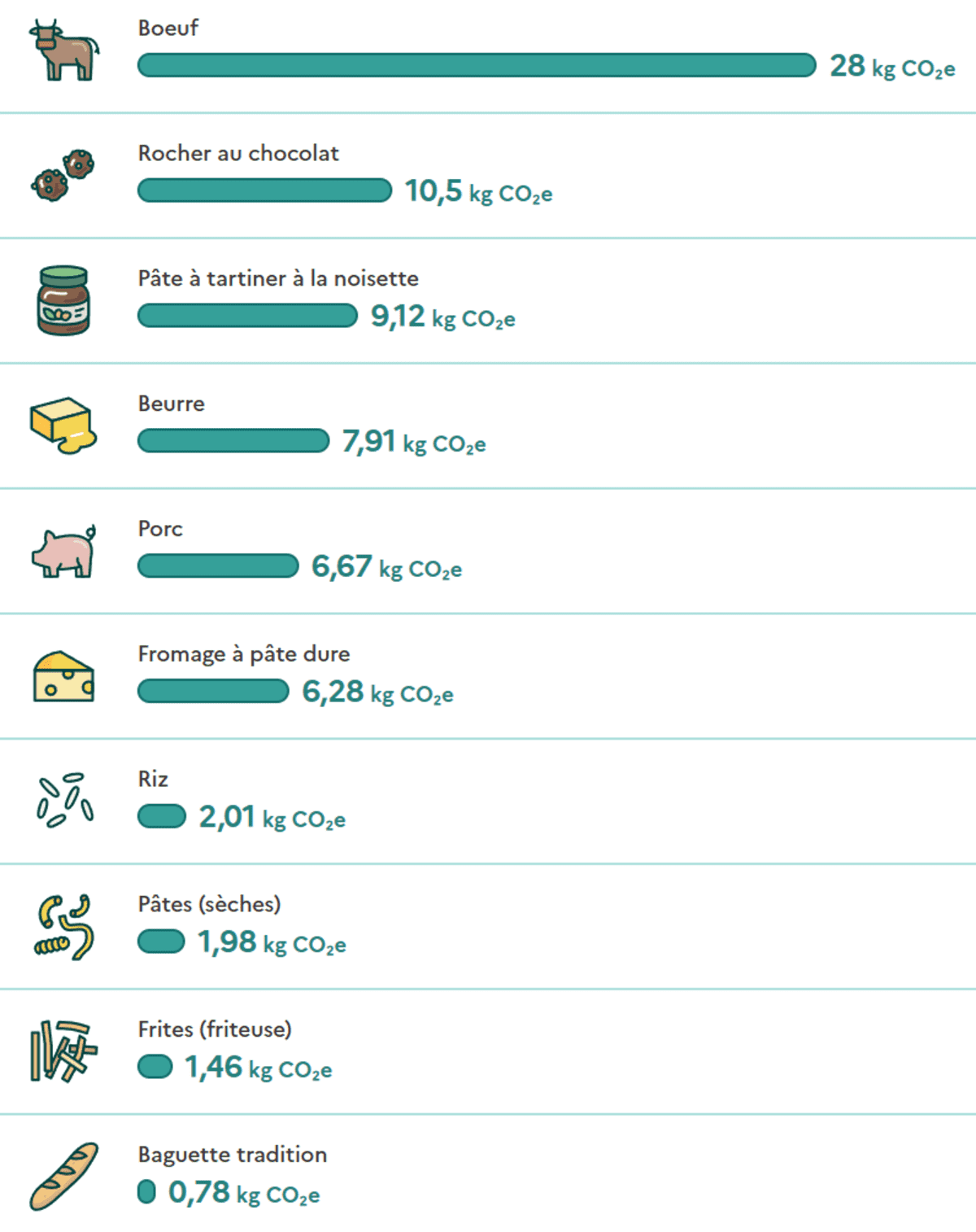
- What are the environmental consequences of different food types?Emissions by food type• The environmental impact of foods varies greatly depending on their origin and production method. According to ADEME, greenhouse gas emissions from producing one kilogram of food range: • from 0.5 to 2 kg CO2 equivalent for cereals, legumes, fruits, and vegetables; • between 4 and 7 kg for dairy products, eggs, or poultry; • up to 28 kg for beef. • Processed and packaged products often have a high indirect impact because of energy consumption, transport, and packaging.Top ten foods emissionsGreenhouse gas emissions from the ten most consumed foods per kilogram of food
- More environmentally friendly diets: what are the gains?Reduce red meatDecreasing red meat consumption is one of the most effective ways to lighten the climate impact of food. Even without completely changing your diet, eating meat less often already reduces greenhouse gas emissions.Meal comparisonGreenhouse gas emissions from different meal types
- Fertilizer, pesticides, deforestation: what effects on nature?Water pollutionThe use of fertilizers and pesticides can lead to pollution of rivers, lakes, and groundwater. For example, between 2000 and 2020, the average concentration of nitrates in waterways in mainland France increased by 6% (source: Insee). These substances, in excess, can disrupt aquatic ecosystems.Air pollution from livestockLivestock also contributes to air pollution. It generates ammonia emissions from animal waste and fine particles. These pollutants can have effects on human health and the environment.Soil artificialisationFurthermore, certain agricultural structures such as buildings, greenhouses, and access roads make soils artificial. When foods travel long distances before reaching consumers, more transport and storage are needed. This can lead to the loss of natural spaces available for wildlife, flora, or agricultural soils, and harms biodiversity.Imported deforestationFinally, some imported foods like soy or palm oil may be linked to deforestation in producing countries. This deforestation causes the loss of biodiverse natural habitats.
- What are the consequences of food waste on the environment?Food waste volumeIn France, 8.8 million tonnes of food waste were produced in 2021, or 129 kilos per person (source: SDES).Edible wastePart of this waste is still-edible food. This edible waste is estimated at approximately 3% (source: ADEME) of the annual carbon footprint of the French, or 16 million tonnes CO2 equivalent.Losses at consumptionMore than half of these edible losses occur at consumption: 39% at home and 13% in restaurants or cafeterias. They are often due to buying more than needed, poor storage, or oversized portions.
Further reading
- Les émissions de gaz à effet de serre et l’empreinte carbone de la Francenotre-environnement.gouv.fr
Les activités humaines émettent des gaz à effet de serre, responsables de l’accélération du réchauffement climatique. L’empreinte carbone permet de calculer leur impact sur le climat.
- Moins de protéines animales pour réduire les conséquences de l’alimentation sur le climatnotre-environnement.gouv.fr
Produire et consommer des aliments d’origine animale conduit à d’importantes émissions de gaz à effet de serre. Découvrez l’impact de la viande sur l’environnement et les solutions pour agir au quotidien.
- Tout comprendre : une alimentation plus durablelibrairie.ademe.fr
ADEME (Agence de la transition écologique) - 2024.
- Les déchets alimentaires en France et dans l’Union européenne en 2021statistiques.developpement-durable.gouv.fr
Datalab essentiel - Service des données et études statistiques - Avril 2024.
- Empreinte carbone de l’alimentationinsee.fr
Insee Références (Institut national de la statistique et des études économiques) - Édition 2024.
- L’agriculture face aux enjeux environnementauxinsee.fr
Insee Références (Institut national de la statistique et des études économiques) - Édition 2024.
- Accélérer la transition climatique avec un système alimentaire bas carbone, résilient et justehautconseilclimat.fr
Haut Conseil pour le climat - Janvier 2024.