Limites planétaires
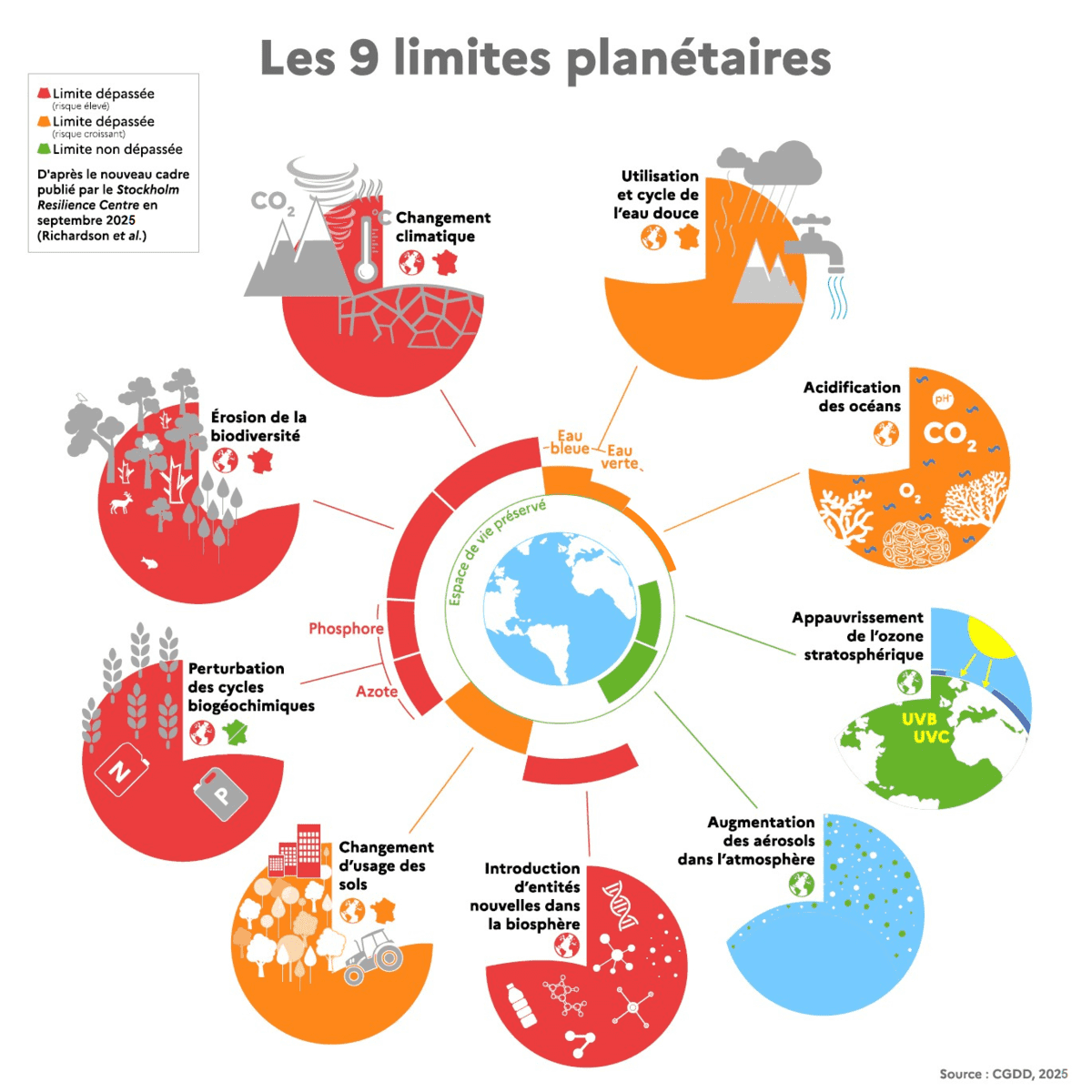
Comment évaluer l’impact des activités humaines sur la planète ? Jusqu’à quel point la nature peut-elle supporter les pollutions ? Pour répondre à ces questions, une équipe internationale de chercheurs a défini le concept des neuf limites planétaires. Ils ont identifié les seuils à ne pas dépasser pour préserver l’équilibre de la nature et maintenir des conditions de vie sur Terre favorables. En septembre 2025, les chercheurs tirent la sonnette d’alarme : sept des neuf limites planétaires ont été dépassées.
How can we measure the impact of human activities on the planet? To what extent can nature withstand pollution? To answer these questions, an international team of researchers defined the concept of nine planetary boundaries. They identified the thresholds that must not be exceeded to preserve the balance of nature and maintain favorable living conditions on Earth. In September 2025, researchers are sounding the alarm: seven of the nine planetary boundaries have been crossed.
- Planetary boundaries: where do we stand?Planetary boundaries concept• Life on Earth depends on nine biological, physical and chemical processes, identified by the international team of researchers at the Stockholm Resilience Centre (SRC). These researchers established the thresholds that must not be exceeded for each of these processes, lest they trigger abrupt and irreversible changes to the balance of nature. Their work is the subject of ongoing research and has been revised several times since its first publication on planetary boundaries in 2009. • When a planetary boundary is crossed, we enter an "orange" zone of increasing risks. A second threshold marks the transition into a "red" zone of high risk. The further we move away from the preserved living space (in green), the greater the risk. • Since 2024, the Planetary Boundaries Science Lab publishes an annual report on the state of the environment. In 2025, this report notes that a seventh planetary boundary has been crossed: ocean acidification.Nine planetary boundaries• climate change; • biodiversity loss; • massive fertilizer use (nitrogen and phosphorus); • land use change (deforestation); • freshwater cycle; • release of new substances into nature; • ocean acidification; • ozone layer depletion; • increase in atmospheric particles. • As of September 2025, only the last two boundaries have not been crossed. • With seven boundaries crossed out of nine, the planet is now well beyond the safe operating space for humanity.
- Planetary boundaries linked togetherClimate-ocean interdependenceThe nine planetary boundaries are linked to each other and depend on one another. For example, ocean acidification is linked to climate change: the more carbon dioxide (CO2) in the atmosphere, the more oceans absorb. This excess CO2 that dissolves in the oceans acidifies them.Biodiversity and land useFurthermore, biodiversity loss depends on land use change. When intensive agriculture or concrete areas replace natural habitats, such as forests or grasslands, many species lose their habitat. Another example: disruption of the freshwater cycle also contributes to biodiversity loss in lakes and rivers.Systems approachAll these connections between Earth system mechanisms must be taken into account to find effective solutions. The nine boundaries cannot be treated as separate problems: action must account for all planetary boundaries together. This is called a systems approach.
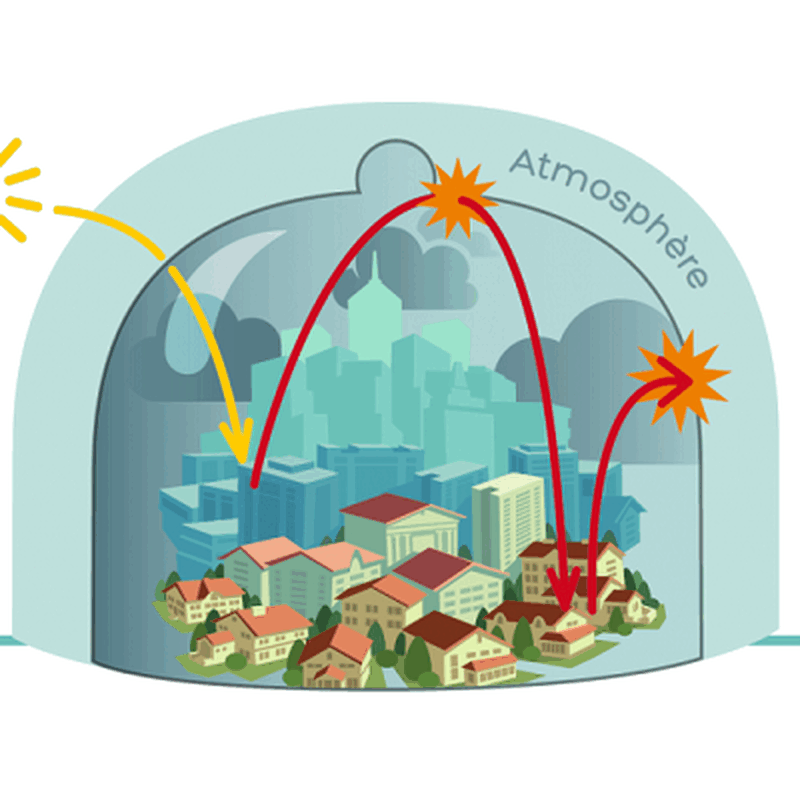
- An overview of planetary boundariesClimate change• Since the Industrial Revolution, human activities have released a significant amount of greenhouse gases into the atmosphere. This has caused climate change that manifests in various ways: rising temperatures, sea level rise, glacier melting, natural disasters, etc. • The concentration of CO2 in the atmosphere is one of the parameters used to measure climate change. The boundary has been crossed. In 1850, atmospheric CO2 concentration was 280 parts per million (ppm). It is 426 ppm in 2025. • Another parameter for measuring climate change is radiative forcing. This measures the difference between the amount of energy entering the atmosphere (through solar rays) and the amount of energy leaving toward space. A radiative forcing above zero means the planet is warming because heat is trapped in the atmosphere due to the greenhouse effect.Biodiversity loss: the disappearance of animal and plant species• To assess biodiversity status, we can measure how many species out of a million have disappeared in a year. The boundary is set at 10 extinctions per year per million species. Yet each year, between 100 and 1,000 species per million disappear worldwide. • In mainland France, the index of species extinction risk is increasing faster (+ 99% between 2000 and 2022) than at the European scale (+ 67%) or globally (+ 36%). • The Intergovernmental Science-Policy Platform on Biodiversity and Ecosystem Services (IPBES) has identified five main causes of biodiversity loss: • change in land use, such as deforestation, which reduces natural habitats; • direct exploitation of species, such as overfishing or hunting; • climate change that alters species' living conditions; some cannot adapt to rising temperatures; • pollution of water, air and soil that modify or destroy natural habitats; • invasive alien species: species that disrupt natural habitats because they are introduced by humans, intentionally or accidentally.Disruption of nitrogen and phosphorus cycles: massive fertilizer pollution• Nitrogen and phosphorus are elements essential for plant growth. They are used massively as fertilizers and end up in wastewater, polluting aquatic environments and disrupting ecosystems. This pollution is notably responsible for the proliferation of algal blooms, sometimes toxic. They monopolize oxygen and light, preventing other species from surviving: this is eutrophication. • While the amount of nitrogen released by human activities should be below 62 million tonnes per year (Mt/year) globally, it reached 190 Mt/year in 2023. Phosphorus use on agricultural land also exceeds the boundary: 17.5 Mt/year is released instead of 6.2 Mt/year.Land use change: deforestation• Land use change is assessed by comparing the area of forests today versus before 1700. For the planet to function properly, 75% of historical forests must be preserved. Today, only 60% of forests from before 1700 still exist as forests. The boundary has been crossed, and global deforestation is approaching the "red" high-risk zone. • Between 2000 and 2018, the main causes of global deforestation are the expansion of crops (50%) and pasture expansion (38%). 6% of deforestation is due to urbanization, according to the United Nations Food and Agriculture Organization. • In France, forest area is increasing: it grew from 16.2 million hectares (Mha) in 2010 to 17 Mha in 2020. However, France imports a significant quantity of agricultural raw materials. It thus indirectly uses land located in other regions of the world, contributing to land use change abroad.Freshwater cycle• The natural water cycle is how water circulates on Earth. Water from oceans, lakes and rivers evaporates thanks to the sun's heat. Plants also transpire tiny droplets that evaporate into the air. All these droplets rise into the atmosphere to form clouds, and when they become too heavy they fall as rain, snow or hail. Some of the water that falls on Earth seeps into the soil and feeds underground aquifers. The rest flows across the surface in rivers and streams for example. • Disruptions to the freshwater cycle are linked to climate change, particularly rising temperatures and disrupted rainfall patterns. They are also caused by human activities. For example: water withdrawal for agriculture, industry and households, or the creation of infrastructure such as dams. These human activities destabilize the natural water cycle. • Scientists assess two indicators. "Blue" water, meaning water in rivers, lakes and underground aquifers, and "green" water: the amount of water absorbed by soil and vegetation. The use of blue water and the degradation of green water exceed the planetary boundary. • In September 2023, over 15% of soils on the planet were in water deficit, meaning the amount of water evaporating from soils exceeds the amount entering the ground. The boundary is 11% of soils in water deficit.Release of new substances into nature• This planetary boundary concerns all chemical or biological substances released into nature that threaten human, animal and ecosystem health. For example: plastics, medications, pesticides, genetically modified organisms (GMOs), or endocrine disruptors (chemical substances that disrupt hormonal functioning). • This boundary is measured by the percentage of products released into the environment without appropriate safety testing. It is widely exceeded. Today, 350,000 chemical products are put on the global market: 50 times more than in 1950.Ocean acidification• The boundary on ocean acidification was crossed in 2025, according to the Planetary Boundaries Science Lab report. • Like forests, oceans are carbon sinks: they absorb 25% of the carbon dioxide (CO2) present in the atmosphere, helping to limit the increase in the greenhouse effect. • CO2 is absorbed by the ocean in two ways. It naturally dissolves in surface water and is then carried by currents to the depths. Carbon is also absorbed by phytoplankton, microscopic algae that photosynthesize: they capture CO2 and transform it into organic matter and dioxygen (O2) using sunlight. When these phytoplankton die, they sink to the ocean floor where carbon is stored for tens of thousands of years. • But when carbon dissolves in water, oceans become more acidic. This acidification affects several marine species (including phytoplankton) that can no longer build their calcium carbonate skeletons or shells. This acidification is problematic for two reasons: there are fewer phytoplankton to absorb CO2, which worsens climate change, and it weakens marine species. • Indeed, because plankton cannot build their calcium carbonate skeletons, they are smaller and fewer in number. Yet these microscopic organisms are at the base of the food chain and feed many marine species. Another example: corals struggle to develop in acidic oceans. Yet they are an essential ecosystem on which many fish, algae and crustaceans depend. They also help protect coastlines from storms. • The indicator used to assess ocean acidity is the measurement of the aragonite level (a calcium carbonate produced by marine organisms to build their shells or calcium skeletons) in surface waters.Ozone layer depletion• Ozone is a gas found in one of the upper layers of the atmosphere: the stratosphere. This ozone layer plays the essential role of shielding against the sun's ultraviolet rays, which are dangerous for human health and the environment. • Certain gases, such as chlorofluorocarbons (CFCs), destroy the ozone layer. CFCs were used notably for air conditioners and refrigerators. But in 1987, many countries adopted the Montreal Protocol to gradually stop using these substances. This international agreement was effective: the ozone layer in the stratosphere has recovered. • In France, CFCs were gradually replaced by other gases: hydrofluorocarbons (HFCs). They have no negative impact on ozone, but they are potent greenhouse gases.Pollution: increased atmospheric aerosol presence• Aerosols are solid or liquid particles suspended in the air. While some of these particles originate naturally, a growing share comes from human activities. Aerosols affect climate either by reflecting solar radiation (causing cooling) or by absorbing it (warming the atmosphere). This planetary boundary has not been exceeded. • Fine particles in the air nonetheless pose a danger to human health: in 2019, the World Health Organization (WHO) estimates that 4.2 million people died prematurely due to outdoor air pollution.Planetary boundaries at local scale• The planetary boundaries framework is primarily global. However, it can be applied at the national or even local scale. The Greater Lyon metropolitan area in 2019 and the Hauts-de-France region in 2021 undertook this exercise. • In October 2023, in its publication 'France facing the nine planetary boundaries,' the Commissariat général au développement durable (CGDD) proposes two examples of local application. One example concerns agri-food products from a large retail company, the other addresses the territory of the South-Loire territorial coherence scheme (SCoT). This approach helps better understand how to apply planetary boundaries at the local scale.
Further reading
- Comprendre le changement climatiquenotre-environnement.gouv.fr
En raison des gaz à effet de serre émis par les activités humaines, le climat sur Terre se réchauffe rapidement avec de nombreux impacts déjà observables.
- La connaissance de la biodiversiténotre-environnement.gouv.fr
La connaissance de la biodiversité repose sur l’évaluation de l’état de conservation des habitats naturels et sur le suivi des espèces sauvages.
- Les menaces sur la biodiversiténotre-environnement.gouv.fr
Canicules et vagues de froid : l’influence des températures extrêmes sur la santé et les mesures prises en France pour s’adapter.
- Les cycles biologiques des engrais azotés et phosphorésnotre-environnement.gouv.fr
L’azote et le phosphore existent sous différentes formes grâce à des processus de transformations cycliques entre les grands réservoirs que sont le sol, l’eau et l’air.
- Le cadre réglementaire concernant l’azote et le phosphorenotre-environnement.gouv.fr
L’azote et le phosphore sont deux éléments nutritifs indispensables au développement des cultures. Ce sont uniquement les excès d’apports qui peuvent nuire à l’environnement.
- Changement d’utilisation des solsnotre-environnement.gouv.fr
Les changements d’utilisation des sols à l’échelle planétaire sont principalement dus à l’intensification et à l’extension de surfaces agricoles qui conduisent au déboisement de vastes surfaces forestières.
- Pourquoi la ressource en eau renouvelable a-t-elle diminué depuis 1990 ?notre-environnement.gouv.fr
Essentielle aux écosystèmes, à l’homme et à ses activités, la ressource en eau renouvelable diminue. Quelles en sont les raisons selon les territoires et les saisons ?
- L’eau sous tension, surtout l’éténotre-environnement.gouv.fr
En France, chaque année la ressource en eau peut devenir problématique, principalement durant l’été. La sécheresse de 2022 a d’ailleurs été exceptionnelle.
- Les produits chimiquesnotre-environnement.gouv.fr
Quels sont les grands types de pollution en France ? Air, eau, sols, bruit, substances chimiques. Tour d’horizon des principales sources de pollution et de leur surveillance.
- Acidification des océansnotre-environnement.gouv.fr
L’acidification des océans constitue un défi majeur, à la fois pour la biodiversité marine et pour la capacité des océans à continuer de fonctionner comme puits de carbone.
- Protection des espaces naturels terrestres et marins : où en est la France ?notre-environnement.gouv.fr
La mise en place de dispositifs de protection des espaces naturels constitue une réponse à l’érosion de la biodiversité. Où en est la France dans ce domaine en 2021 ?
- Appauvrissement de l’ozone stratosphériquenotre-environnement.gouv.fr
L’ozone stratosphérique désigne la couche de l’atmosphère comprise entre 20 et 50 km d’altitude.
- La pollution de l’air extérieurnotre-environnement.gouv.fr
Les polluants de l’air ont des effets sur la santé, l’environnement et l’économie. Les pouvoirs publics et la société doivent répondre à cet enjeu en réduisant les émissions de ces polluants.
- La France face aux neuf limites planétairesstatistiques.developpement-durable.gouv.fr
- Les limites planétaires sur le site du Stockholm resilience centre (en anglais)stockholmresilience.org
- La France face aux neuf limites planétairesstatistiques.developpement-durable.gouv.fr
Théma - Commissariat général au développement durable-Service des données et études statistiques - Septembre 2023
- Le nouveau rapport sur l’état de l’environnement en Francenotre-environnement.gouv.fr
Dans quel état est l'environnement en France ? Partager une information fiable et transparente est nécessaire pour réussir la transition écologique. Le Rapport sur l'état de l'environnement (REE), publié tous les 4 ans, est la publication officielle de référence pour connaître l’état de notre environnement et mieux comprendre les enjeux.
- Quelle participation du Sud Loire à l’atteinte des limites planétaires ?epures.com
Epures, 2021