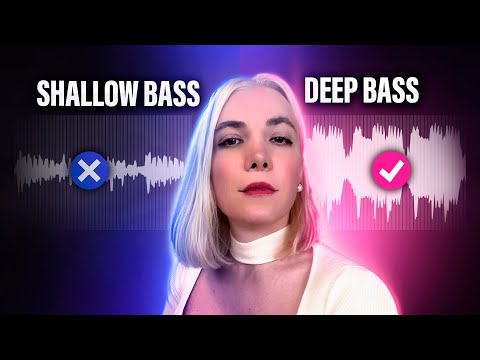
What Makes a Deep Bass?
5 capitulos
- Understanding Frequency Response and the Sweet SpotFundamental ConceptThe human hearing range extends from 20 Hz to 20 kHz, but the 20-30 Hz range is a transition area where almost half the population cannot hear and most speakers cannot generate these frequencies.Ideal Frequency Range• Optimal bass range: 30 to 60 Hz • Sweet spot for deeper bass: 35 to 55 Hz • These frequencies correspond to notes between D and APractical ApplicationStaying within the sweet spot of 35-55 Hz makes tracks and bass feel deeper, though this doesn't mean always using these notes exclusively.Testing the RangeTesting from E0 (20 Hz) to E1 (40 Hz) produces frequencies too low to hear, while moving up to E2 (80 Hz) loses the deep feeling and starts sounding aggressive.
- Duration and Envelope: Sustain for DepthWhy Sustain MattersDeep sounds from nature are sustained and lengthy. Short, picky sounds feel aggressive and in-your-face rather than deep, which is why duration is critical for perceived depth.Control Methods• Sustain control: Keep the synthesizer playing sound as long as the note is held • Decay control: Increase decay time to create sustained sounds rather than short notesPractical DemonstrationShortening a base note transforms it from sounding fine to aggressive, while maintaining length preserves the deep character.Key TakeawayBefore experimenting with other parameters, carefully control the sustain of your notes to maintain depth.
- Timbre and Filtering: Creating Perceived DepthFiltering PrincipleThe brain associates deep sounds with filtered sounds. Underground sounds are naturally filtered by earth, resulting in very low-pass filtered characteristics that can be emulated with a filter.Waveform Selection• Sine waves contain both even and odd harmonics, sounding softer and deeper • Square waves contain only odd harmonics, feeling less deep • Triangle waves produce similar results to sine wavesSound Design TechniquesYou can scarify or modulate your sine wave to create a signature deep bass sound with more character than a pure waveform.Effect of FilteringApplying a low-pass filter to an unfiltered base dramatically increases perceived depth while maintaining character in the sweet frequency zone.
- Spatial Effects: Reverb and Delay for AmbianceReverb Application• Underground sounds are naturally diffused with reverberation and delay • Use reverb plugins like Riv Pro to create deep ambiance • Adjust decay time to sustain the deep characterEQ and CompressionUse EQ to cut the super deep bass part and super high frequencies for easier control. Apply side-chain compression to maintain groove without cluttering the mix.Delay Techniques• Long echo sounds make bass feel deeper but can clutter melodies • Shorter delays are preferable when playing melodic notes • Use ping-pong delay to open up spaceSubtle IntegrationThe magic is in making effects subtle so listeners perceive depth without immediately noticing the reverb or delay is present.
- Synthesis Techniques and Final PrinciplesUniversal PrinciplesThe four core principles of deep bass work regardless of whether you have a reese bass or a sustained long bass sound.Core Principles Summary• Frequency selection: Stay in the 35-55 Hz sweet spot • Duration and sustain: Keep sounds long and sustained • Filtering: Apply low-pass filtering for natural deep character • Spatial effects: Use reverb and delay subtly for ambianceExperimentationThere are multiple techniques available for creating signature deep bass sounds, allowing for personal creativity while maintaining fundamental principles.Next StepsFor learning more about making professional bass sounds, explore additional video resources on the channel.